Intro source: Wikipedia (EN)
Author
Johannes Vermeer
Movement / period
Northern Baroque
Medium
oil on canvas
Location
Mauritshuis, The Hague
Infrared reflectography in 1994 revealed that Vermeer originally painted eyelashes on the girl, then wiped them out entirely, which is why she looks so unnervingly direct.
Highlights
Facts & legends
- The painting sold at a 1881 estate auction in The Hague for just two guilders and thirty cents — roughly the price of a loaf of bread — because it was so dirty nobody could make out what it depicted.
- Infrared reflectography in 1994 revealed that Vermeer originally painted eyelashes on the girl, then wiped them out entirely, which is why she looks so unnervingly direct.
- Nobody knows who she is: Vermeer's eldest daughter Maria has been a popular theory since 1999, but it remains pure speculation — not a single 17th-century document names the sitter.
- The pearl itself has baffled scientists for decades: its shape and reflections are inconsistent with any real pearl, leading many researchers to conclude Vermeer painted a glass or tin drop earring instead.
- The painting has been loaned out for a 2014 restoration tour where conservators discovered the featureless black background was originally a dark green curtain — the pigments simply degraded beyond recognition over 350 years.
- Tracy Chevalier's 1999 novel turned the anonymous girl into a global obsession, and the 2003 film adaptation with Scarlett Johansson caused visitor numbers at the Mauritshuis to spike by nearly 20 percent the following year.
More details A nameless tronie on a 44.5 by 39 cm canvas that became the face of Dutch painting.
What you see
Forty-four centimetres and nothing to spare
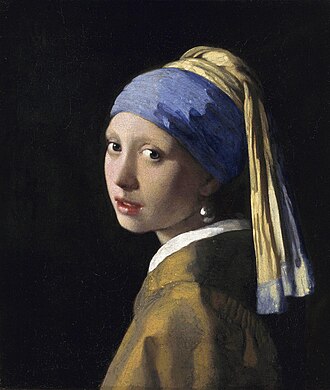
The canvas is 44.5 by 39 centimetres, not much bigger than a sheet of A3. There is no room, no window, no table of pewter and bread of the kind Vermeer painted elsewhere: just a head and shoulders lifted out of the dark. The body turns away from us, the face turns back. It is the posture of someone answering a voice behind them. The lips are parted, with a wet catchlight built from two tiny pinkish dots, one laid over the other. The eyebrows are painted so faintly that you have to look for them, which is part of why the face reads as unfinished and alive at once.
The turban is two fabrics. Ultramarine blue across the crown, and a lemon-yellow tail that drops behind the left shoulder and pulls the eye downward. The jacket is dense ochre; the white collar is loaded on thickly, the one place where paint stands up off the canvas. The pearl is two touches of the brush: a soft grey reflection of the collar underneath, a hard white spark at the upper left. No hook, barely an earlobe, so the thing simply hangs in the air. Close up it is smears of paint. From two metres away it has weight.
The background reads as black, though it is warm and uneven, and in the top left corner a pale monogram, IVMeer, sits almost invisibly against it. Nothing else is given. No book, no letter, no glass, no ring — nothing to tell us the year, the household or the rank of the person looking back.
How it was made
No commission, no contract, one ruinously expensive blue
Not a line of paperwork survives about this painting: no contract, no receipt, no mention in a letter. The date of about 1665 rests on style alone, on the way Vermeer was handling cloth and dissolving edges by the middle of that decade. The sitter's name was never written down either. Candidates have been floated — the painter's eldest daughter Maria; Magdalena, daughter of his Delft patron Pieter Claesz van Ruijven — and every one of them remains a guess. About the painter himself we know only a little more: thirty-seven accepted works, eleven surviving children, mounting debts, and a widow declared bankrupt two years after his death in 1675.
The support is fine linen, roughly fifteen threads per centimetre each way, lined onto a second canvas at some later date, over a ground of chalk and lead white. The face was worked wet into wet and smoothed until no single stroke can be isolated; the clothing went down fast. The blue turban is natural ultramarine, ground from lapis lazuli shipped out of Afghanistan and worth more than its weight in gold. The reds involve cochineal carried across the Atlantic from the Americas; the background used indigo and weld. Even the whites are two different lead whites, chosen to keep the transitions across skin soft.
In 1994 Jørgen Wadum cleaned the picture and Nicola Costaras retouched it, in a glass-walled studio that visitors could watch from above. Then, between 26 February and 12 March 2018, a team led by conservator Abbie Vandivere put the painting through scanning X-ray fluorescence, imaging spectroscopy and microscopy without taking a single new paint sample. The findings were published in 2020. She does have eyelashes: fine brown hairs around both eyes. And the black void behind her was once a green curtain, its folds still legible at the upper right. The translucent glaze of indigo and weld broke down over three centuries, and the space simply closed up.
Where it comes from
Tronies, turbans and the Delft Thunderclap
The Dutch had a word for this kind of picture: tronie, a study of a head rather than the portrait of a particular person. Rembrandt and his circle turned them out by the dozen, and buyers read them as demonstrations of craft — a striking type, an odd costume, a difficult light. In Delft the specialist before Vermeer was Carel Fabritius, a Rembrandt pupil killed on 12 October 1654 when the city's gunpowder store went up and destroyed a large part of town. The turban tells us nothing about where the girl came from; exotic headgear was studio property, fashionable among Dutch painters long before 1665.
Vermeer's own beginnings were nothing like this. His earliest canvases are large narrative pieces: Christ in the House of Martha and Mary, about a metre and a half tall, Diana and her Companions, The Procuress of 1656. The format then shrank to a single room with a window, and by the mid-1660s to one head against darkness. It is not a retreat from storytelling but storytelling squeezed down to the instant.
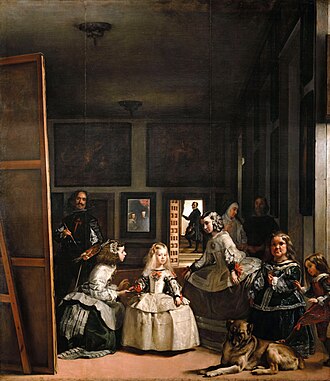
Across Europe those decades were spent catching movement in the middle rather than at the end. In Rome, Bernini cut the Ecstasy of Saint Teresa, the whole group balanced on the second between the angel's gesture and the nun's collapse. In Madrid in 1656 Velázquez painted Las Meninas and sent his figures' gazes out past the frame until the viewer stands inside the scene. Vermeer needed a dark ground and the turn of a neck. No architecture, no retinue, no clouds.
What happened next
Two guilders and thirty cents
In 1696 an Amsterdam sale dispersed a collection holding twenty-one Vermeers, three of them catalogued as tronies; ours may well have been among them. After that the trail goes cold for the better part of two centuries. The painting resurfaces in 1881 at the Venduhuis der Notarissen on the Nobelstraat in The Hague, grimy and attributed to nobody. Victor de Stuers, the civil servant who spent his career keeping old Dutch pictures inside the country, recognised what it was. He and his neighbour, the retired officer and collector Arnoldus Andries des Tombe, agreed not to bid each other up. Des Tombe took it for two guilders plus thirty cents in fees.
Des Tombe died childless in 1902, and in 1903 the painting entered the Mauritshuis under his bequest, where it carries inventory number 670. Under German occupation the museum's collection went underground: first into shelter, then into a vault cut into the limestone galleries of the Sint-Pietersberg near Maastricht, some thirty-five metres down. It came home after the liberation, in the spring of 1945.
While the Mauritshuis was being rebuilt, between 2012 and 2014 the painting travelled: Tokyo and Kobe, the de Young in San Francisco, the High Museum in Atlanta, the Frick in New York. Around 2.2 million people saw it and the fees paid for the building work. The museum then promised to keep her at home, and broke that promise exactly once, for the Rijksmuseum's Vermeer retrospective of 10 February to 4 June 2023, which gathered twenty-eight of the thirty-seven paintings; she was back in The Hague by 30 March.
On 27 October 2022 two Just Stop Oil activists went for her: one tried to glue his head to the protective glazing while the other emptied a tin of tomato soup over him. Three people were arrested and conservators found no damage. In the summer of 2026 the museum closed for works again, and for the first time in twelve years she left the country, on show at the Nakanoshima Museum of Art in Osaka from 21 August to 27 September.
Afterlife
A pearl that still works at thumbnail size
The nickname “the Dutch Mona Lisa” is a twentieth-century invention, but the mass audience arrived with a novel and a film. Tracy Chevalier's book of 1999 is fiction: Griet, the maid who narrates it, appears in no document. Peter Webber filmed it in 2003 with Scarlett Johansson and Colin Firth, collecting three Oscar nominations — cinematography for Eduardo Serra, production design, costume design — and ten BAFTA nominations.
On the night of 20 October 2014 a Banksy appeared on Hanover Place in Bristol: the same pose, with the pearl replaced by the burglar alarm box already bolted to the wall. Girl with a Pierced Eardrum was splashed with black paint two days later, and in April 2020 somebody fitted her with a surgical mask.
In 2023, while the original hung in Amsterdam, the Mauritshuis invited the public to send in their own versions. It received 3,482 and printed five to fill the empty wall. One of them, made in Midjourney by the Berlin creator Julian van Dieken, set off a week of argument over whether an AI-generated image belonged in that room at all.
The picture survives any amount of compression — mug, avatar, book cover, a 64-pixel icon — and stays recognisable. That is a matter of construction: a face in a void, a direct look, one point of light. Everything else the viewer has to supply, and everyone supplies something different.
Official sources
Where to check
- Official institution site Mauritshuis
Visual context
 Las Meninas