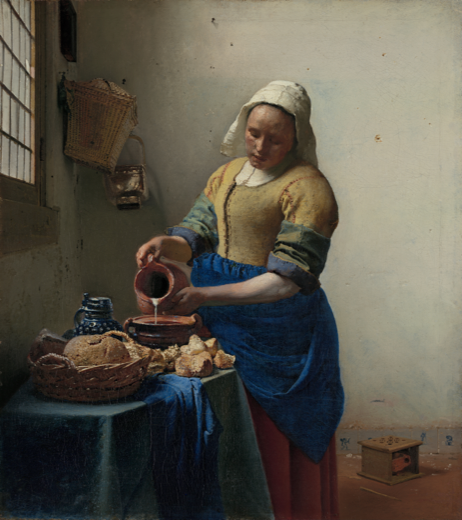
Intro source: Wikipedia (EN)
Author
Johannes Vermeer
Movement / period
Baroque
Medium
painting
Location
Kunsthistorisches Museum, Vienna
After Vermeer died, his widow Catharina secretly transferred the canvas to her mother as payment for debts, trying to hide it from creditors — the city of Delft's bankruptcy committee caught on and voided the transfer.

Highlights
Facts & legends
- Vermeer never sold this painting — he kept it until his death in 1675, which is almost unheard of for a working artist who died deeply in debt and left his wife and eleven children with nothing.
- After Vermeer died, his widow Catharina secretly transferred the canvas to her mother as payment for debts, trying to hide it from creditors — the city of Delft's bankruptcy committee caught on and voided the transfer.
- For nearly two centuries the painting floated through private collections under the wrong attribution, often listed simply as "a work by de Hooghe" — Vermeer's authorship wasn't firmly established until the 1860s, when French art critic Théophile Thoré-Bürger tracked it down.
- Hitler personally acquired it in 1940 for his planned Führermuseum in Linz, paying Count Czernin 1.65 million Reichsmarks — after the war, Austria declared the sale coerced and the Austrian Republic has owned it ever since.
- X-ray analysis revealed that Vermeer made significant changes mid-painting: the map on the back wall was originally smaller, and the chandelier was repositioned — he was composing on the fly, not copying a pre-planned sketch.
- The model posing as Clio, the muse of history, is wearing a laurel wreath and holding a trumpet and a heavy book of Thucydides — art historians read this as Vermeer's quiet argument that painting is as noble a discipline as history itself.
More details Why Vermeer turns away, dresses his model as the muse of history, hangs a map of a lost united country, and how the studio passed through Hitler's collection before Vienna.
The painter turns his back
We enter as uninvited witnesses
Curtain, chair and tiled floor bring us to the threshold while the painter's face remains hidden. His formal costume makes work ceremonial.
The studio is visible yet private: we watch an image being born without joining the sitting.
The model is Clio
Book, trumpet and laurel turn sitting into history
Her attributes identify the muse of history and fame; the painter begins with her laurel wreath.
Mask, sketchbook and fabric connect painting with sculpture, drawing and theatre.
A country that no longer existed
The map reunites seventeen provinces
Visscher's map shows the Netherlands before political division; city views frame it and Vermeer's signature sits above.
The Habsburg eagle and old geography link painting's glory to cultural memory.
Vermeer kept it
His family tried to protect an exceptional canvas
After his death, widow Catharina Bolnes transferred it to her mother, probably to shelter it from creditors, but the estate was auctioned in 1677.
Its remaining in the house supports its status as a statement about painting itself.
Hitler wanted it for Linz
Provenance became part of the meaning
From the Czernin collection it was bought by Hitler in 1940, recovered after the war and handed to the KHM in 1946.
A quiet allegory of history became an object of state possession and contested memory.
Official sources
Where to check
- Official institution site Kunsthistorisches Museum
- The Art of Painting: meaning and provenanceKunsthistorisches Museum
- The masterpiece in ViennaKunsthistorisches Museum
Visual context
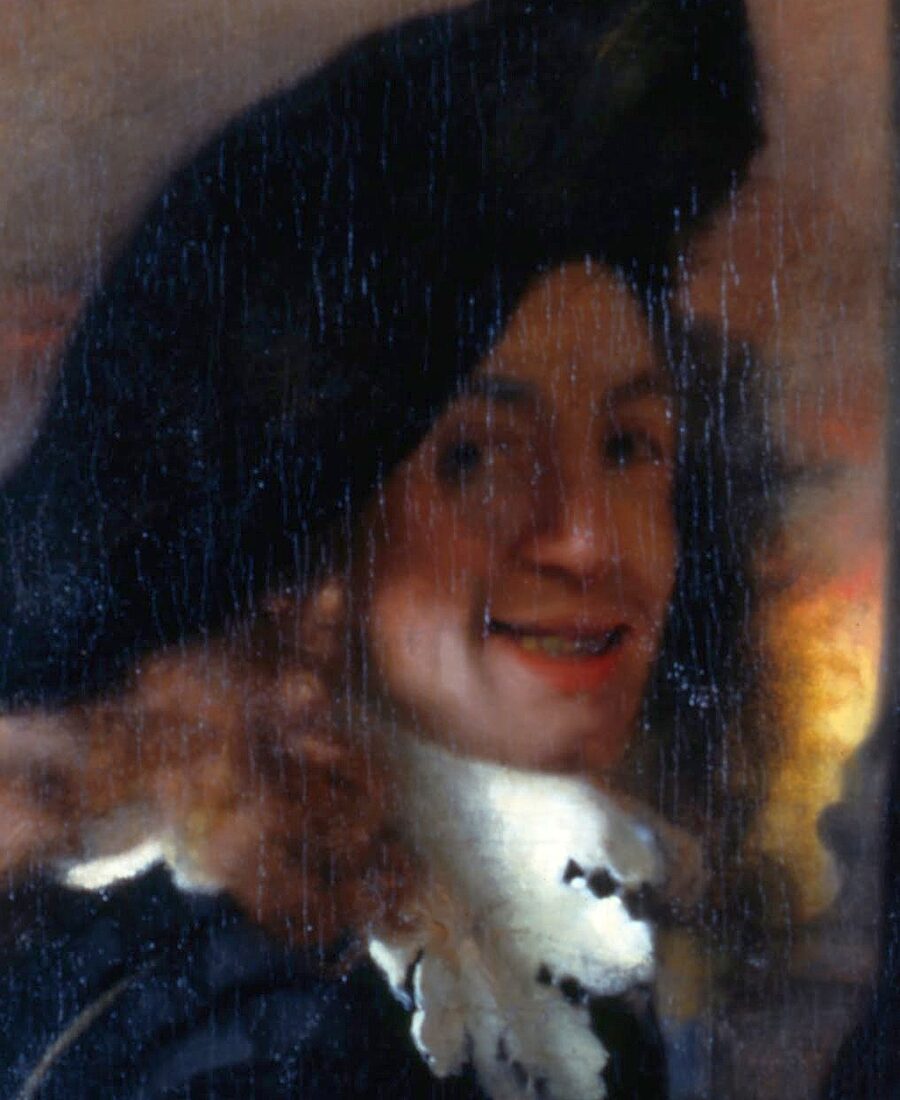 Johannes Vermeer
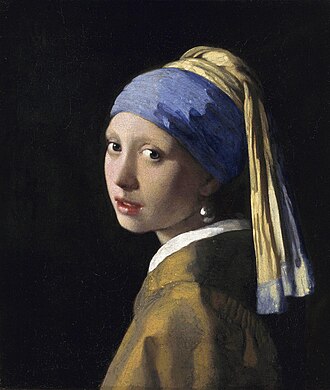 Girl with a Pearl Earring
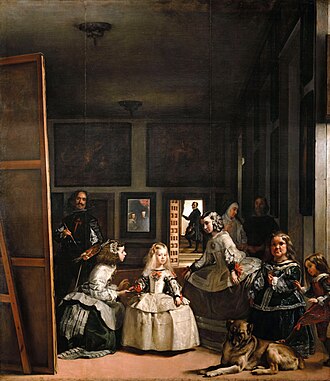 Las Meninas