
Intro source: Wikipedia (EN)
Author
Diego Velazquez
Movement / period
Spanish Baroque
Medium
oil on canvas
Location
Museo del Prado, Madrid
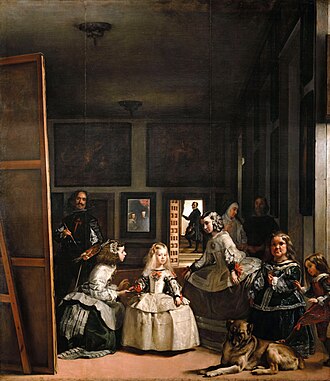
The red cross of the Order of Santiago was added after the painting was made: Velázquez entered the order only in 1659. Who painted it is unknown; the story that Philip IV added it himself remains a legend.
Highlights
Facts & legends
- The canvas is enormous — 318 × 276 cm — yet Velázquez painted it in Philip IV's own working studio inside the Alcázar Palace, a room he used daily as court painter.
- The red cross of the Order of Santiago was added after the painting was made: Velázquez entered the order only in 1659. Who painted it is unknown; the story that Philip IV added it remains a legend.
- The tiny mirror at the back of the room reflecting Philip IV and Queen Mariana is only about 30 cm wide in the actual painting — yet it has generated more art-theory writing than almost any other detail in Western art.
- Michel Foucault opened his 1966 book The Order of Things with an extended analysis of the exchanges of gaze between painter, model, mirror, and viewer.
- Picasso was so obsessed with Las Meninas that in 1957 he painted 58 variations of it in a single burst of work, now housed as a separate series at the Museu Picasso in Barcelona.
- The dog in the foreground — a South Spanish Mastiff — is one of the most accurately observed animals in 17th-century painting; its breed was specifically favored by the Spanish royal family and appears in several Velázquez portraits.
More details A room, a mirror and eleven lines of sight: how Velázquez turned a court portrait into a painting about seeing itself.
What is happening in the room
A casual instant calculated down to the last interval
This is neither a ceremonial lineup nor a royal entrance. Five-year-old Infanta Margarita Teresa has paused in a large room of Madrid's Alcázar. María Agustina Sarmiento kneels to offer her water in a small red clay cup; Isabel de Velasco prepares to curtsy. Court dwarfs Mari Bárbola and Nicolasito Pertusato stand nearby, the boy nudging a sleepy mastiff that refuses to react. Farther back, chaperone Marcela de Ulloa speaks with an attendant, while court marshal José Nieto Velázquez pauses in the open doorway. The painter himself stands at the left behind a huge canvas whose blank reverse occupies almost a quarter of the scene.
The painting is genuinely monumental: 318 by 276 centimetres. Its near-human scale makes the gallery feel like an extension of the painted room. The back wall is covered with pictures, yet its only bright image is a tiny mirror reflecting King Philip IV and Queen Mariana of Austria. They may be standing where we stand, posing for Velázquez, or appearing as a reflection of the portrait hidden on the front of his canvas. The painting refuses to settle the question. “Who are they looking at?” becomes the mechanism that keeps the scene alive.
Light enters from unseen windows on the right, touches the Infanta, her attendants and the painter's hands, then fades toward the back. Margarita is the brightest figure, but she is not the geometric centre. Velázquez separates visual attraction from spatial structure: the eye moves from child to mirror, from doorway to painter, before discovering that the viewer's position may already belong to the royal couple.
Why and how it was made
A court painter shows the court at work
Velázquez painted Las Meninas in 1656, during the final decade of his life. He had served Philip IV for more than thirty years and was also a senior palace administrator, the aposentador mayor responsible for rooms, ceremonies and royal journeys. He knew the Alcázar intimately and set the scene in the Cuarto del Príncipe, former apartments of the dead crown prince Baltasar Carlos that had become a studio. Early biographer Antonio Palomino identified this room, so the architecture records a real space.
Margarita was then the most important dynastic child at court. Formal portraits of her were regularly sent to Vienna for her future husband Leopold I. Here, however, Velázquez avoids the frozen diplomatic formula. The child is surrounded by people who serve water, supervise, entertain and protect her. The court appears as a living system of duties. Rembrandt's Night Watch creates a comparable group drama, but where Amsterdam's guards surge forward, the Spanish court barely moves; tension comes from glances and suspended gestures.
The paint is designed to work at a distance. Close up, Margarita's dress breaks into quick strokes of white, grey and ochre; lace can look almost careless. Step back and those marks become silk, light and air. Velázquez does not describe every detail. He calculates what the eye will complete, which is why reproductions often make the picture look tidier and flatter than the astonishingly loose original surface.
Mirror, perspective and the painter's rank
A self-portrait inside a royal portrait
Ceiling and wall lines converge near the open doorway, where José Nieto marks the vanishing point and at the same time blocks it. He seems to be entering and leaving at once. The mirror sits nearby but does not perfectly coincide with that geometrical focus. This slight mismatch is crucial: the room obeys perspective, yet no diagram can conclusively locate the royal couple or tell us what is on the hidden canvas.
Velázquez paints himself almost full length and taller than most people around him. A red cross of the Order of Santiago appears on his chest, although he was admitted to the order only in 1659, three years after the painting's date. It is therefore usually treated as a later addition. The popular story that Philip IV painted it himself is a legend, not established fact. What matters is the claim being made: Velázquez stands beside the royal family not as a manual craftsman but as an intellectual author capable of shaping the image of monarchy.
The picture argues for the dignity of painting without a written manifesto. King and queen are absent in body but organise the room through reflection and returned gazes. The painter is physically present, while the object of his labour remains concealed. Like Vermeer's Art of Painting, Las Meninas turns a studio into a model of the world; Velázquez adds court power and makes our own position in front of the canvas part of the model.
The painting's changing life
A fire, a palace and three different titles
The 1666 Alcázar inventory described the work as a portrait of the empress with her ladies and a dwarf. Margarita was by then Holy Roman Empress. After the Christmas Eve fire of 1734, it was listed as The Family of King Philip IV and later shortened to The Family in the new Royal Palace. The title Las Meninas first appeared in Pedro de Madrazo's Prado catalogue of 1843. Menina was a Portuguese-derived court term for a young lady-in-waiting. The name by which the work is now universally known belongs neither to Velázquez nor to his century.
The canvas survived the Alcázar fire and, according to the Prado, remains in exceptional condition. In 1984 conservator John Brealey removed yellowed varnish. Viewers accustomed to a warm brown haze were startled by the cooler, clearer range that returned. The treatment did not repaint Velázquez; it restored distinctions between silver light, the Infanta's pink-cream dress and the shadowed room.
Today Las Meninas hangs in Room 012 of the Prado. It cannot be grasped like a poster. The figures are close to life size, the mirror is small, and the brushwork changes with distance. The most revealing way to look is to begin far back, approach the Infanta and painter, then retreat again. With every step, not the plot but the hierarchy of attention changes. That shifting act of looking is the painting's true subject.
Afterlives
From Goya and Sargent to Picasso and Foucault
Goya knew Las Meninas in the royal collection and made an etching after it in 1778. In The Family of Charles IV he also placed himself beside a large canvas, replacing Velázquez's enigmatic pause with a brilliantly exposed family lineup. John Singer Sargent copied Velázquez at the Prado; his Daughters of Edward Darley Boit inherit the deep doorway, generous empty space and unsettling sense that children are being absorbed by the room around them.
The most sustained answer came from Pablo Picasso. Between August and December 1957 he painted 58 canvases in Cannes, 45 of them variations on Las Meninas (the other 13 are doves and landscapes). He changed the format, fractured the room into black-and-white planes, enlarged the dog and turned Velázquez into something close to architecture. These are not copies but an extended dissection of figures, light, rhythm and authority, rebuilt in a twentieth-century language.
Michel Foucault opened The Order of Things in 1966 with a long reading of the painting. He was less interested in solving the mirror than in its network of absences: the painter watches a model outside the picture, the viewer occupies that model's place, and the completed image is turned away. Las Meninas consequently became not only a museum masterpiece but a tool for thinking about vision, representation and power. Its secret is not a hidden answer; it is the way every possible answer relocates the person looking.
Official sources
Where to check
- Official institution site Museo del Prado
- Official collection / archive Museo del Prado
Visual context
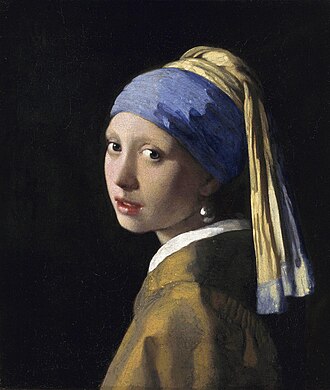 Girl with a Pearl Earring


