
Intro source: Wikipedia (EN)
Author
Gian Lorenzo Bernini
Movement / period
Baroque
Medium
sculpture
Location
Santa Maria della Vittoria, Rome
Teresa of Ávila herself described the angel's golden spear piercing her heart in her autobiography, and Bernini followed her words almost literally: the arrow, her half-open mouth, the crumpled robe — it's basically a direct illustration of a mystical text, translated into marble.

Highlights
Facts & legends
- Cardinal Federico Cornaro paid Bernini the equivalent of roughly 12,000 scudi — an enormous commission — to design the entire chapel, sculptures included, as a unified theatrical space, including the marble opera-box balconies where carved portraits of the Cornaro family sit watching the scene.
- Teresa of Ávila herself described the angel's golden spear piercing her heart in her autobiography, and Bernini followed her words almost literally: the arrow, her half-open mouth, the crumpled robe — it's basically direct illustration of a 16th-century mystic's self-reported vision.
- The group is about 3.5 meters tall and was carved between 1647 and 1652; Bernini used a hidden window cut into the vault above to flood the marble with real natural light from behind, so the gilded bronze rays you see aren't decorative — they're framing actual sunlight falling on the stone.
- President Charles de Brosses, visiting in 1739, wrote that the expression on Teresa's face looked far more like erotic pleasure than religious rapture — a reaction that has never quite gone away and got the sculpture a starring role in Roland Barthes's 1977 writings on pleasure.
- The marble's famous softness — Teresa's robes look like wet fabric, not stone — was achieved through Bernini's trick of undercutting deeply, leaving paper-thin layers of marble that catch light from the sides and make the material glow rather than simply reflect.
- Dan Brown referenced the chapel in Angels & Demons (2000), which sent tourist numbers at Santa Maria della Vittoria surging so dramatically that the church had to install extra lighting and crowd barriers around an altarpiece that had stood quietly for 350 years.
More details How Cardinal Cornaro turned a family chapel into a theatre, where Teresa's vision comes from, why the sculpture has never left the church, and how it became a byword for the argument between mysticism and the body, from Charles de Brosses to Lacan.
What the chapel shows
Two figures over the altar, and a whole chapel around them
Above the altar of the Cornaro Chapel, two slightly larger-than-life white marble figures hang in suspended motion: Teresa of Ávila reclines on a cloud, eyes closed, mouth open, one hand falling limp. Beside her floats a smiling angel holding a gilded arrow — the metal set against the whiteness of the Carrara marble from which both bodies and the heavy folds of drapery are carved.
The group sits inside an aedicule faced with coloured marble, dark green and yellow, complete with columns and an entablature, like a piece of real architecture. Natural daylight falls from a window hidden from the visitor standing in the nave, striking gilded bronze rays that descend toward the figures from above, so that the light itself reads as part of the vision rather than simply illuminating it.
On both side walls of the chapel, marble boxes cut into the stone resemble theatre balconies. Inside them, high-relief, almost full-length figures of men from the Cornaro family sit, talk, read, and watch the group over the altar the way an audience watches a stage.
No single element stands alone: the columns, the coloured stone, the concealed window, the rays and the two central figures were all conceived by Bernini together, as architecture, sculpture and light in one operation. That is what separates the Cornaro Chapel from an ordinary altar statue — the viewer faces not an isolated object but an entire designed space.
How it was made
Cardinal Cornaro's commission and five years of work
On 22 January 1647 the Venetian cardinal Federico Cornaro obtained patronage rights over the chapel in the left transept of Santa Maria della Vittoria and decided to make it his family's burial chapel. The church belonged to the Discalced Carmelites and had until then been unremarkable. Contact between the cardinal and Bernini seems to have begun before that official date, since work was already under way by early 1647.
Bernini finished the chapel in 1652, after five years of work. Cornaro reportedly paid 12,000 scudi for it, a sum comparable to a major private commission of the period. A small terracotta model, about 47 centimetres tall and made between 1644 and 1647 while the composition was still being worked out, survives today in the Hermitage Museum, its surface still carrying the sculptor's fingerprints.
The commission arrived at a difficult moment for Bernini. In 1646 the bell towers he had built for the façade of St Peter's Basilica cracked and had to be dismantled by order of Pope Innocent X — a public failure that cost him his standing as Rome's leading papal artist. The Cornaro Chapel became one of the works that restored his reputation as the city's foremost sculptor, even though the patron here was a private cardinal rather than the papal court itself.
Bernini worked not only as sculptor but as architect of the whole ensemble: he designed the coloured marble of the aedicule, the hidden window above the group, the gilded bronze rays and the side boxes with the family reliefs — light, stone and narrative planned as a single task rather than commissioned piecemeal.
Where the imagery comes from
Teresa's autobiography and Bernini's theatrical craft
The subject is not drawn from a general iconographic type but from one specific text — Teresa of Ávila's own autobiography, The Life of Teresa of Jesus, written around 1565. In chapter 29 she describes a vision in which a beautiful angel held a long golden spear tipped with fire and thrust it into her heart several times; the pain was so great it made her moan, yet it carried a sweetness so intense that she did not wish it to end. The Church calls this episode the transverberation.
Teresa had been canonized in 1622, the first Discalced Carmelite nun to be made a saint, and her cult was still relatively new when Bernini received the commission. He adds choices of his own to the text — the relaxed pose, the parted lips, the slack weight of the body — pushing the sensual charge of the scene further than the written source does on its own.
The device of building the audience into the work itself — the Cornaro family watching the miracle from their boxes — grows out of Bernini's own theatrical career: alongside sculpture and architecture, he wrote and staged comedies, a side of his work covered on the page for Gian Lorenzo Bernini. A few years later, Velázquez set himself a related problem in Las Meninas, folding the viewer into the scene so that the boundary between the painting and the room dissolves, even though painting and theatrical sculpture work through entirely different means.
The fate of the work
A chapel that has never left the church
Unlike a painting, the marble group and the whole Cornaro Chapel have never been sold or moved: since 1652 it has stood exactly where Bernini placed it, in the left transept of Santa Maria della Vittoria in Rome, built into a specific architecture and calibrated for the light of one particular window.
The church was built for the Discalced Carmelites and consecrated in 1626; after the Cornaro Chapel was added, it became one of Rome's most visited religious monuments while remaining an active parish rather than a museum. Responsibility for the chapel's upkeep falls to the Italian state, through the Special Superintendency of Rome, since the monument is recognized as part of the national cultural heritage.
Over three and a half centuries the marble suffered from leaks through the hidden window, which left staining, and from decades of soot and urban grime settling on the white stone. A major restoration was completed in October 2021 — the most thorough cleaning in nearly twenty years — removing layers of black grime and water stains, restoring the gilding on the bronze rays and the coloured marble of the aedicule, and bringing the marble back to something close to the finish Bernini gave it when he completed the work in 1652.
The chapel remains inseparable from the church, physically and legally: it cannot be insured and shipped to an exhibition, because it is part of a building whose fate is bound to that of Santa Maria della Vittoria itself.
Cultural legacy
From Charles de Brosses to Lacan and Dan Brown
The sensuality of Teresa's face and pose was debated even by contemporaries: the French traveller Charles de Brosses, passing through Rome in the eighteenth century, remarked that if this was divine love, he knew all about it — a line still repeated as shorthand for the centuries-long argument over the work. The Victorian critic Anna Jameson went further, arguing the statue was too carnal for an altar and ought to be destroyed.
In the twentieth century the debate shifted register: the psychoanalyst Jacques Lacan, in his seminar Encore (1972–73), used this very group to illustrate an "other" form of feminine enjoyment that cannot be reduced to a phallic economy. Since then, images of Bernini's statue have become almost obligatory illustrations in textbooks on psychoanalysis and gender theory, and Lacan's own line — "you only have to go and look at Bernini's statue in Rome" — is quoted on its own, detached from the seminar.
Popular culture has used the work differently: in Dan Brown's novel Angels & Demons, the Cornaro Chapel appears as one of the fictional "altars of science" on the Illuminati trail, though the novel's plot details do not match the monument's real history, and the street artist Banksy produced his own version of the composition, removing the angel and adding fast-food imagery.
The Ecstasy of Saint Teresa remains one of the most discussed works of Baroque sculpture precisely because the tension it stages between mystical and bodily experience has never been settled in four centuries of argument.
Official sources
Where to check
- Official institution site Official Rome cultural guide
- Restoration and theatrical structure of the Cornaro ChapelItalian Ministry of the Interior
- Bernini's cloud: restoration researchVatican Museums
Visual context
 Girl with a Pearl Earring
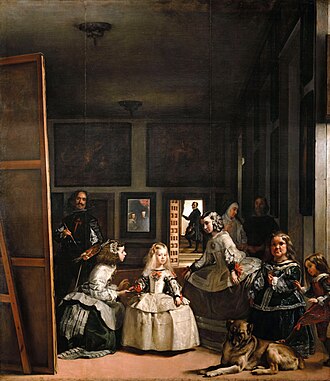 Las Meninas
