From 10 October the Philadelphia Art Museum is showing "Marcel Duchamp". The last retrospective on this scale in North America was in 1973, organised by the museum together with MoMA. The new show covers six decades of work: painting, sculpture, readymades, film, photography, drawings and printed matter. It runs until 31 January 2027.
There is no better place for it: Philadelphia holds the largest Duchamp collection in the world, from the 1912 Nude Descending a Staircase to The Large Glass and Étant donnés, the last work he made in secret over twenty years. Nude Descending a Staircase on the site · Fountain · Marcel Duchamp
Since 7 October the Hall Napoléon at the Louvre has hosted a major exhibition of Francisco de Zurbarán (1598–1664), one of the leading painters of the Spanish Golden Age. It was organised by the National Gallery in London, the Louvre and the Art Institute of Chicago: London showed more than forty paintings over the summer, and after Paris the exhibition moves to Chicago. At the Louvre it runs until 25 January 2027.
One of its centrepieces is Saint Francis of Assisi from the 1630s, lent by the Musée des Beaux-Arts in Lyon and restored for Paris. The saint stands in a dark niche with light only on his face and hands. Zurbarán painted him as legend says his body was found in the tomb at Assisi: incorrupt, upright and in ecstasy. The Louvre on the site
Mary Cassatt lived in France for about sixty years and showed with the Impressionists, yet France's national museums had never given her a major solo show. From October 6 the Musée d'Orsay is putting on around 80 of her paintings, pastels and prints, including works from American collections that rarely travel to Europe. The timing is twofold: it's a hundred years since her death and forty since the museum opened.
The show, "Mary Cassatt: The Independent", runs until January 31, 2027. It follows how Degas invited her to join the Impressionists in 1879, how American collectors bought their paintings on her advice, and how she backed the fight for women's right to vote. We've written a separate piece on one of her best-known works. The Child's Bath on this site · Mary Cassatt on this site
Back in July, Yusuf Ali Osman from Croydon in south London asked the museum whether its Bayeux Tapestry show would offer audio-described tours, where a guide puts into words what the image shows. The answer was no: light on the nearly thousand-year-old textile is rationed by the hour each week, so visitor numbers are capped and the museum is relying on self-guided visits. On September 24 his lawyers at Leigh Day sent the museum a pre-action letter citing the Equality Act.
The tapestry is in England for the first time in more than nine centuries; the exhibition opened on September 10 and runs until July 11, 2027. Since the complaint, the museum has promised at least one live audio-described tour and possibly an audio version in its app. For an embroidery nearly 70 metres long, where everything is in the detail, that is hardly a formality.
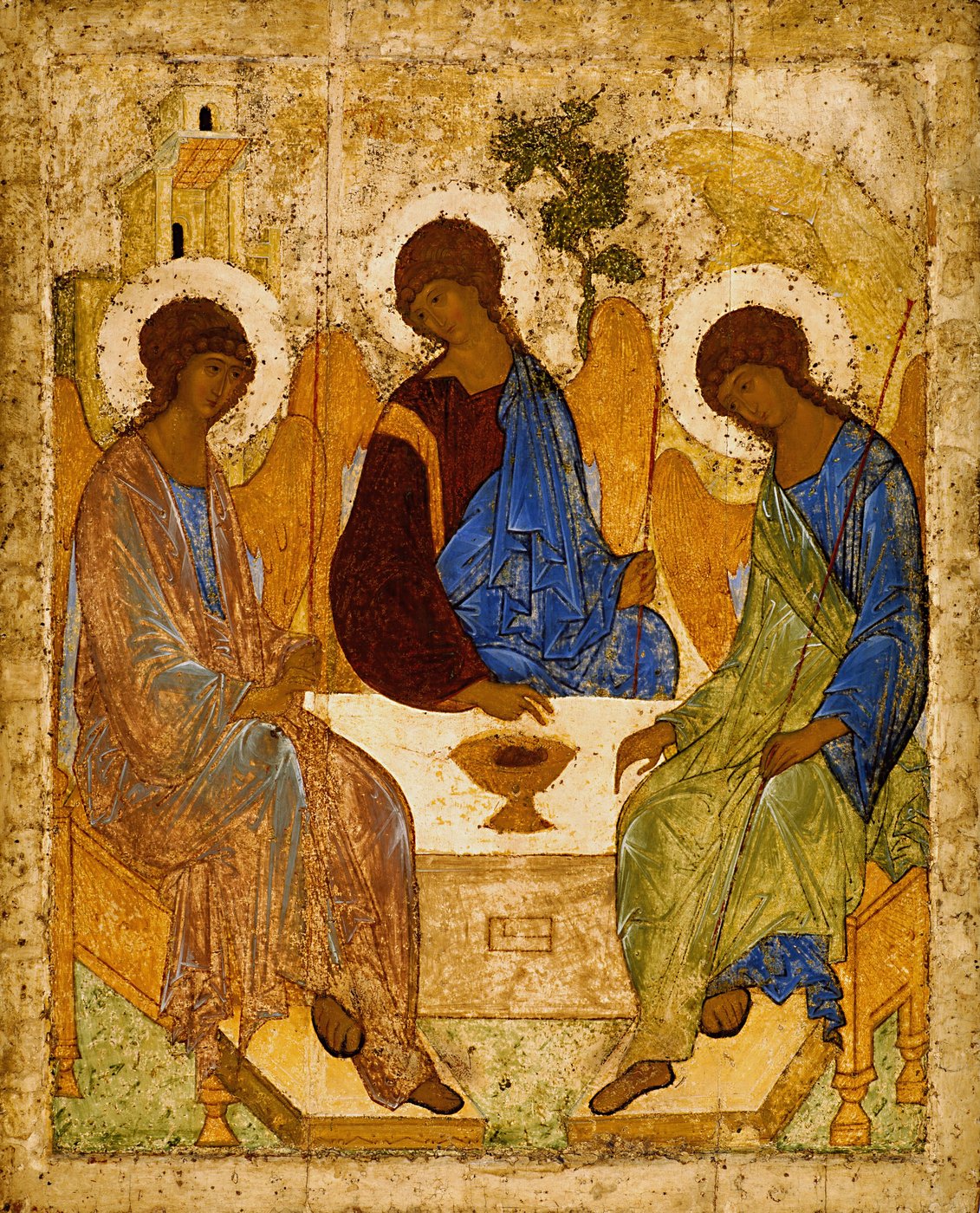
The climate-controlled case housing the icon at the Trinity Lavra of St. Sergius has failed again: rising humidity has caused one panel to swell and "curl into a tube." A German conservator had already repaired the case once but could not return for a second fix, so the icon was moved to an inspection room meeting Tretyakov Gallery standards.
The icon was transferred to the Russian Orthodox Church from the Tretyakov Gallery in 2023 by presidential decree; experts warned at the time that the fragile 15th-century panel could be at risk outside museum conditions. Read more about the Trinity and about Rublev in the relevant sections of this site. The Trinity on this site · Andrei Rublev on this site
The museum began construction on the Oscar L. Tang and H.M. Agnes Hsu-Tang Wing, designed by Mexican architect Frida Escobedo — the first woman to design a wing for The Met in its 156-year history. The five-storey building will increase modern and contemporary exhibition space by nearly 50 percent; $670 million has already been raised, including a $125 million gift, the largest single cash donation in the museum's history.
The wing is expected to open in 2030. While it is under construction, read more about The Met itself in the Museums section of this site. The Met on this site
The museum founded by George Lucas and Mellody Hobson opened to the public today in Exposition Park — a 300,000-square-foot building designed by MAD Architects (Ma Yansong). The institution builds its program around visual storytelling: painting, illustration, comics, film, and photography are treated as one continuous history of the image rather than split into "high" and "popular" art.
It is the most notable museum debut of the season: the collection spans names from Norman Rockwell to Frida Kahlo, setting a new benchmark for museums of popular visual culture.
"So Cute! The Art of Happiness" brings together nearly 300 works — from Egyptian cats and antique statuettes of babies to portraits by Géricault and Renoir, sculptures by Jeff Koons, and photographs by Cindy Sherman. Co-produced with the museums of Strasbourg, the show traces how art across the centuries has deliberately courted tenderness.
A rare case of a major museum making the viewer's emotional response, rather than chronology or style, the organizing idea of an exhibition — running through January 18, 2027.
More than 22,000 tickets have already been booked for the show, which brings together 45 works by Renoir in partnership with the Musée d'Orsay and the Museum of Fine Arts, Boston — outpacing the 2024 blockbuster Van Gogh: Poets and Lovers over the same period. It is the largest Renoir retrospective in Britain in twenty years.
"Father Country I Do Love You" spans 42 works combining photography, text, video, and sculpture, spiraling around the real story of an unnamed federal agent. It is the museum's first monographic rotunda presentation by a photography-based artist and its largest debut of new work ever shown.
The project took nearly a decade to make and opens in the same year the United States marks its 250th anniversary.
Unionized workers at the Brooklyn Museum, the American Folk Art Museum, and the Whitney (all Local 2110 UAW) voted overwhelmingly to authorize a strike if contract talks fail; no strike date has been set. Their central demand is raising minimum pay, currently below New York City's living wage of $71,000 a year for a single adult.
Guggenheim staff voted the same way in June, with 93 percent backing a strike — a trend that shows growing tension between museums' missions and the working conditions of the people who deliver them.
The 1924–25 canvas, measuring 160 by 180 cm — the largest from the celebrated Iris series ever to come to market — is estimated at €22–30 million ahead of a Sotheby's Paris sale. It was painted in the final years of the artist's life, as his near-blind eyes were relearning how to see colour.
Read more about the artist and his famous series in the Creators section, and on the pages devoted to the Water Lilies, Rouen Cathedral, and Gare Saint-Lazare cycles.
"Prado. Siglo XXI" sums up a quarter-century in which nearly a thousand new paintings entered the collection, including works by Fra Angelico, Velázquez, and Goya. Next, opening November 17, comes "Rilke and Spanish Art," on how Velázquez, Murillo, and El Greco shaped the poet's eye for painting.
Goya is one of the most extensively represented artists in the Prado's collection; The Third of May 1808 has its own feature in the Masterpieces section. The Third of May 1808 on this site