
Author
Andrei Rublev
Movement / period
Medieval Russian icon painting
Technique
tempera on wood
Where it is
Trinity Cathedral, Trinity Lavra of St. Sergius, Sergiev Posad
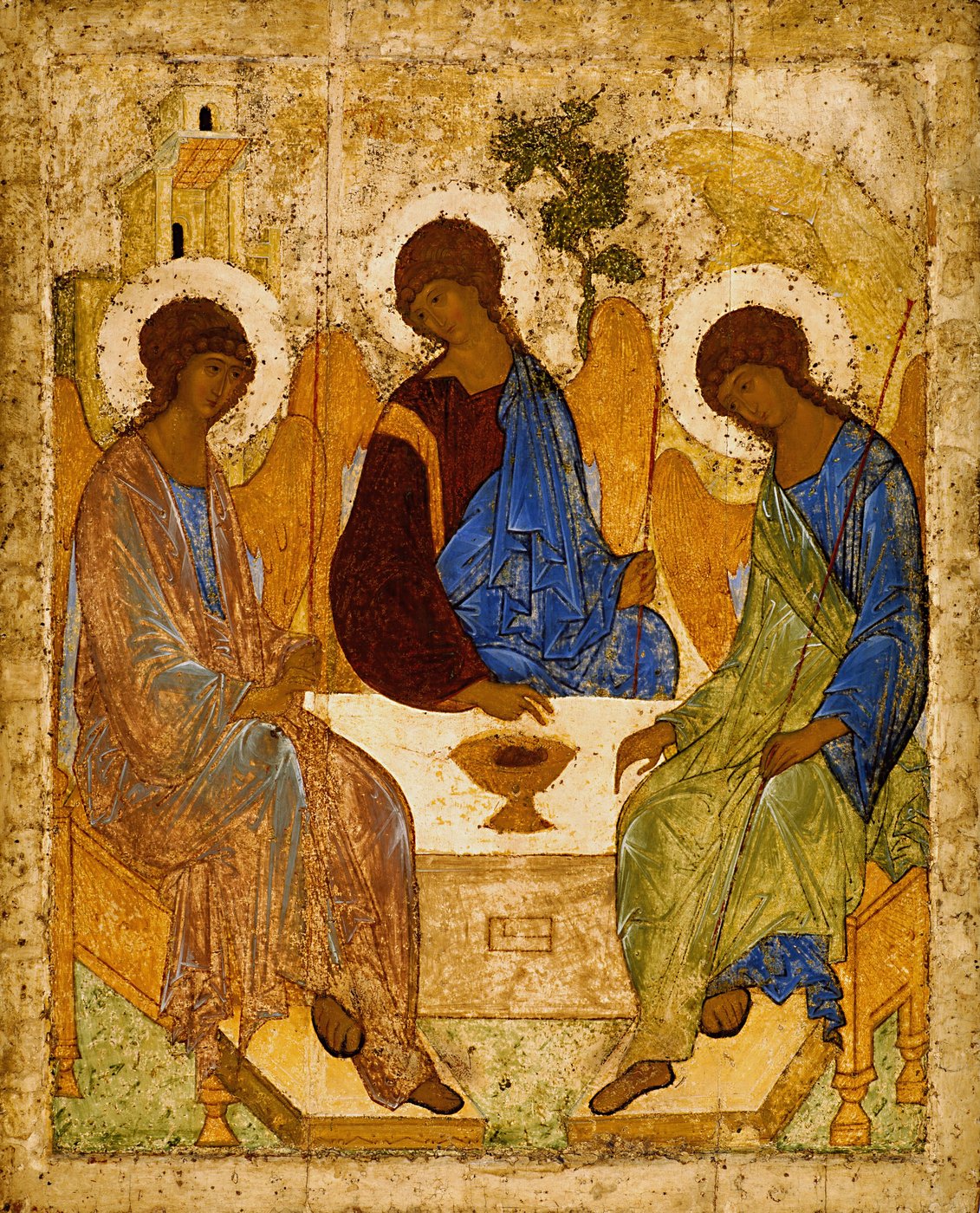
The three figures are arranged so their silhouettes form a single circle — a symbol of divine unity and harmony.
Highlights
Facts & legends
- The icon depicts three angels visiting Abraham at the oak of Mamre — a biblical scene Rublev transformed into an image of the Holy Trinity.
- The three figures are arranged so their silhouettes form a single circle — a symbol of divine unity and harmony.
- For centuries the icon was hidden under darkened varnish and later overpainting, only uncovered by restorers in the early 20th century.
- The icon was made for the Trinity Cathedral of the Trinity Lavra of St Sergius, founded by St Sergius of Radonezh himself; the stone cathedral over Sergius’s tomb was later built by his disciple Nikon of Radonezh.
- Rublev was canonised as a saint by the Russian Orthodox Church, and his icon-painting manner became the benchmark for centuries to come.
More details Why Rublev removed Abraham and Sarah, how three angels form a circle around a sacrificial cup, why the icon became a centuries-long model, and where it has been since 2024.
A meal becomes silent theology
Household detail disappears
Rublev reduces Abraham's hospitality to three angels, table, cup, house, tree, and mountain. History becomes a meditation on three persons united without losing identity.
The icon does not illustrate a conversation as a sequence of speeches. The central angel's gesture bends toward the cup, the left appears to bless, and the right receives the movement. Interpretations of Father, Son, and Holy Spirit differ, so responsible accounts avoid turning them into fixed labels. Meaning lies in relationship: faces resemble one another, garments differ, and silence feels like consent rather than inactivity.
An invisible circle holds the figures
No angel can become the sole centre
Heads, shoulders, hands, and cup lead the eye continuously around the group. Geometry expresses unity without drawing a literal diagram.
Several forms sustain the circle. Wings meet above the table, staffs make three verticals, and footstools open the space toward us. Perspective does not retreat to a western vanishing point; the throne lines seem to widen outward. The near side of the table remains free. Viewers are therefore not sealed outside a sacred scene but encounter a place apparently left for them.
The cup anchors the exchange
Meal and sacrifice share one sign
The calf's head recalls Abraham's food and anticipates the Eucharistic sacrifice. The outer angels also form a larger chalice around the central figure.
Behind the angels are compressed signs of the story: Abraham's house, the oak of Mamre, and the mountain. Their scale is not domestic scenery but theological orientation. Tradition associates house with divine ordering, tree with both ancient oak and future Cross, mountain with spiritual ascent. These are interpretive lineages, not a single code mechanically printed on the icon.
It belonged to a specific cathedral
Sergius's memory shaped its meaning
Made around 1422–27 for Trinity Cathedral and associated with Nikon of Radonezh's praise of Sergius, the icon later became the prescribed model for generations.
The original surface did not arrive untouched. The icon was renewed, varnished, and covered by precious metal revetments; darkened layers altered its colour. Early twentieth-century uncovering returned pale blues, greens, and gold relationships to view, but conservation is not a journey to a perfectly unchanged 1420s object. We see both an old image and an artefact with centuries of material biography.
Museum and church histories meet again
The original has been in the Lavra since 2024
Restored and studied by museum specialists, it entered the Tretyakov Gallery in 1929. On 22 June 2024 it was permanently installed left of the Royal Doors in Trinity Cathedral, so the site's former location was outdated.
Its present location belongs to that biography. After decades of museum care and study at the Tretyakov Gallery, the original was installed in the Trinity Cathedral of the Lavra in June 2024. The transfer produced public debate about preservation. Both dimensions matter: it is a sacred image in an active church and a fragile fifteenth-century object requiring continuous professional monitoring.