
Author
Gian Lorenzo Bernini
Movement / period
Baroque
Medium
sculpture
Location
Galleria Borghese, Rome
Cardinal Scipione Borghese commissioned the group in 1622, when Bernini was twenty-three; interruptions followed, and the sculpture was completed in 1625.

Highlights
Facts & legends
- Bernini carved the entire group from a single block of Carrara marble — the bark, leaves, and fingers all emerging from one continuous piece — which still stuns structural engineers today.
- Cardinal Scipione Borghese commissioned the group in 1622, when Bernini was twenty-three; interruptions followed, and the sculpture was completed in 1625.
- A Latin distich by Cardinal Maffeo Barberini (later Pope Urban VIII) was carved on the base specifically to give the piece a moral alibi — without that warning about lust turning to bitterness, the Vatican might never have allowed such a sensually charged nude in a cardinal's villa.
- Daphne's fingers and the laurel leaves she is transforming into are so thin that light passes through them; Bernini left them structurally unsupported, a thing most sculptors of his era considered technically suicidal.
- The work was designed to be walked around counterclockwise: Apollo's expression from the back reads as triumph, and only as you round the figure do you see the shock and horror dawn on his face — the whole narrative unfolds in space as you move.
- Napoleon's brother-in-law Camillo Borghese sold most of the Borghese collection to Napoleon in 1807, but the French government explicitly excluded Apollo and Daphne from the deal — even then, it was considered literally irreplaceable.
More details Bernini froze a nymph mid-transformation into a laurel tree — and made marble seem to move.
What You See
A Moment That Never Finishes
The group stands 243 centimeters tall, carved from a single block of Carrara marble, and the figures are life-size — Apollo's eyes land almost exactly at the viewer's own eye level. He has just brushed Daphne's back with his fingertips; his left arm is still reaching, his cloak has whipped up behind him in a heavy stone wave, caught by wind that never actually blew through this room. His face isn't triumphant. It's startled, lips slightly parted, the look of someone who realizes, one step from the goal, that the goal is disappearing.
Daphne is no longer entirely human. Bark climbs from her thighs, her skin splitting into a texture that reads as wood grain; the fingers of her right hand fan out, and each one sprouts a sprig of laurel — Bernini and his workshop cut some of those leaves down to a few millimeters, thin enough that light passes straight through them. Her hair is thrown back as if by a sudden turn of the head, mouth open on a scream nobody will ever hear, because the transformation takes her voice before it takes the rest of her. Her feet have already rooted into a low outcrop of stone — the only base under the entire group, since Apollo's lunging body balances on a single leg and, essentially, on the sculptor's nerve. At the base by her feet, the stone is left deliberately rough, worked almost like broken ground rather than a smooth museum plinth — the chisel marks stay coarse there on purpose, so the contrast with Apollo's polished skin registers almost as a difference in touch, not just sight. There's no color anywhere: just white stone, polished smooth on skin, left slightly rougher on drapery and bark.
The Making
The Marble Was Bought in a Day; the Sculptor Waited Two Years
Cardinal Scipione Borghese bought the block of marble on 2 August 1622 — the one date in this story that is actually on paper. Bernini was twenty-three, fresh off finishing the Rape of Proserpina for the same patron, a piece Borghese immediately gave away to Cardinal Ludovico Ludovisi, the reigning pope's nephew, to buy himself goodwill with a more powerful family. What he kept for himself was whatever Bernini carved next — and that turned out to be Apollo and Daphne.
Payments to the sculptor didn't start until 1624, and the work itself was interrupted: through 1623–24 Bernini was busy carving his David for the same cardinal. The group was finished by August 1625; the final payment, on 24 November 1625, brought Borghese's total outlay to 1,000 scudi. A large share of the finest carving — the twigs sprouting from Daphne's fingers, the wind-blown strands of hair, the paper-thin leaf edges — was cut not by Bernini himself but by his young assistant Giuliano Finelli, a stonecutter from Carrara with an unusual feel for the material. Art historians still argue over exactly how much of that foliage is Finelli's hand; he himself, after breaking with Bernini in 1629, complained he had never gotten credit for it. In September 1625 the finished group was carried to the Villa Borghese and set against a wall near the chapel and the spiral staircase — Bernini had planned it so a visitor entering the room would see Apollo's right side first.
Origins
The Apollo Belvedere Learns to Run
Apollo's head and the twist of his torso are lifted almost directly from the antique Apollo Belvedere, then standing in the Vatican and considered, by every Roman with an opinion on the subject, the definitive image of male beauty. The difference is motion: the ancient original just stands there; Bernini gives it the same head, the same profile, and sends it sprinting. The story itself comes straight from Ovid's Metamorphoses — Cupid's revenge, a golden arrow of desire for Apollo and a leaden one, killing all feeling, for the nymph Daphne, a follower of Diana.
This wasn't Bernini's first multi-figure marble for the Borghese household. Years earlier, working alongside his father Pietro, he had carved Aeneas, Anchises and Ascanius (1618–19), and right before Apollo and Daphne came the Rape of Proserpina already mentioned. Each commission pushed the marble toward riskier motion. A few years later the same sculptor would go further still, freezing not flight but rapture, in the Ecstasy of Saint Teresa. Set this scene against its near-opposite — the quiet, contained turn of a head under a turban that the Dutchman Vermeer would paint some forty years later, Girl with a Pearl Earring — and you can see Roman Baroque and the Dutch Golden Age reaching for opposite ends of the same century: there, a moment of thought; here, a moment of panic.
Afterlife
How It Survived While Half the Villa Went to Paris
The Latin couplet on the base — written by Maffeo Barberini — was carved straight into the marble pedestal so visitors to the villa would be told, on the spot, that they were looking at a lesson about the emptiness of fleshly pleasure, not just an excuse to enjoy it. Two years after writing those lines, in 1623, Barberini became Pope Urban VIII and remained Bernini's most important patron in Rome for the next two decades — Apollo and Daphne turned out to be something like the opening chapter of that long partnership.
The group itself was barely touched for the next two centuries. In 1807 Napoleon's brother-in-law, Prince Camillo Borghese, was pressured into selling roughly seven hundred pieces from the villa to France — but those were ancient statues and reliefs, not Bernini's own Baroque sculptures, which were not classified as antiquities and never left Rome. In 1902 the Italian state bought the villa itself, along with everything still inside it, from the Borghese family, and opened it to the public as the Galleria Borghese in 1903. The room is still known today as the Sala di Apollo e Dafne, and the gallery's own conservators periodically clean the marble of dust and old wax buildup, but unlike some other Baroque monuments in Rome, no major intervention or loss has ever been recorded for this group. Apollo and Daphne has stood in the same third room ever since — the room it was made for — though now on a pedestal in the middle of the space rather than against the wall, so visitors can walk all the way around it.
Legacy
The Sculpture Everyone Explains With the Same Sentence
No survey of art history skips this group. It's the standard example for showing the difference between Renaissance marble, calm and stable, and Baroque marble, which looks like a single frame lifted out of continuous motion. Art historians have a set phrase for that effect — "frozen motion" — and this is usually the piece used to teach it, set next to a photo of Michelangelo's still, upright David.
Ironically, its neighbor in the same museum, the Ecstasy of Saint Teresa, ended up with a louder kind of fame: it became one of the stops on the trail in Dan Brown's thriller Angels & Demons and its 2009 film adaptation, while Apollo and Daphne never made it into that book at all — it stayed the property of art historians and museumgoers rather than pop culture. It gets reproduced in other ways instead: plaster casts of Daphne's leaves and fingers have been studied in art academies for generations as a benchmark for carving impossibly thin stone, and the group routinely turns up on the covers of editions of Ovid's Metamorphoses. Workshops in Italy that still carve marble replicas to order list it, alongside the Pietà and the Ecstasy, among their most requested pieces — no small thing for a sculpture closing in on four hundred years old.
Official sources
Where to check
- Official institution site Galleria Borghese
Visual context
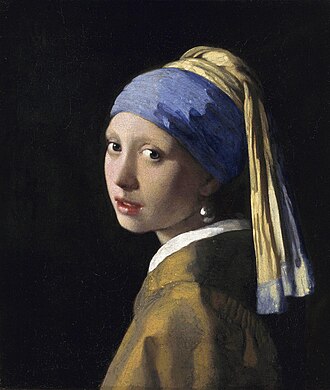 Girl with a Pearl Earring
 Las Meninas
