
Intro source: Wikipedia (EN)
Velázquez hides the real subject in the back: the mortal who out-weaves the goddess Athena and is punished for her pride.

Highlights
Facts & legends
- For ages it was seen as a simple workshop of weavers — until scholars realized the background scene shows the myth of Arachne, who dared challenge a goddess.
- Velázquez hides the real subject in the back: the mortal who out-weaves the goddess Athena and is punished for her pride.
- The spinning wheel on the left turns so fast Velázquez blurred its spokes — one of the earliest paintings of motion this convincing.
- Strips were added to the canvas by a later hand, enlarging the picture beyond Velázquez's original composition.
- It is a painting about painting itself — about skill, rivalry and the price of artistic genius.
More details How Velázquez hid Arachne's contest inside a noisy workshop, placed Titian and Rubens within his canvas, and why the modern frame conceals part of the physical painting.
Myth begins as work
The foreground long passed for daily life
A spinning wheel blurs with speed while women handle wool in shadow. The scene looked so ordinary that generations treated the picture as a tapestry workshop.
Velázquez makes this realism a disguise: labor fills the foreground while the myth's climax waits in the bright room behind.
Long called simply The Spinners, the picture was read as a royal tapestry workshop. Its mythic layer was recognized later: Arachne confronts Minerva in the rear, before a tapestry of Europa based on Titian. Velázquez lets elevated story hide behind labour, as if myth is literally made by hands and thread.
Mortal and goddess meet
Arachne was punished despite her skill
Ovid tells how Arachne challenged Athena and wove the gods' deceptions with perfect skill.
The Prado identifies the old spinner and young worker with the disguised rivals, while helmeted Athena confronts Arachne at the rear.
The foreground does not label the legend. The older woman may be Minerva in disguise and the young spinner Arachne, but attributes remain uncertain. The wheel turns so fast its spokes vanish, an early convincing image of motion made by still paint.
Two masters live inside Velázquez
The tapestry carries Titian through Rubens
The hanging shows Europa carried away by Jupiter as a bull, after Titian's painting and Rubens's copy.
Ovid becomes Titian, Titian becomes Rubens, and their painting becomes woven cloth inside Velázquez: a contest across generations.
Light divides two theatres. Workers occupy a dim room while courtly spectators face the myth on a raised stage. A few steps create a scene within a scene. Viewers enter as workshop visitors before noticing a judgement about artistic rivalry.
The canvas physically grew
Eighteenth-century additions changed its depth
Strips were attached above, beside, and below the original, making the rear episode seem farther away.
In 2021 the Prado designed a frame that hides but does not destroy those historical additions, restoring Velázquez's visible proportions.
The present canvas is larger than Velázquez's original because strips were later added above and at the sides. The familiar arch therefore belongs partly to the object's later life. Additions changed balance and long disguised the original composition's tighter force.
An inventory supplied the key
The 1664 title revealed the hidden plot
Pedro de Arce's inventory called the work the Fable of Arachne, confirming that workshop realism did not exhaust its meaning.
Its double title now preserves both experiences: spinning observed with astonishing immediacy and a meditation on artistic rivalry.
Ovid's story concerns competition with power. Arachne's superior skill cannot protect her. A court painter sets it among anonymous workers whose technique supplied palace splendour, asking who receives fame when beauty depends on unseen hands.
Official sources
Where to check
- Las hilanderas o la fábula de AracneMuseo Nacional del Prado
- Diego VelázquezMuseo Nacional del Prado
- VelázquezMetropolitan Museum of Art
- Diego Velázquez: artist recordNational Gallery of Art
- Diego VelázquezEncyclopaedia Britannica
- Velázquez's FablesMuseo Nacional del Prado
Visual context
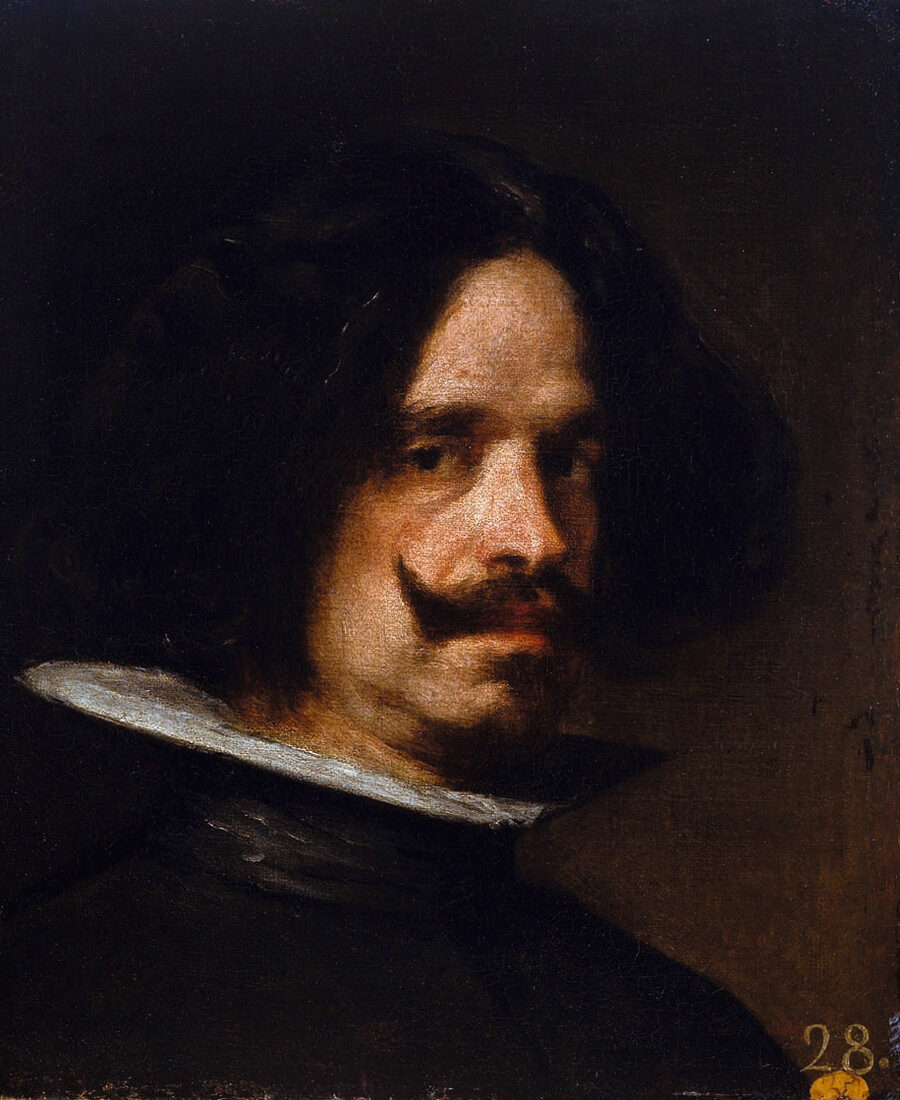 Diego Velazquez
 Girl with a Pearl Earring
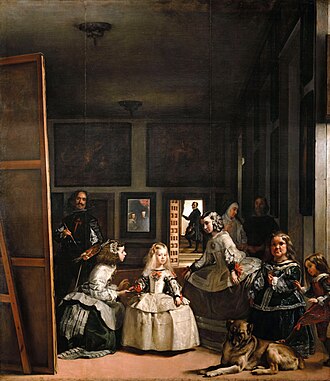 Las Meninas
