
Intro source: Wikipedia (EN)
It was attacked three times: slashed with a bread knife in 1911, sprayed with sulfuric acid in 1975, and stabbed with a knife again in 1990 — the 1975 damage required 18 months of restoration and is still visible under UV light.

Highlights
Facts & legends
- The painting is enormous — 363 × 437 cm — and was actually trimmed on all four sides in 1715 to fit through a doorway in Amsterdam's town hall, removing roughly 60 cm from the left edge alone and cutting out two full figures in the process.
- It was attacked three times: slashed with a bread knife in 1911, sprayed with sulfuric acid in 1975, and stabbed with a knife again in 1990 — the 1975 damage required 18 months of restoration and is still visible under UV light.
- The title is a complete historical accident — the painting was so thick with dark varnish by the 19th century that people assumed it showed a night scene; cleaned in the 1940s, it turned out to depict broad daylight, but the name stuck.
- X-ray analysis revealed a chalk sketch underneath showing Rembrandt moved several figures around before committing to paint — the little girl in yellow was originally positioned closer to the captain's arm.
- The 18 militia men who commissioned the group portrait each paid between 100 and 200 guilders depending on how prominently Rembrandt placed them — Frans Banninck Cocq, front and center, paid the most.
- During World War II the canvas was rolled up and hidden in Steenwijk Castle, then in caves near Maastricht, to keep it out of Nazi hands — it spent most of the war underground and emerged without damage.
More details Neither night nor patrol: how a 1642 group portrait was cut down, attacked with a knife and researched in public.
What we see
A company steps out instead of posing
Two men emerge from a dark arch toward us. Captain Frans Banninck Cocq, dressed in black with a red sash, extends his left hand; its shadow falls across Lieutenant Willem van Ruytenburch's golden coat. Behind them an Amsterdam militia bursts into action: one man loads a musket, another fires, a third blows powder from the pan, a drummer raises his sticks, a boy runs and a dog barks. Rembrandt replaced the customary row of equally important heads with a compressed street drama. Some faces are fully lit, others half visible, and several almost disappear behind weapons and companions.
The painting remains enormous after being cut down: about 379.5 by 453.5 centimetres. At that scale the captain's hand almost enters the viewer's space. His gesture launches a diagonal through spear, flag, muskets and raised arms. Light does not describe one credible sun; it selects actors like a stage spotlight. The yellow lieutenant and a girl in a golden dress therefore register before many of the men who actually paid to be portrayed.
The girl is not an ordinary participant. A chicken with conspicuous claws hangs from her belt, an emblem of the kloveniers militia linked to the Dutch klauw, or claw. A powder horn and a suggestion of the company's ceremonial cup complete the visual badge. Her face has often been compared with Saskia, Rembrandt's wife, who died in the year the painting was finished, but calling it her portrait goes beyond the evidence. She is better understood as a heraldic symbol made strangely alive.
Commission and risk
Eighteen paying members and no orderly lineup
The work was commissioned for the new great hall of the Kloveniersdoelen, headquarters of Amsterdam's arquebusiers, and completed in 1642. It represents the militia company of District II under Captain Cocq and Lieutenant Van Ruytenburch. The names of eighteen paying members were later inscribed on a shield above the group. Contributions varied with prominence and averaged roughly one hundred guilders. In a conventional civic guard portrait, each subscriber expected a clearly recognisable face.
Rembrandt broke that unwritten contract. He built an event rather than a roster: bodies overlap, several members fall into shadow and the space feels crowded and noisy. This makes the old tale of furious clients plausible, yet no document records a collective revolt. His career did change after 1642, but blaming later financial troubles on this single canvas is too neat. Amsterdam's market and taste were changing as well.
Compared with The Anatomy Lesson of Dr Nicolaes Tulp, painted ten years earlier, the leap is clear. The earlier group remains organised around a demonstration. Here action splinters into dozens of small incidents. Rembrandt scratched wet paint with a brush handle, built highlights in thick relief and kept shadows thin. Metal, velvet, skin and smoke are painted at different speeds, so the physical surface joins the march.
Why it is not a night watch
Darkened varnish invented a different time of day
The Rijksmuseum's official title is Militia Company of District II under the Command of Captain Frans Banninck Cocq, known as The Night Watch. The event takes place in daylight. Over centuries, varnish, dirt and changes in the paint made the image look so dark that eighteenth-century viewers began to read it as nocturnal. The shorter nickname defeated historical accuracy and became the painting's international identity.
In 1715 the canvas moved from the Kloveniersdoelen to Amsterdam Town Hall. It did not fit between the doors and was cut on all four sides. The largest loss came from the left, where two figures, steps and balancing space disappeared. Gerrit Lundens's seventeenth-century copy and early drawings record the original arrangement. The removed strips have never been found.
For Operation Night Watch, Rijksmuseum researchers combined the Lundens copy with machine learning to reconstruct the missing margins at full scale. Printed strips were temporarily installed around the original in 2021. They were not presented as recovered Rembrandt, but as a visual experiment. With the left side restored, captain and lieutenant shift to the right, more air enters the scene and the advance becomes less frontal.
A dangerous biography
Evacuation, knife, acid and visible scars
During the Second World War the canvas was removed from its stretcher and evacuated with thousands of museum objects. The vast painting was stored rolled on a cylinder in protected shelters before returning to the Rijksmuseum. It had already crossed palaces and temporary galleries; since the current museum opened in 1885, a purpose-built Night Watch Gallery has made it the institutional centre of gravity.
On 14 September 1975, Wilhelmus de Rijk attacked the painting with a table knife, cutting long slashes through it. Restoration took years, and several vertical scars can still be detected. In 1990 another attacker sprayed sulphuric acid onto the surface. Guards immediately diluted it with water, limiting most damage to the varnish. Today's viewing distance is therefore not abstract caution but the consequence of specific assaults.
Every intervention added new questions. Old varnishes altered contrast, earlier treatments consolidated paint in different ways, and the large canvas responds to tension and climate. Current conservation does not begin with a promise to make the picture brighter. Researchers first map its condition, compare photographs and analyse canvas, ground, pigments and deformation. Preserving The Night Watch means managing its entire biography, not pretending to return to an untouched 1642.
The painting as laboratory
717 gigapixels and conservation in public
In 2019 the Rijksmuseum launched Operation Night Watch, the largest research and conservation project in the work's history. A transparent chamber was built in the gallery so the process could remain visible. Macro X-ray fluorescence scanning, multispectral photography, spectroscopy and microscopic samples revealed preparatory marks, changes to weapons and a lead-rich impregnation beneath the ground, probably intended to protect the huge canvas from a damp wall.
In 2022 the museum released a 717-gigapixel image assembled from 8,439 photographs, with about five micrometres between pixels. Pigment grains, varnish cracks and brush traces that cannot be seen from the gallery floor become legible. Digital resolution cannot replace the original, but it opens the material surface to viewers and gives conservators a precise baseline for future comparisons.
The Night Watch matters because Rembrandt turned collective portraiture into a story in which individual status competes with common movement. The painting has continued to change without its maker: it was reduced, darkened, renamed, wounded and digitised. Looking at it means seeing 1642 together with every later attempt to possess, explain and save the image.
Official sources
Where to check
- Official institution site Rijksmuseum
- Official collection / archive Rijksmuseum
Visual context
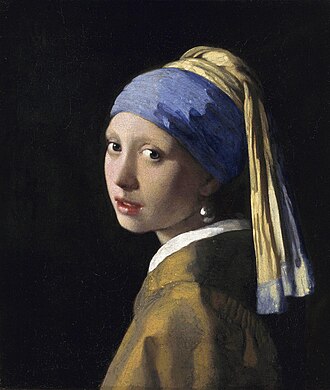 Girl with a Pearl Earring
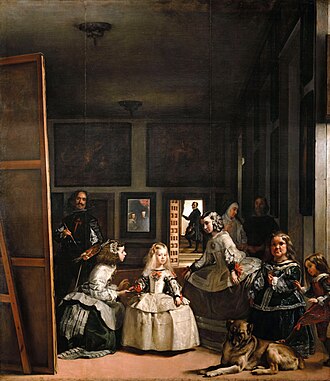 Las Meninas


