
Intro source: Wikipedia (EN)
Rembrandt painted the arm muscles in anatomically incorrect order: the flexor digitorum in the painting attaches where it shouldn't, which anatomists have been quietly noting for decades.

Highlights
Facts & legends
- The corpse being dissected is Adriaen Adriaenszoon, a convicted thief hanged that same morning — January 31, 1632 — and handed straight to the guild.
- Rembrandt painted the arm muscles in anatomically incorrect order: the flexor digitorum in the painting attaches where it shouldn't, which anatomists have been quietly noting for decades.
- Dr. Tulp is shown holding the tendons with forceps rather than a scalpel — a deliberate choice to present him as a scholar directing the lesson, not a butcher doing the cutting.
- X-ray analysis revealed that Rembrandt painted a thirteenth figure in the background and then painted over him; nobody knows who he was or why he was removed.
- The seven observers in the painting each paid Rembrandt a fee to be included — it was essentially a group portrait commission disguised as a medical scene.
- The painting has never left the Netherlands and has been in the Mauritshuis collection without interruption since 1828, which makes it one of the most location-stable masterworks in Europe.
More details At twenty-six, Rembrandt turned the dissection of a hanged robber into the first great theatre piece of Baroque painting.
What the canvas shows
A canvas the size of a doorway
Rembrandt's canvas measures 216.5 by 169.5 centimeters, and the figures are life-size: if Tulp and his colleagues stood up, they would look you straight in the eye. Eight men in black fill the room, the only relief coming from white ruffled collars and the pallor of the body on the table. Only one man keeps his hat on — Tulp himself; the wide-brimmed black hat marked his office as praelector anatomiae, the guild's official lecturer.
The corpse belonged to a hanged robber. The skin of the forearm has been peeled back and the tendons pulled free with forceps in Tulp's right hand, while his own left hand rises in an echo of that same curl of fingers — he is teaching through gesture, not touch. None of the surgeons looks where we look. One is absorbed in an open anatomy textbook at the corpse's feet, two stare straight out at us, another cranes past a neighbor's shoulder just to see the wound. Tulp himself isn't looking at the arm at all — he's watching his audience. He isn't cutting; he's lecturing.
Light falls hard from the upper left, almost theatrically, picking out faces and dead flesh against an almost black-brown ground. The one other pale note, besides the skin, is a sheet of paper gripped by the man at the far right, Hartman Hartmansz — today it carries the names of six of Tulp's colleagues, added, it turns out, well after the paint had dried.
The body on the table wasn't anonymous. Records name him Aris Kindt — his real name was Adriaen Adriaenszoon — a man the same age as Rembrandt and, like him, born in Leiden. He had a record: in January 1632 he was hanged for mugging a passer-by and taking his cloak. Under Dutch law of the time, repeat theft with violence was a capital offense, which is how his body ended up on the surgeons' guild table.
How it was made
The scalpel came before the brush
In 1631 Rembrandt, a twenty-five-year-old newcomer from Leiden, moved to Amsterdam and lodged with the art dealer Hendrick van Uylenburgh, who rented rooms to painters and matched them with clients. The Amsterdam Surgeons' Guild commissioned a group portrait like this roughly once a decade — earlier ones had been painted by Aert Pietersz and Thomas de Keyser — and hung them in the guild hall, directly above the public dissection theatre in the Waag, the old city-gate building on Nieuwmarkt.
The year's one legal public dissection fell at the end of January 1632; the body was that of a robber hanged the day before. Rembrandt is thought to have attended the actual procedure, but painted the surgeons' faces afterward and separately — gathering eight men in one pose at once was simply not practical, and every other guild portrait of the period was assembled the same way. A place in the composition cost money: the closer to the center, the higher the fee, and Tulp, as the lecturer, paid the most of anyone.
The 1998–99 technical study, presented to the public as "Rembrandt under the Scalpel," examined that sheet of paper in Hartmansz's fist. Beneath the seven names — clearly added after the painting was finished — conservators found Rembrandt's own underdrawing: a small sketched arm. The list of names, in other words, is a later revision, not what left the easel in 1632.
How accurate is the arm under Tulp's forceps? Scholars have kept checking well into this century. In 2006 Dutch surgeons re-dissected the same stretch of forearm on an actual cadaver and found real discrepancies from Rembrandt's version of the flexor muscles. And a pale cord that had puzzled anatomists for decades was identified in 2007 as the tendon of a rare accessory muscle — not everyone even has it — the abductor digiti minimi.
Where the imagery comes from
Caravaggio's light, by way of Leiden
The raking side-light and the theatrical pause weren't Rembrandt's invention. He had spent six months studying under Pieter Lastman, a history painter who had traveled to Italy and brought Caravaggio's manner back to Holland — filtered further through the Utrecht Caravaggisti, Honthorst and Terbrugghen, until it had spread across the whole country. Earlier guild portraits of surgeons had lined their subjects up like a class photograph; Rembrandt was the first to break the row, turning a routine commission into a scene of scattered glances and an unstated plot.
The same Baroque instinct — catch not the pose but the instant of motion — was being chased all over Europe at almost the same moment. In Rome, Bernini was carving marble not as a frozen figure but as a fraction of a second mid-transformation: his Apollo and Daphne is caught exactly on that edge. And in the very year "The Anatomy Lesson" was painted, 1632, Delft saw the birth of Vermeer, who a generation later would draw the opposite conclusion from the same Dutch light — not a public spectacle but the sealed quiet of a room, as in his Girl with a Pearl Earring.
Twenty-four years later the guild commissioned a sequel: "The Anatomy Lesson of Dr. Deijman" (1656), showing Deijman, who had succeeded Tulp as praelector anatomiae, dissecting the brain of an executed tailor. It was meant to hang as a pair with the Tulp picture in the same anatomical theatre, but a 1723 fire badly damaged it; only the central fragment survived, and today it hangs not in the Mauritshuis but in the Amsterdam Museum.
What happened to it
A royal decree pulled it off the auction block
For nearly two centuries the painting stayed the property of the Surgeons' Guild and hung exactly where it was meant to — in the hall above the Waag's dissection theatre. The guild was dissolved in 1798 and the picture passed to its widows' fund; by 1828 it was slated for public auction on August 4. A royal decree of July 19 that year, issued by King William I, stopped the sale and had the state buy the picture instead for 32,000 guilders — an enormous sum at the time. That is how "The Anatomy Lesson" reached the Mauritshuis, where the royal painting collection had already moved in 1822.
It has not left the building since, with one exception: in the autumn of 2013, while the Mauritshuis was closed for renovation, it traveled briefly to the Gemeentemuseum Den Haag for an exhibition called "The Anatomy Lesson: From Rembrandt to Damien Hirst," where it hung alongside all ten surviving seventeenth-century Dutch guild anatomy portraits.
The major technical campaign, in 1998–99, was publicized as "Rembrandt under the Scalpel." Removing later varnish made the anatomical figure in the open book at the corpse's feet far easier to read, and — as noted above — stripped away later overpaint on the sheet of paper in Hartmansz's hand to reveal Rembrandt's own sketch beneath the added names. Unlike several other Mauritshuis masterpieces, it has never been stolen or at the center of a scandal — too famous, too documented, to interest a black market.
The building where it all happened outlived the picture's original home in a different way. The Surgeons' Guild kept its dissection theatre on the top floor of the Amsterdam Waag, the old weigh house on Nieuwmarkt, until 1869. Today the Waag holds a café-restaurant, and another floor houses Waag Futurelab, an organization working at the intersection of technology, art and science.
Its mark on culture
From a Philadelphia operating theatre to an autopsy that never happened
Rembrandt's composition became the template for medical group portraiture itself: Thomas Eakins consciously echoed it in "The Gross Clinic" (1875) and "The Agnew Clinic" (1889), transplanting the same crowd of onlookers and the same hard light from Amsterdam into a Philadelphia operating theatre. Édouard Manet, studying the Dutch masters, made his own painted sketch after Tulp in 1856. The writer W. G. Sebald devoted pages of "The Rings of Saturn" (1999) to the picture, fixating on the detail that the corpse's navel is shaped almost like the letter R, and wondered half-seriously whether Rembrandt had hidden a signature there; the American novelist Nina Siegal built an entire book, "The Anatomy Lesson" (2014), around that single day of dissection.
The most explosive reworking came out of South Africa. In 2010 the painter Yiull Damaso restaged the scene with a still-living Nelson Mandela as the corpse, the deceased child AIDS activist Nkosi Johnson as the lecturer, and Desmond Tutu, Thabo Mbeki, Jacob Zuma and other politicians as the onlookers. The ANC called the painting racist and accused the artist of invoking witchcraft; he received death threats, and in 2018 the canvas was sold to an anonymous buyer and hasn't been shown publicly since.
Gentler answers exist too: the Australian artist Susan Dorothea White swapped the surgeons' gender in her 2012 painting "The Anatomy Lesson of Dr. Freeman," shown at the Venice Biennale the following year. And in the autumn of 2013, when the original briefly left the Mauritshuis for the Gemeentemuseum Den Haag, it hung next to work by Damien Hirst — proof that an opened body on canvas has kept pulling artists back for nearly four centuries.
In 2019, for the Rembrandt anniversary year, the Mauritshuis and the insurer Nationale-Nederlanden released a free app, "Rembrandt Reality," turning a smartphone into a portal straight into the 1632 Waag. Actors in costume were captured by a 600-camera 3D rig, and users literally step through a virtual doorway into the room where Tulp lectures over Aris Kindt's body — no VR headset required, just a phone screen.
Official sources
Where to check
- Official institution site Mauritshuis
Visual context
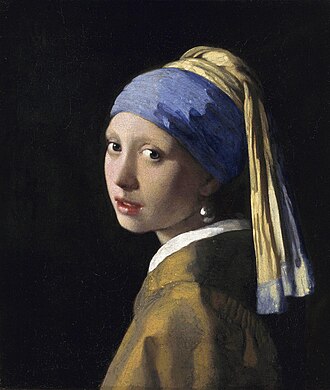 Girl with a Pearl Earring
 Las Meninas


