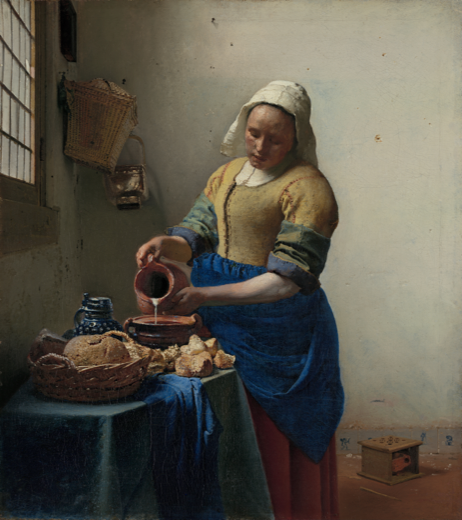
Intro source: Wikipedia (EN)
Vermeer fell into obscurity after his death. The French critic Étienne-Joseph-Théophile Thoré helped restore his reputation in the nineteenth century, publishing a landmark study under the name William Bürger in 1866.

Highlights
Facts & legends
- Proust declared View of Delft "the most beautiful painting in the world" in his novel In Search of Lost Time — and then, in 1921, he dragged himself out of his sickbed to see it at a Paris exhibition, collapsed afterward, and died eighteen months later.
- Vermeer fell into obscurity after his death. The French critic Étienne-Joseph-Théophile Thoré helped restore his reputation in the nineteenth century, publishing a landmark study under the name William Bürger in 1866.
- X-ray analysis has revealed that Vermeer made significant changes during painting — the reflection of a tower in the water was completely repositioned, suggesting he was working from direct observation of the city rather than a single preparatory sketch.
- Vermeer almost certainly used a camera obscura to achieve the painting's uncanny optical accuracy; the soft, blurred halos of light on the roof tiles (called "pointillés") closely mimic the way a lens renders out-of-focus highlights.
- The painting is enormous by Vermeer's standards — 96.5 × 115.7 cm — making it his only true large-format work and his only cityscape, a complete departure from the small domestic interiors he painted almost exclusively throughout his career.
- When the Mauritshuis was forced to sell works to cover debts in 1822, Dutch King William I personally stepped in and purchased View of Delft for 2,900 guilders to keep it in the country — a bargain that today looks almost comically small.
More details How Vermeer made Delft calmer and tidier than reality, moved a church tower toward the centre, left a dating clue in its empty belfry and inspired Proust's fictional death scene.
A southern morning view
Water and sky replace civic spectacle
From the Kolk harbour we see city wall, gates and New Church. Eastern sun and full leaves indicate a summer morning.
Moored boats and tiny people sit within three horizontal bands: water, city and clouded sky.
Not a literal panorama
Vermeer tidied Delft for compositional calm
He straightened and lengthened the bridge, lowered gates, closed gaps with trees and moved the church tower toward the centre.
Alteration creates a more convincing order than topographic accuracy.
Empty belfry as calendar
Missing bells help date the picture
Sky shows through the tower. Hemony's bells were installed between May 1660 and autumn 1661.
A tiny absence ties the picture's stillness to a precise period of change.
Light as material
Roof, tower and boat require different paint surfaces
Coarse lead white makes the yellow roof rough; smooth lead-tin yellow models the sunlit tower.
Dots on a boat become sparkling water only at viewing distance.
Proust's yellow patch
A fictional writer dies before the painting
Proust called it the world's most beautiful picture. His Bergotte sees a “little patch of yellow wall,” regrets his own writing and dies.
Bought by the Mauritshuis in 1822, the cityscape became a model for how concentrated looking changes literature.
Official sources
Where to check
- Official institution site Mauritshuis
- View of Delft: catalogue, technique and historyMauritshuis
- Collection travel and masterpiece statusMauritshuis
Visual context
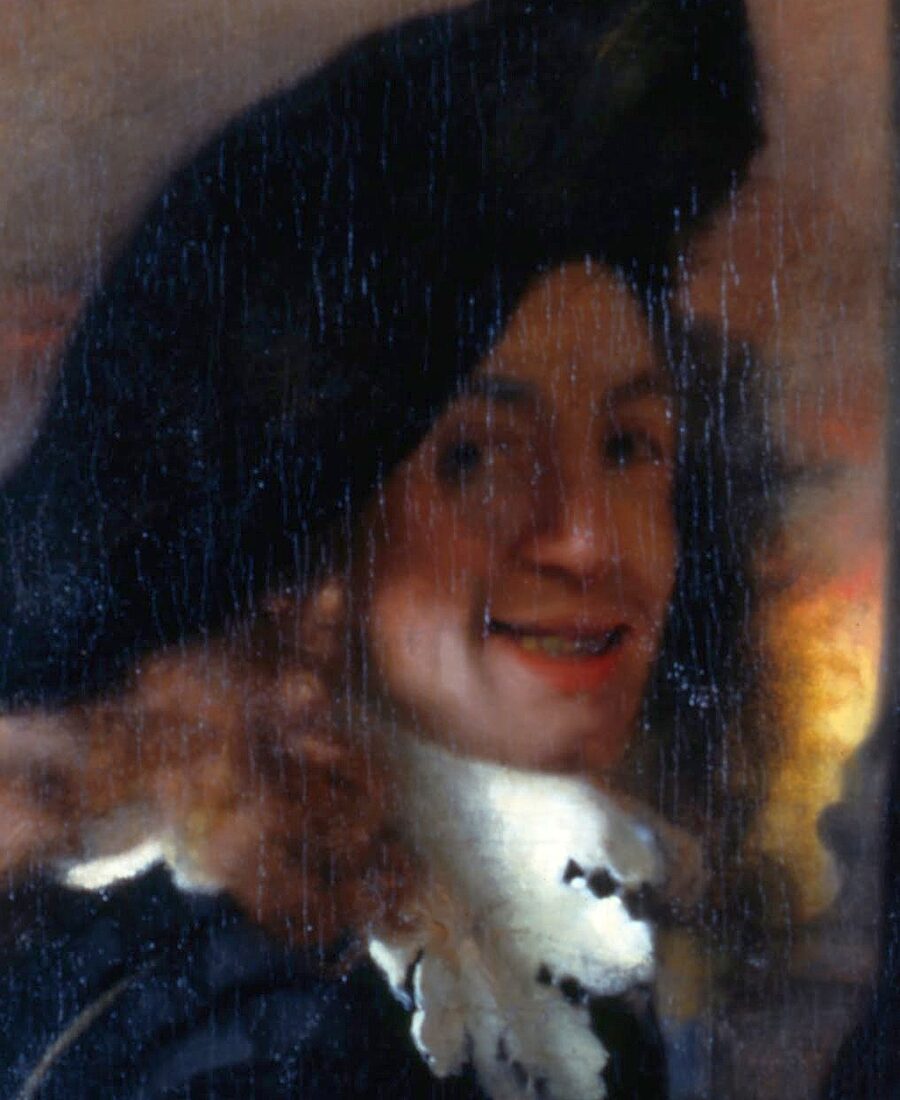 Johannes Vermeer
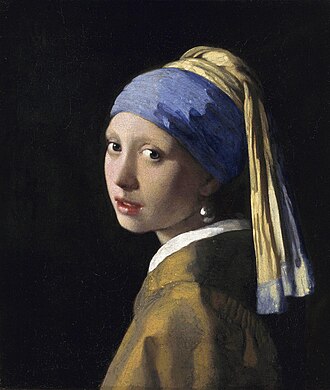 Girl with a Pearl Earring
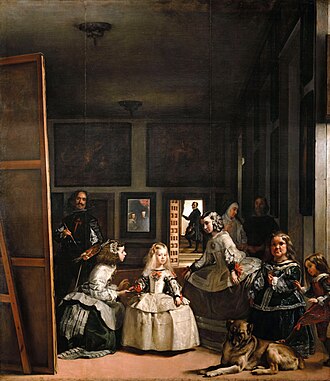 Las Meninas