Author
Wassily Kandinsky
Movement / period
Abstraction and the Avant-Garde
Medium
oil on canvas
Location
Guggenheim Museum, New York
The canvas measures 140 x 201 cm, and Kandinsky spent months working out the placement of every circle and diagonal in preparatory studies, treating geometry the way a composer writes a score.

Highlights
Facts & legends
- Kandinsky painted Composition VIII in 1923 while teaching at the Bauhaus in Weimar — it was completed the same year the school nearly collapsed under political pressure from the right-wing Thuringian government.
- The canvas measures 140 x 201 cm, and Kandinsky spent months working out the placement of every circle and diagonal in preparatory studies, treating geometry the way a composer writes a score.
- When the Nazis seized power in 1933, they classified Kandinsky’s work as "degenerate art" — about 57 of his pieces were confiscated from German museums and some were auctioned off in 1939 in Lucerne for a fraction of their real value.
- Hilla Rebay, the Guggenheim’s first director and a devoted Kandinsky admirer, acquired Composition VIII for the Solomon R. Guggenheim Collection in 1937 — she called it "absolute painting" and hung it as the centerpiece of her vision for a non-objective museum.
- Kandinsky had synesthesia: he literally heard colors and saw sounds, and claimed that yellow made a sound like a trumpet while blue sounded like a cello — Composition VIII is essentially his attempt to transcribe a symphony into paint.
- Despite its cool geometric look, Kandinsky insisted the large circle dominating the upper left was not a "sun" or "planet" but a pure spiritual force — he wrote extensively in "Point and Line to Plane" (1926) about why the circle was the most perfect and cosmic of all shapes.
Estimated value
What it is worth today
Composition VIII is at New York's Guggenheim Museum and not for sale. For comparison, Kandinsky canvases have reached about $45 million at auction.
More details How a Bauhaus course on form and color turned into Kandinsky's most geometric canvas.
What's on the canvas
Two dozen shapes, not one story
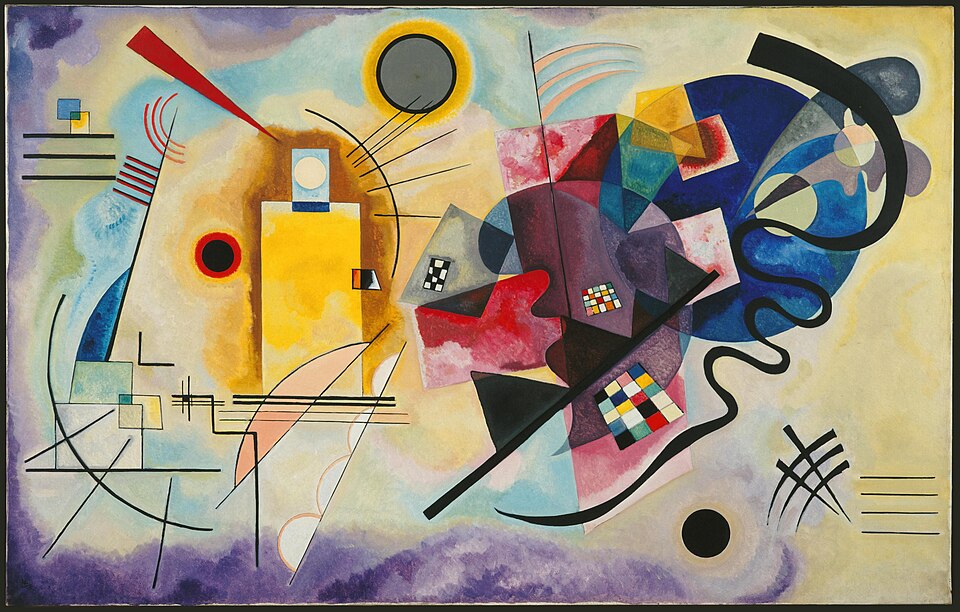
There isn't a single recognizable object on this 140-by-201-centimeter canvas — no face, no tree, no horizon. Instead there's a scatter of more than twenty geometric shapes across a pale gray field, and your eye never settles: land on one form and it slides straight to the next. Top left, a large circle sits inside a thick black outline; just below it, a black triangle points straight at the circle like a spent arrow. Down in the lower left corner, a tight checkerboard grid is the one genuinely regular pattern in the whole picture, as if torn from a graph-paper notebook. A wide band of muted green-gray cuts diagonally through the center, and dozens of thin black lines cross over and around it — not quite straight, gently bowed, like a musical staff someone has pulled at the edges.
Color follows its own logic, separate from shape. The hottest patches — dense yellow, brick red — cluster near the top of the canvas, as though sound were falling from above; blue, green, and violet shapes settle into the bottom third, in a quieter register. A few small circles aren't painted solid but drawn as rings of varying thickness, like ripples on water frozen mid-spread. The canvas is large enough that standing in front of it at the Guggenheim, you can't take it all in from one spot — you step back to see the whole, then lean in again for what's hiding inside the grid.
Look past the circle and the grid and you'll find a stray crescent turned on its side, short comma-like flicks along some of the lines, and tiny dots scattered near the edges, some barely bigger than a stray touch of the brush. The ground itself isn't quite white — it's a warm, grayish beige that makes the cool blues and violets read even colder and the dense yellow read even hotter. Among Kandinsky's late Bauhaus canvases, this is arguably the most crowded: his other compositions from the same decade carry noticeably fewer shapes, with more open field around each one.
How it was made
A painting that outran its own textbook
Kandinsky barely touched oil paint for seven years before 1922 — the Russian Revolution, work on Soviet art commissions, and teaching at Moscow's Vkhutemas and Inkhuk had eaten up his studio time. He left Russia for Berlin at the end of 1921, and by the summer of 1922 he was teaching at the Bauhaus, still based in Weimar, running an "analytical drawing" course on how form and color behave on their own, with no subject standing behind them. Composition VIII, finished in July 1923, was the first large canvas where he tested those classroom ideas on paint rather than a blackboard.
He wouldn't systematize the same theory in print until 1926, in his book Point and Line to Plane — the painting beat its own treatise into the world by three years. Guggenheim curators note that Kandinsky himself regarded this particular canvas as the high point of his postwar painting, coming after nearly a decade with almost no large-scale work. Preparatory drawings survive in the Bauhaus archives, and they show the checkerboard grid and the big circle shifting position more than once before he committed to their final places on the canvas.
Teaching alongside him at the Bauhaus that year were Paul Klee and Lyonel Feininger. Unlike his Munich years, when he sometimes painted straight from intuition with no sketches at all, for Composition VIII he worked through dozens of small ink and watercolor studies first; several of them survive today in the Bauhaus archive in Berlin rather than alongside the finished canvas.
Where the imagery comes from
From burning riders to bare geometry
Kandinsky's first Compositions, painted before 1914, looked nothing like this — cities on fire, riders on horseback, boats going under, apocalyptic scenes dressed up as near-abstraction. The first three canvases in the series burned in 1944, in an air raid on the German city where the collection was being kept; only black-and-white photographs of them survive. Composition VII, finished in 1913, made it through and has hung in the Tretyakov Gallery ever since — the last painting of that early, explosive phase.
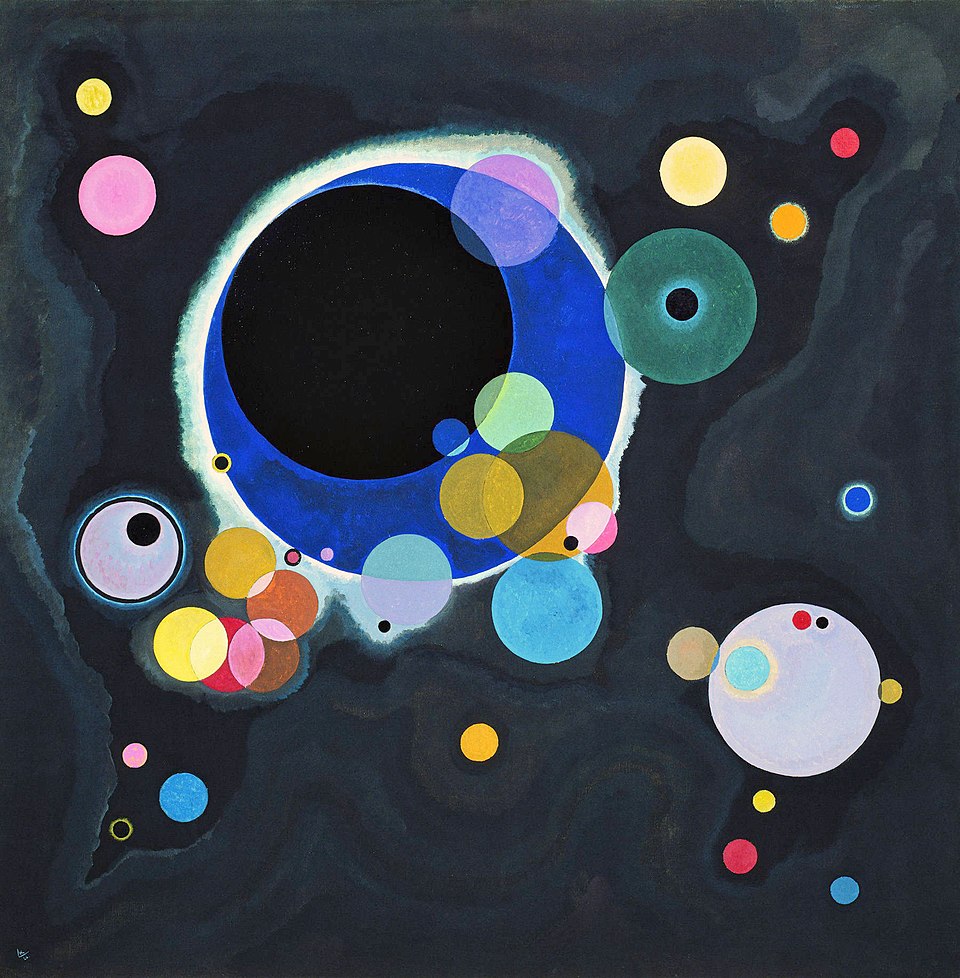
Between VII and VIII lies more than five years: a revolution and an emigration. From 1915 to 1921 Kandinsky lived in Moscow, taught at Vkhutemas alongside Malevich and Rodchenko, and came face to face with Suprematism and Constructivism, with their conviction that a circle, a square, and a straight line could say more than a loaded brush. He'd push that same interest in the unadorned circle even further three years later, in Several Circles, where nothing is left but discs of varying size floating on a dark ground. More on how a Moscow-trained lawyer became a painter is on his artist page.
From Malevich he took the conviction that geometric form could stand entirely on its own, but not the purism that came with it: Malevich's Black Square deliberately refuses even a hint of color-as-sound, while Kandinsky kept insisting that every shape carried its own "sound" — an idea he'd brought with him from Munich and never abandoned, not even in the thick of his most constructivist experiments.
What happened to it
From a Dessau studio straight to New York
In the spring of 1929, Solomon Guggenheim and his wife Irene, touring Europe with Hilla Rebay, stopped by Kandinsky's studio in Dessau — the Bauhaus had already relocated there from Weimar. Rebay had spent years pushing Guggenheim toward abstract painting instead of landscapes and portraits, and she steered him straight to this canvas. Guggenheim bought Composition VIII on the spot; it became the first of what would eventually be more than a hundred and fifty Kandinsky works in his collection.
The canvas had already left Germany years before German museums began losing Kandinsky's work to the "degenerate art" campaign — by then it had been sitting in New York for a good while. In 1939 Guggenheim's collection became the Museum of Non-Objective Painting, the institution's precursor, and in 1959 it moved into Frank Lloyd Wright's spiral building on Fifth Avenue, where the painting has hung ever since, leaving only occasionally for loan shows — most recently the 2021-2022 retrospective "Vasily Kandinsky: Around the Circle," where it held a central spot.
That 1929 trip wasn't a one-off visit: Rebay had mapped out a years-long shopping route through the studios of Europe's abstract painters, and Composition VIII was less an isolated stroke of luck than the opening move in a strategy that eventually built the museum itself. The canvas has never left the Guggenheim's holdings since — never sold, never pawned, never caught up in a restitution dispute, unlike a good many other works stranded in Europe by the war.
Its afterlife in culture
The canvas that helped shape its own museum
Hilla Rebay believed "non-objective" painting like Composition VIII wasn't decoration but a new visual language that needed a new kind of room. She passed that conviction on to Frank Lloyd Wright while he designed the Fifth Avenue building: the unbroken spiral ramp was meant to let visitors move through abstract painting without tripping over doorways between galleries, closer to listening to music without pauses between movements. In that sense, canvases like this one had a hand in shaping one of the most recognizable museum buildings of the twentieth century.
The course material behind this painting became, a few years later, Point and Line to Plane, a book that made its way into design-school syllabuses and still turns up in classes on color theory and composition. Kandinsky's synesthesia, known even to people who've never opened a book on the Bauhaus, has made Composition VIII a go-to illustration in writing about color and sound perception; researchers keep returning to this exact canvas as their clearest historical case study. These days people are more likely to recognize it from a book cover or a poster than from the gallery wall — by now it circulates well beyond the building that holds it.
Among Kandinsky's Bauhaus colleagues, it was Josef Albers who picked up that late gridded vocabulary most directly, later developing his own theory of color squares in the United States with an obvious debt to what Kandinsky had been teaching. Decades on, the same vocabulary — the bare circle, the triangle, the grid — resurfaces in 1960s Op Art, in painters like Victor Vasarely, though art historians are careful about drawing a straight line of influence.
Visual context


 Several Circles