
Intro source: Wikipedia (EN)
Author
Salvador Dali
Movement / period
Surrealism
Medium
oil on canvas
Location
Museum of Modern Art, New York
Dalí claimed the idea came to him in about twenty minutes while he was staring at a piece of melting Camembert cheese — he finished the whole painting the same afternoon, before Gala returned home from the cinema.

Highlights
Facts & legends
- The painting is shockingly small — just 24 x 33 cm, roughly the size of a sheet of printer paper — yet it gets its own protective wall at MoMA and draws bigger crowds than canvases ten times its size.
- Dalí claimed the idea came to him in about twenty minutes while he was staring at a piece of melting Camembert cheese — he finished the whole painting the same afternoon, before Gala returned home from the cinema.
- The headless, slug-like figure draped over a ledge in the center is actually a self-portrait of Dalí's own face, seen in profile, eyes closed, as if in a dream state.
- When MoMA acquired it in 1934 for an undisclosed sum, the museum's director Alfred Barr described it as "the most disturbing landscape in modern art" — a quote that stuck and essentially made Dalí's American career.
- The flies crawling on one of the open watches were a deliberate reference to rotting meat, grounding the dreamscape in physical decay and the very real passage of biological time.
- During World War II the painting was stored in a vault outside New York City because MoMA genuinely feared it could be destroyed in a bombing — it spent roughly four years crated in the dark.
More details A postcard-sized canvas of ants, a fly, Catalan cliffs and four watches that stopped holding their shape.
On the canvas
Thirteen inches across, and no more
The canvas measures 24.1 by 33 centimetres — nine and a half by thirteen inches, small enough to carry under one arm. The horizon sits high, the sea is squeezed into a thin blue band, and three quarters of the surface is given over to an empty ochre plain. On the right, catching low evening light, stands a rocky headland: the coast of Cap de Creus, near Port Lligat, where Dalí was living and working. The left half falls into flat shadow, and the border between light and dark cuts across the picture almost diagonally. Shadows on the plain stretch nearly the full width of the canvas: the sun is right down at the waterline.
Inside that shadow sits a rectangular block, half table, half plinth. A bare olive branch juts out of it. A watch hangs from the branch, drooping like a wet cloth. A second has slumped over the edge of the block. A third lies out on the plain, draped across a pale creature spread flat on the ground.
The creature repays a long look: a shut eye with heavy lashes, a drawn-out nose, a fleshy growth like a lolling tongue. The profile repeats the sagging head from The Great Masturbator of 1929, and viewers have long read it as the painter himself, asleep. There is a fourth watch too — orange, its lid closed, the only one still holding its shape. Ants swarm over the case in a tight clump, the way they work over meat.
Here is the detail almost everyone misses. A fly is perched on the dial of the watch hanging off the block, and it throws a long, wrong-sized shadow that looks more human than insect. An ant here is the size of a grain of rice; the lashes are painted hair by hair. All of it was done with brushes a few bristles wide, laid down so smoothly that not a single stroke shows — the method of seventeenth-century Dutch painting, aimed at a scene that could never happen. There is no full human figure anywhere on it: the entire population of the picture is four watches, a clump of ants, one fly and a sleeping head.
How it was made
A camembert, a missed film, two hours
Nobody commissioned it. In 1930 Dalí and Gala bought a fisherman's hut in Port Lligat, a single room at the water's edge, and he kept coming back there to paint for decades. In the summer of 1931 he was twenty-seven. He went on enlarging the house room by room for decades; in 1931 it was still one whitewashed cell above the water.
Everything we know about the birth of the soft watches comes from the artist himself, in The Secret Life of Salvador Dalí, published in 1942 and layered thick with self-invention. In his telling, he finished dinner with an over-ripe camembert that had run across the plate; he begged off the cinema with a headache while Gala went out with friends; he came back to an almost finished landscape and, in a couple of hours, added the melting dials. By the time Gala returned, the picture was done. No document confirms that evening. It is a legend told by an interested witness, and it deserves to be read as one. A canvas this size really can be finished in an evening, which makes the story plausible without making it true.
Other things can be checked. Asked whether relativity had softened the time in his painting, Dalí said the watches owed nothing to Einstein and everything to a camembert dissolving in the sun. He described his pictures as hand-made photographs of dreams, and he worked accordingly: thin transparent layers, minute brushes, forensic conviction applied to impossible objects. The working principle he had just named the paranoiac-critical method — provoke a delusion deliberately, then record it as coolly as a camera.
The public did not have to wait long. From 3 to 15 June 1931 the canvas hung at Pierre Colle's gallery in Paris among some sixteen paintings: a small object in a room of larger ones, and not the first thing anyone noticed.
Where the images come from
Ants out of a film, a face out of a rock
The ants arrived before the watches. In 1929 Dalí and Luis Buñuel made Un Chien Andalou, in which ants pour out of a hole in a man's palm; from then on the insect travels through his paintings as a standing sign of rot. The sagging head in the middle is close to a quotation from his own Great Masturbator, painted that same year, and its shape came from the rocks of Cap de Creus. Dalí insisted all his life that he saw faces, camels and eagles in that stone, and he carried the outlines straight onto canvas. The landscape was not painted from memory: the bay of Port Lligat was visible from his window, and the same shoreline recurs in dozens of his canvases of the 1930s.
The rest is borrowed and digested. The enamel-smooth handling comes from the Dutch and Spanish masters he copied at the Madrid academy. The long empty perspectives with their raking evening shadows come from Giorgio de Chirico, whose deserted squares the Surrealists claimed as their prologue. The half-vegetable drooping bodies come from Bosch, whose Garden of Earthly Delights hung in the Prado, a short walk from his student residence. Vermeer was a separate obsession: Dalí took The Lacemaker apart and quoted it for decades, chasing the same density of small detail.
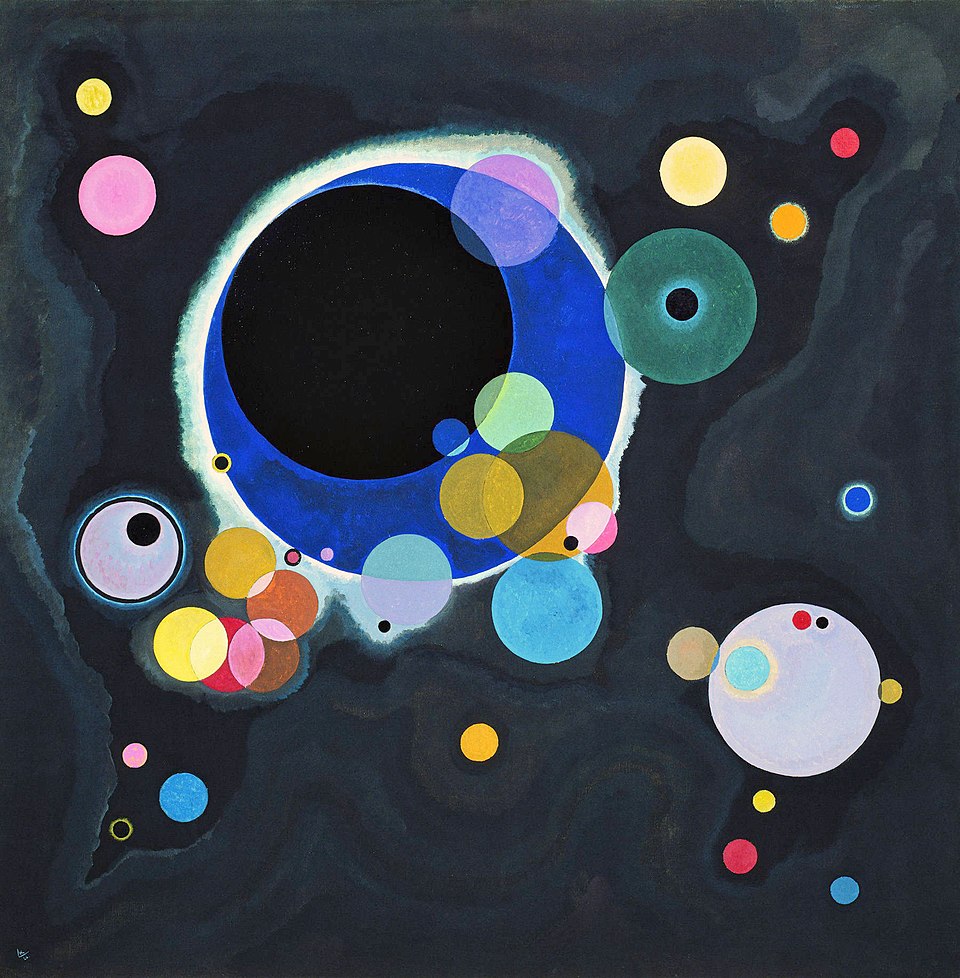
Then there is the moment. By 1931 European painting had spent more than a decade walking away from recognisable things: Kandinsky had already made Composition VIII, in which the world is reduced to circles, arcs and angles. Dalí went the opposite way, leaving objects every gram of their solidity and breaking only their physics. He had met Picasso in Paris in 1926, on his first trip to France; six years after The Persistence of Memory the older Spaniard would paint Guernica, and the two pictures would spend decades hanging in the same New York museum.
What happened next
Two hundred and fifty dollars, then an anonymous gift
It left Paris quickly. The American dealer Julien Levy paid 250 dollars for it, more than he had ever spent on a single painting. From 9 to 29 January 1932 it hung in his New York gallery in Surréalisme, the first Surrealist exhibition in the United States. That show was America's introduction to Dalí. Levy had opened his Madison Avenue gallery only months earlier, and it was the first American room to trade seriously in Surrealism and in art photography.
In 1934 an unnamed friend of the Museum of Modern Art bought the picture from Levy and handed it straight to the museum. In MoMA's records it carries the number 162.1934 and, in the credit line, the words anonymous gift. It has not changed hands since, has never appeared at auction, and therefore has no market price at all: in more than ninety years it has not been sold once.
From there the story is purely institutional. In 1936 Alfred Barr put it into Fantastic Art, Dada, Surrealism, the exhibition that explained the movement to American audiences. In November 1941 MoMA opened a Dalí retrospective that ran into January 1942. There is no theft in this painting's file, no slashing, no dramatic restoration — an unusually quiet life for an image this famous. By then the painter was a newspaper celebrity in America: on 14 December 1936 Time ran his portrait, taken by Man Ray, on its cover.
New York lets it travel rarely. The most notable trip came in the winter of 2009, when the canvas was lent to the Dalí Theatre-Museum in Figueres. It was the first time The Persistence of Memory had been shown in Spain, half an hour from the bay it depicts. It stayed on view until 18 March, then went home.
Cultural footprint
The melting watches ate the title
Plenty of people cannot name the painting; everyone can name the melting watches. Dalí worked the discovery for the rest of his life. Between 1952 and 1954 he painted The Disintegration of the Persistence of Memory, in which the same landscape breaks into floating blocks, fish tails and unravelling dials — it now hangs at the Dalí Museum in St. Petersburg, Florida — and afterwards he reproduced the drooping clock face in lithographs, bronze and jewellery.
His commercial appetite was not forgiven. As early as 1939 André Breton rearranged his name into Avida Dollars, greedy for dollars, and wrote him out of the Surrealist group. The painting's fame did not notice. For a while afterwards his former colleagues spoke of him in the past tense, as though he had died.
After that the image lived independently of its author. The Simpsons and Sesame Street both parodied it, the second replacing the sleeping profile with Cookie Monster and the dials with biscuits; it has surfaced in Futurama, in Doctor Who and in video games; it is endlessly recycled in advertising, in cartoons about deadlines and in anything that needs to signal a dream. Later artists borrowed less the brushwork than the trick itself: take an ordinary object and remove exactly one of its physical properties. Dalí turned his own face into the same kind of trademark: the moustache is recognised independently of the paintings, and that is part of the machinery.
The reason it survives is mechanical. A picture the size of a magazine cover reads instantly at any scale — even shrunk to a thumbnail, the silhouette of a slumping dial is unmistakable. In under a century The Persistence of Memory has hardened into a pictogram: time is unreliable, and so is everything else. At MoMA there is reliably a crowd in front of this object while canvases twenty times its size hang nearby.
See the original
Official pages and reference links
Official sources
Where to check
- Official institution site Museum of Modern Art
- Official collection / archive Museum of Modern Art
Visual context


 Several Circles