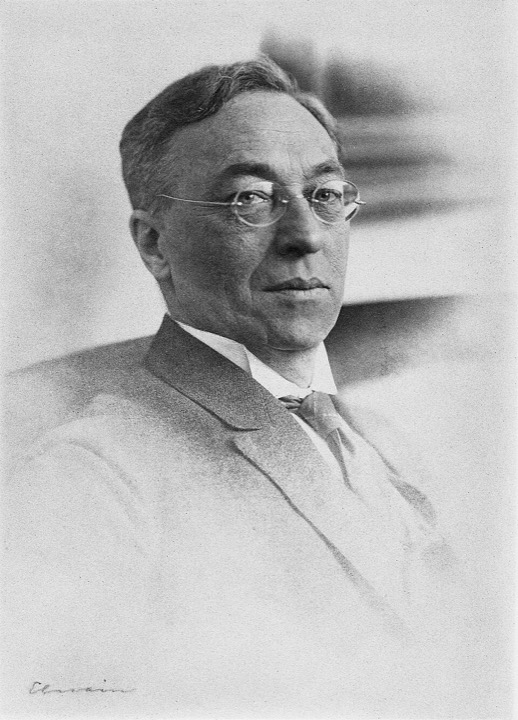
Author
Wassily Kandinsky
Movement / period
Abstraction and the avant-garde
Medium
oil on canvas
Location
Guggenheim Museum, New York
The Guggenheim acquired it in 1929 directly from Hilla von Rebay, Solomon Guggenheim's art advisor, who personally convinced Guggenheim that Kandinsky was the future of painting — this was one of her first major purchases for what would become the museum.
Highlights
Facts & legends
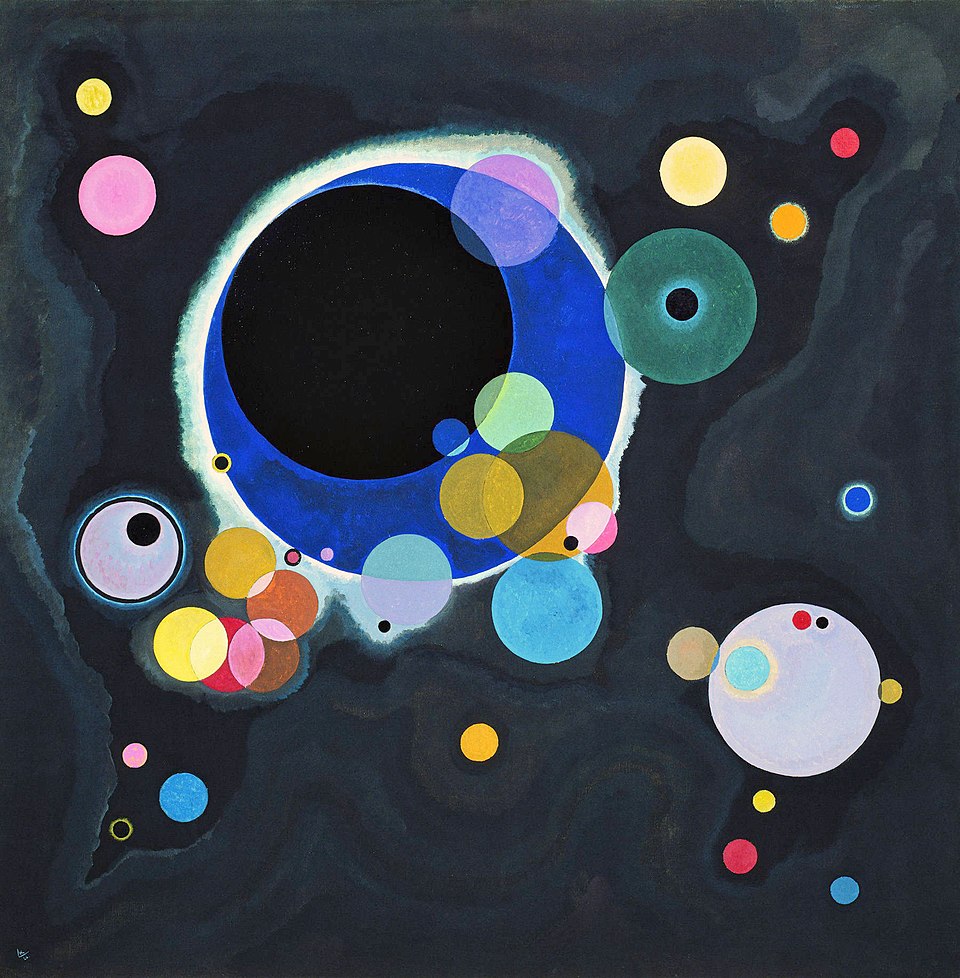
- Kandinsky painted this in January 1926 while teaching at the Bauhaus in Dessau — the canvas is enormous at 140 x 140 cm, and he reportedly worked on it in a single concentrated stretch over several days.
- The Guggenheim acquired it in 1929 directly from Hilla von Rebay, Solomon Guggenheim's art advisor, who personally convinced Guggenheim that Kandinsky was the future of painting — this was one of her first major purchases for what would become the museum.
- Kandinsky claimed he literally heard music when he looked at colors, a neurological condition called synesthesia, and the circles here map almost exactly to how he described sustained musical tones in his theoretical treatise Point and Line to Plane, published the same year.
- The painting survived the Nazi regime's 1937 purge of "degenerate art" — dozens of Kandinsky's works were confiscated from German museums, but this one was already safely in New York.
- Under close examination, art historians have noted that the black ground is not flat: Kandinsky built up the dark field in thin translucent layers, which is why the colored circles appear to glow as if backlit rather than sitting on top of the surface.
- When Kandinsky was asked which shape he considered the most perfect, he answered without hesitation: the circle, because it is simultaneously the most stable and the most unstable — it can suggest a planet, a void, or a sound wave depending on context.
More details How a square canvas made in Dessau became a cosmos without depicting a single star: the story of Kandinsky's circles, their hidden sheen, their Bauhaus setting, and the form that replaced the horseman in his imagination.
Two months in Dessau
The painting appeared as the Bauhaus began a new life
Kandinsky painted Several Circles in January and February 1926, soon after the Bauhaus moved from Weimar to Dessau. The school gained Walter Gropius's new building, while Kandinsky continued teaching the foundations of form and color. That year he and Paul Klee also became neighbors in the celebrated double Masters' House.
Geometry in his painting became stricter but not colder. Suprematism and Constructivism encouraged clear planes and contours, while Kandinsky's own theory demanded psychological and spiritual action from every form. A square canvas just over 140 centimeters wide became a laboratory in which one figure could display dozens of different characters.
No two circles behave alike
Scale, color, and overlap turn an exact shape into movement
Dozens of circles drift across the dark field: transparent ones pass through each other, small disks gather in groups, and large bodies hold the space. They are not arranged on a grid and do not depict actual planets. Even so, the eye almost inevitably reads orbits, encounters, eclipses, and stars—a cosmos appears without a literal subject.
The largest black circle seems like emptiness but acts as a heavy body. A blue halo beside it creates luminosity; tiny colored disks establish rhythm, and the diagonal spread of mass prevents the system from freezing. Order and chance remain together: space is structured, yet no trajectory feels final.
A reproduction loses half the experience
Some circles absorb light while others reflect it
The Guggenheim records a crucial technical detail. Kandinsky layered precise, transparent circles to create rich chromatic relationships, then applied varnish selectively to certain forms, especially the largest black circle. Matte and glossy surfaces therefore alternate across the canvas.
A photograph can reproduce color but largely erases the way sheen changes as a viewer moves. In the gallery, some disks remain flat while others suddenly advance or flare with reflected light. The work proves that geometric abstraction can be physical: its space is built not only by contour but by the behavior of actual paint under illumination.
The circle replaced the horseman
Kandinsky chose it for inner force, not geometrical neatness
Writing to his friend and biographer Will Grohmann, Kandinsky said his frequent use of the circle did not come from geometry but from a strong feeling for its inner force and countless variations. He compared the attachment to his earlier love of horses: the circle offered more internal possibilities and took the horse's place.
For him it reconciled opposites—concentric and eccentric, stability and movement—and pointed more clearly than the other primary forms toward a fourth dimension. The plain title is therefore deliberate. Several Circles refuses to tell us what is pictured, leaving the shape free to become point, body, sound, orbit, and time.
From Bauhaus experiment to museum emblem
The canvas entered a founding collection built around nonobjective art
The painting now belongs to the Solomon R. Guggenheim Founding Collection as object 41.283. The museum grew from the alliance of Guggenheim and artist-adviser Hilla Rebay, who collected nonobjective art as an independent spiritual language rather than a preliminary step toward depicting things.
That history helps explain why Several Circles became an emblem of the collection. It joins Bauhaus theory, close material investigation, and an experience of infinite space. The picture does not ask viewers to identify an object; it demonstrates how a minimal alphabet—a colored disk on darkness—can generate an entire universe of relationships.
Official sources
Where to verify the museum and historical context
- Several Circles: materials, date, and cosmic spaceSolomon R. Guggenheim Museum
- Kandinsky at the Bauhaus and the meaning of the circleSolomon R. Guggenheim Museum
- Kandinsky at the Bauhaus, 1922–1933Solomon R. Guggenheim Museum
- Vasily Kandinsky Research ProjectSolomon R. Guggenheim Museum
- The Guggenheim Founding CollectionSolomon R. Guggenheim Museum
- Kandinsky on the inner force of the circleCentre Pompidou
Visual context