Intro source: Centre Pompidou
Author
Wassily Kandinsky
Movement / period
Abstraction and the avant-garde
Medium
oil on canvas
Location
Centre Pompidou, Paris
When the Nazis came to power in 1933, they seized hundreds of Kandinsky's works from German museums and labeled them "degenerate art" (entartete Kunst) — Yellow-Red-Blue escaped only because it had already left Germany, purchased by a private collector before the purge began.
Highlights
Facts & legends
- The canvas is enormous — 127 by 200 centimeters — yet Kandinsky completed it in a single year at the Bauhaus in Dessau, where he was simultaneously teaching a color theory course and writing his book "Point and Line to Plane."
- When the Nazis came to power in 1933, they seized hundreds of Kandinsky's works from German museums and labeled them "degenerate art" (entartete Kunst) — Yellow-Red-Blue escaped only because it had already left Germany, purchased by a private collector.
- Kandinsky was a trained lawyer who practiced for years before picking up a serious brush at age 30, after seeing Monet's "Haystacks" in Moscow and being stunned that he couldn't immediately identify the subject — that disorientation became the seed of his entire abstract theory.
- He genuinely believed specific colors trigger specific emotional responses: yellow he described as aggressively pushing toward the viewer, blue as pulling inward and toward the spiritual, and red as a self-contained, confident warmth — in this painting all three are deliberately set in collision.
- The painting has lived at the Centre Pompidou since the museum opened in 1977, acquired as part of Nina Kandinsky's donation of her late husband's estate — she outlived him by 36 years and carefully managed how the world received his legacy.
- Kandinsky originally titled the work using the German color names — "Gelb-Rot-Blau" — and the title itself follows his theory that naming colors in order of their emotional "temperature" creates a kind of score the viewer reads before even looking at the canvas.
More details Not a classroom chart but an argument between two worlds: how Kandinsky made Bauhaus geometry sound, move and resist order.
Entering without a subject
The picture begins like a conversation in which nobody is named
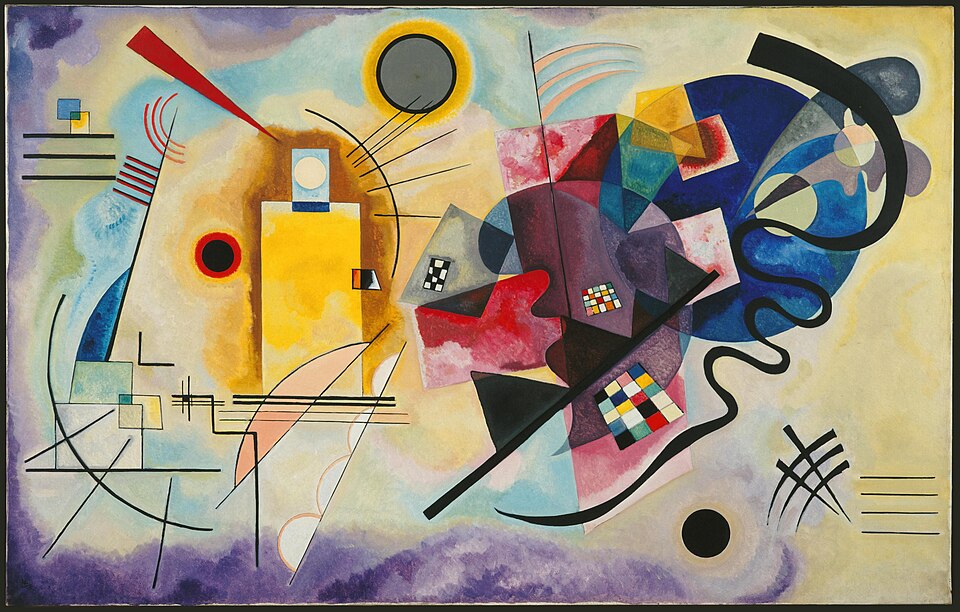
There is no landscape, figure or object to identify as the centre of the story. A luminous yellow field on the left is crossed by thin lines and sharp angles. Red forms hold the middle; on the right, a deep blue circle meets dark curves and a chequered grid. The eye tries to turn them into a face, a sun or a machine. The painting permits such guesses but confirms none. It asks what colour, weight, direction and distance are doing.
The canvas is nearly two metres wide, 128 by 201.5 centimetres. In reproduction it can resemble a clean diagram; in front of the original, transparent paint sits beside dense pigment, lines tremble and the circle is not mechanically perfect. Kandinsky did not replace painting with drafting. He made a stage on which drafting repeatedly loses control and colour behaves like an independent actor.
Bauhaus at a breaking point
It was painted between the closure in Weimar and the move to Dessau
Kandinsky began teaching at the Bauhaus in 1922, analysing point, line, plane, form and primary colour with students. Yet 1925 was not a calm laboratory year. Under political pressure, the school was leaving Weimar and preparing to reopen in Dessau. Yellow-Red-Blue was painted in Weimar from March to May, while a familiar institution was physically coming apart and its teachers had to defend its right to exist.
That context sharpens the division within the canvas. The left resembles a kit of instructional tools: straight lines, diagonals, angles and architectural crossings. The right is darker, freer and less obedient. No wall separates them. Red connects the zones and curves cross geometric order. This is not a poster for rational Bauhaus victory; Kandinsky suggests that a system remains valuable only while it leaves room for surprise.
Colour as an actor
Yellow advances, blue recedes, red sustains tension
Kandinsky described colour not as decoration attached to objects but as a force with a character. Yellow seemed warm, sharp and directed towards the viewer; blue cool, deep and inward; red stable and energetic. He associated yellow with the triangle, red with the square and blue with the circle. Those correspondences appear here, but never as a rigid classroom table. The blue circle is persuasive because unruly shapes live beside it.
The title names three primaries, while the surface contains violet, orange, green, grey and transparent overlaps. Yellow glows through white and thin black lines. Blue deepens against its dark surroundings. Red alternately condenses and breaks into accents. Colours do not fill neutral containers: they change the apparent scale of forms, pushing some forward and allowing others to fall away.
Why the painting is not the theory
Point and Line to Plane explains tools, not a master key
During his Bauhaus years Kandinsky organised his observations in Point and Line to Plane, published in 1926. The Centre Pompidou calls the canvas a visual formulation of that research: horizontals, diagonals, angles and curves can indeed be followed across it. But treating it as an illustrated textbook would miss the work. Theory describes tendencies; it does not decree that a circle must always mean one thing.
The exceptions matter most. Yellow is not confined to triangles, blue does not live only inside the circle and red refuses the square. An organic profile appears on the right, while the left-hand construction resembles both tool and creature. Kandinsky tests his system. If every sign had a fixed translation, the painting would be exhausted at first reading; instead, forms change roles according to where the eye begins.
Music without a literal melody
From the artist's musical thinking to Nina Kandinsky's gift
Kandinsky compared painting with music because music can produce tension without depicting a thing. The canvas is not a score for a specific composition. It is more useful to hear its rhythm: short lines on the left act like quick beats, the large circle sustains a low tone and red accents connect both halves. Beige and white pauses allow forms to separate and meet again. The image unfolds in time while remaining still.
Much of Kandinsky's estate remained with his widow Nina. In 1976 she donated Yellow-Red-Blue to the Musée national d'art moderne; further gifts and her bequest made the Centre Pompidou collection one of the central Kandinsky archives. The painting matters because it keeps the conflict of abstraction alive: reason builds order, vision animates it and feeling prevents the scheme from becoming final.