
Intro source: Wikipedia (EN)
Author
Pablo Picasso
Movement / period
Cubism and Political Modernism
Medium
oil on canvas
Location
Museo Reina Sofia, Madrid
During World War II, a Gestapo officer allegedly visited Picasso's Paris studio, pointed at a photo of Guernica and asked "Did you do this?" — Picasso reportedly replied "No, you did."

Highlights
Facts & legends
- Picasso completed the entire 11-foot by 25-foot canvas in just 35 days, working in a rented studio on Rue des Grands-Augustins in Paris — he had over 40 preparatory sketches done before he put a single brushstroke on the canvas.
- During World War II, a Gestapo officer allegedly visited Picasso's Paris studio, pointed at a photo of Guernica and asked "Did you do this?" — Picasso reportedly replied "No, you did."
- For decades the painting lived not in Spain but at MoMA in New York, because Picasso refused to let it return to Spain while Franco was alive; it finally arrived in Madrid in 1981, six years after the dictator's death.
- X-ray analysis has revealed at least three distinct earlier states beneath the final surface, including a more realistic depiction of a screaming soldier that Picasso overpainted and replaced with the fragmentary figures we see today.
- The canvas was rolled up and shipped from Paris to New York in 1939 on a French ocean liner, wrapped in a brown paper tube with almost no special protection — the most politically charged painting of the century traveled like luggage.
- When it was exhibited across the United States on a fundraising tour in 1939–40, the painting raised money for Spanish war refugees while American officials debated whether it was communist propaganda.
More details Three and a half metres tall, thirty-five days of work, forty-two years spent outside Spain.
What you see
A light bulb for a sun, a flower on a broken sword
Start with the size: 349.3 by 776.6 centimetres. Nearly three and a half metres tall, nearly eight wide, which means there is no spot to take it in from — you walk along it. It is oil on canvas, yet nothing gleams: Picasso had a matt, house-paint-like medium prepared for him, and the surface reads more like a painted wall than a picture. Three colours do all the work: black, white and a dozen greys, one or two of them tipping into cold blue.
On the left the bull stands upright, the only figure that does. Its head is turned back over the shoulder, both eyes crowded onto the same side of the face. Beneath it a woman throws her head back with a dead child in her arms; her tongue is a spike, and the horse at the centre has the same spike in its mouth. The horse's flank is torn open. Along the whole bottom edge lies a soldier taken apart: the head with blank eyes over here, the arm over there, the fist still closed around a snapped sword. A small flower grows out of the hilt, the one living thing in the painting.
Top right, an arm shoves an oil lamp through a broken window. Another woman hauls herself towards the centre, dragging a leg. In the far corner a figure burns, arms up, mouth open, the flames cut into flat shards. Above the horse hangs an eye whose pupil is an electric bulb ringed with saw teeth. And here is what people notice last: the horse's body is filled with tiny vertical dashes that look, close up, like lines of newsprint. Between bull and horse, nearly swallowed by shadow, a bird tips its head back. No aircraft, no bombs, no swastika, no uniforms, not a single red mark. Even the setting refuses to settle: the tiled floor says room, the burning house on the right says street. There are two light sources and they argue with each other: the electric bulb overhead and the oil lamp pushed in from the right — new lighting and old for the same catastrophe. The figures are life-size and larger, so from two paces away you are not looking at a picture but standing at a wall where everything happens at your own scale.
How it was made
Commissioned in January, handed its subject on 26 April
In January 1937 the government of the Spanish Republic commissioned a mural for its pavilion at the Paris International Exposition and advanced 150,000 francs towards costs. Picasso had no subject. He sketched his old standby — the studio, the painter, the model — and let the weeks run down.
On 26 April 1937, roughly between half past four and half past seven in the evening, waves of aircraft from the German Condor Legion and the Italian contingent came over the Basque town of Guernica: Heinkels, a Dornier, Junkers transports pressed into bombing work, Savoia-Marchettis. They dropped some 31 tonnes of ordnance, incendiaries included. About three quarters of the buildings burned. The death toll is still argued over: the Basque government announced 1,654 immediately; local historians counted 126 and later revised that to 153; most current estimates land between 250 and 400.
George Steer, who reached the ruins within hours, published his account in The Times on 28 April, and the French press picked up both the story and the photographs. Picasso made his first sketch on 1 May. He worked in the attic of 7 rue des Grands-Augustins, a studio Dora Maar had found for him; the canvas was too tall for the room and had to be tilted back against the wall.
Between 11 May and 4 June, Maar took 28 photographs — no other painting has been followed in such detail while it was being made. They show the composition changing its mind: a raised fist, empty at first, then gripping a sheaf of grain, is painted out and replaced by light; on 20 May the horse lifts its head. Infrared imaging at the Reina Sofía now brings those buried layers back up. Maar also painted some of the small vertical strokes on the horse herself. The canvas was finished on 4 June and shown in July beside Calder's Mercury Fountain and Miró's Reaper, to a cool response from Republicans who had been hoping for a poster.
Where the images come from
The bullring, the pietà and somebody else's attic
The bull and the ripped-open horse were not invented in 1937. Picasso had been carrying them for decades: the ring, the picador's doomed nag, the minotaur. The nearest ancestor is Minotauromachy, scratched into a copper plate on 23 March 1935 — a monstrous bull, a wounded horse, a woman leaning in from the right with a candle, birds at a window. Two years early, the cast is already assembled.
Closer still is The Dream and Lie of Franco: two plates of nine vignettes, begun on 8 January 1937, with the last four scenes cut on 7 June, after the big canvas was done; the prints were sold in the same pavilion to raise money for the Republic. Behind all of it sits older painting — the Reina Sofía names Goya and Delacroix — along with a pyramidal structure, a mother with a dead child that reads as a pietà, and a sprawled fighter lifted from Deposition scenes. Picasso declined to decode any of it. Talking to the young American Jerome Seckler in 1945, he said the bull was not fascism but brutality and darkness, and left the rest to whoever was looking.
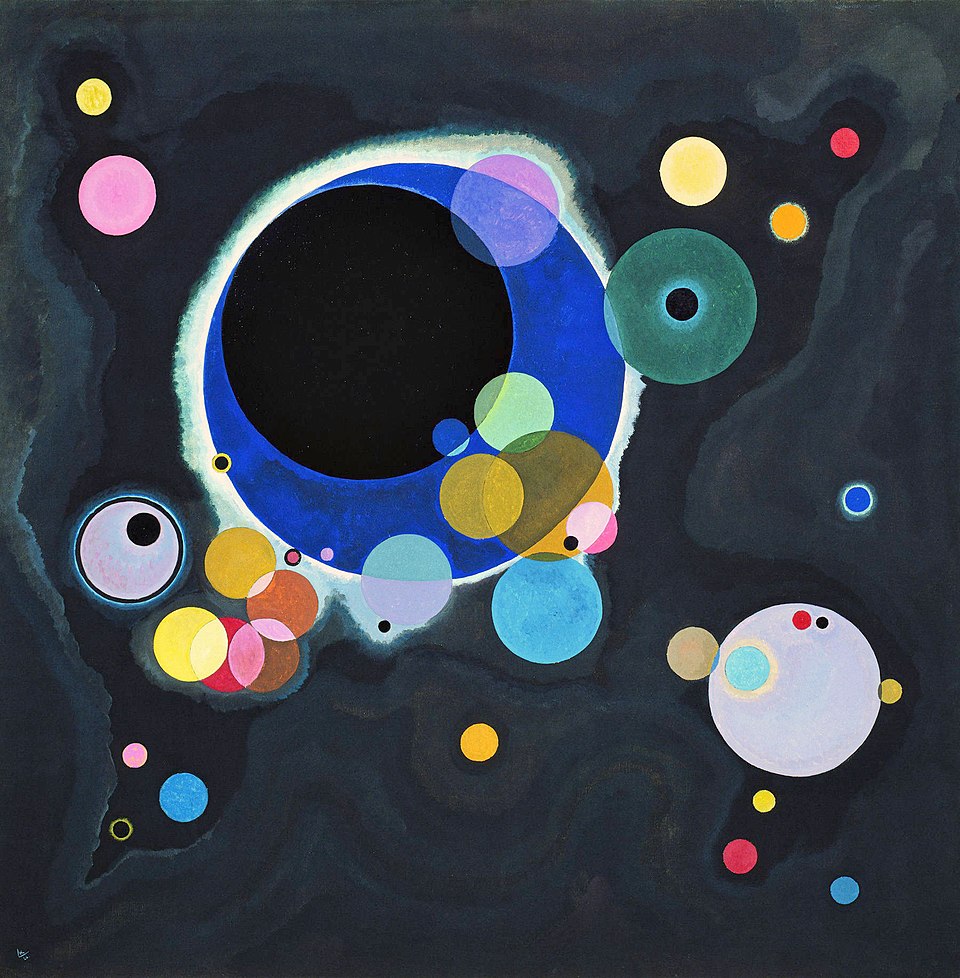
The building supplies a literary rhyme: Balzac housed Frenhofer, the painter of The Unknown Masterpiece, at that very address, and Picasso had etched illustrations for the story in 1931 on Vollard's commission. Cubism taught him to take a body apart; after that the roads fork. Kandinsky, in Composition VIII, drives geometry out of the visible world altogether, and Dalí, in The Persistence of Memory, builds a smooth, lacquered dream. Picasso breaks the figure so that every break lands on something specific: a wrenched neck, a severed hand, an open mouth. One more thread runs further back: the hatching on the horse recalls the Cubist collages of the 1910s, where Picasso glued real newspaper onto the canvas. Here the newspaper is no longer pasted on, it is painted.
What happened next
Forty-two years away from Spain
From January to April 1938 the canvas toured Scandinavia — Oslo, Copenhagen, Stockholm, Gothenburg. It reached the Whitechapel Art Gallery in London on 30 September 1938, then Leeds, Liverpool, Manchester. In May 1939 it hung at the Valentine Gallery in New York, in August in San Francisco, and that November it entered the Museum of Modern Art, where it stayed for more than forty years. Picasso left it in the museum's keeping on one condition: no delivery to Spain until liberty and democracy had returned. He died in 1973, Franco in 1975.
The travelling cost the painting dearly. In 1957 MoMA consolidated the paint layer with molten wax and resin, heated through from the back — an irreversible treatment that soaked the canvas from end to end. The stretcher was replaced in 1964. On 28 February 1974 Tony Shafrazi sprayed KILL LIES ALL across the picture in red, protesting the handling of Lieutenant Calley's case after My Lai; the varnish held and the paint came away with relative ease. Shafrazi went on to become a New York dealer.
On 10 September 1981 the painting flew to Madrid, almost in secret. From 23 October it was displayed at the Casón del Buen Retiro inside an enormous armoured glass case designed by José María García de Paredes; close to a million people came in the first year. In 1992 it moved to the Reina Sofía in a crate built for the purpose, and it now hangs in room 205.10. The survey conducted between 2011 and 2017 described a surface cracked throughout, patches at risk of flaking, and hardened wax that leaves the canvas acutely sensitive to vibration. So when the Basque government asked for it in 2026 for the Guggenheim Bilbao and the 90th anniversary of the raid, culture minister Ernest Urtasun refused on 7 April, citing the museum's report — a document that counts more than thirty past journeys, many of them made with the canvas rolled.
Its cultural afterlife
A tapestry, a blue curtain and a tiled wall in Gernika
In 1950 Alain Resnais and Robert Hessens made a thirteen-minute film called Guernica: a text by Paul Éluard, the voice of María Casarès, details of the painting cut against photographs of the ruins and newspaper headlines. In 1955 Nelson Rockefeller commissioned a woven copy — Picasso would not sell the original, but he approved the work of Jacqueline de la Baume-Dürrbach's atelier in the Var. From 13 September 1985 the tapestry hung at the entrance to the UN Security Council chamber. On 5 February 2003, the day Colin Powell made his case on Iraq, it was covered with a blue curtain; the official explanation was that television crews disliked the backdrop. The Rockefeller family took it back in February 2021 and returned it on 5 February 2022.
The town itself has never had the original. Since 1997 a full-size ceramic copy has covered a wall on Allende Salazar street in Gernika-Lumo, with a demand written underneath: Guernica to Gernika. In that same anniversary year German President Roman Herzog wrote to the survivors, acknowledging his country's responsibility and offering a hand of friendship. For years the Francoist side denied the bombing outright and insisted that retreating Basques had burned the town — and all that time the painting kept the event in plain sight.
That leaves the story everybody repeats. As the legend has it, a German officer saw a reproduction of Guernica at Picasso's place and asked whether he had done it, and the painter answered that they had. It circulates in a dozen versions — a photograph or a postcard, the studio or the flat — and no document backs any of them, so it belongs among the anecdotes rather than the facts. There is plenty on the record without it: a painting that has spent half a century as evidence in other people's arguments, and whose address is still decided at ministerial level.
Visual context


 Several Circles