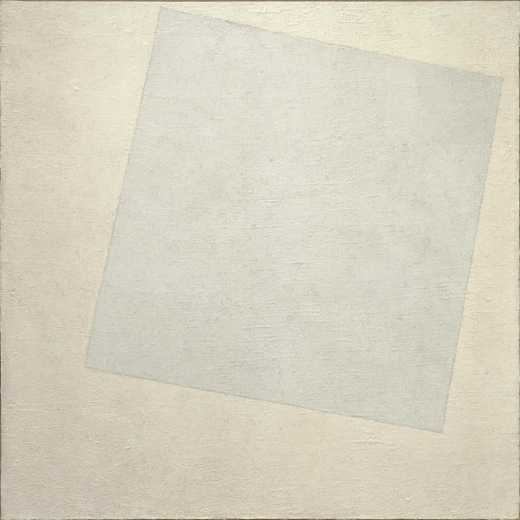
Author
Kazimir Malevich
Movement / period
Avant-Garde
Medium
painting
Location
Tretyakov Gallery, Moscow
Over decades the paint cracked, and conservators discovered earlier, more colorful compositions hidden beneath the black.

Highlights
Facts & legends
- Malevich hung the very first Black Square high in a room corner — the spot traditionally reserved in Russian homes for a holy icon.
- Over decades the paint cracked, and conservators discovered earlier, more colorful compositions hidden beneath the black.
- Under the cracks experts even found a faint pencil inscription, fueling endless debate about what Malevich first wrote there.
- He called it the 'zero of form' — painting stripped of every object, the starting point of a brand-new art he named Suprematism.
- Malevich made several versions over the years; at his funeral in 1935, a Black Square was displayed above his coffin by his wish.
Estimated value
What it is worth today
The 1915 Black Square is in Moscow's Tretyakov Gallery and not for sale. It is priceless, though other Suprematist works by Malevich have fetched up to about $85 million at auction.
More details Two paintings and a scrawled inscription lie hidden under the black paint — and the square isn't really square.
What You See
A Square That Refuses to Be One
The canvas is 79.5 by 79.5 centimeters, almost entirely covered by a dense black oil surface, with a narrow strip of pale ground left bare around the edge. The black isn't flat or glossy — the paint sits in thick, visible strokes rather than a poured, even coat, and where it's thickest the surface looks almost crusted. There's no signature, no date, no title on the front. Just the shape and the color, nothing else to look at.
Take a ruler to it and the sides turn out unequal and not quite parallel; one edge runs a few millimeters shorter than its opposite, the corners aren't true right angles, and the whole shape sits slightly askew on the canvas, as if placed by hand rather than measured. That imprecision is exactly what marks this as a painted gesture, not a geometric diagram — no compass, no straightedge. Decades later, a fine web of cracks spread across the black, and through some of those cracks paler patches show through, hinting that something else lies underneath.
Up close, the difference between "a black square" and this particular canvas becomes physical: the surface is uneven, the paint has ridged in places, brush furrows are visible, and the whole plane catches light differently depending on where you stand in the room. Photographs flatten all of this into one uniform black rectangle; in the gallery at the Tretyakov, it reads instead as a handmade, faintly restless surface.
How It Was Made
A Canvas That Used to Be a Different Painting
The idea predates 1915 by two years. In 1913, Malevich designed sets and costumes for the Futurist opera "Victory over the Sun," staged in St. Petersburg by Mikhail Matyushin and Alexei Kruchenykh; in one scene, a black square replaced the sun on the backdrop, signaling that the old, legible world had been defeated. At the time it was one theatrical detail among dozens. Malevich returned to the gesture two years later, when he needed a single painted manifesto for the new style he himself named Suprematism, from the Latin "supremus" — the highest.
Preparing for the exhibition "0.10," which opened in Petrograd on December 19, 1915, at Nadezhda Dobychina's art bureau, Malevich worked fast and apparently without much preliminary fuss — he didn't stretch a fresh canvas for the final piece but reused one that already carried a finished painting. X-ray and infrared scans carried out by Tretyakov Gallery conservators in 2015 revealed not one but two earlier compositions buried under the black: first a multicolored Cubo-Futurist arrangement of overlapping planes and fragmented objects, then a simpler, proto-Suprematist one closer to what he was ultimately trying to say. The black square, quite literally, painted over two earlier attempts rather than discarding them.
That layering and haste had a side effect conservators still study: the paint sat unevenly on grounds of different composition and drying time, and by the late 1920s a visible network of cracks had already spread across the surface. The problem was obvious enough that in 1929, preparing Malevich's solo show at the Tretyakov Gallery, the museum's staff asked him to produce a fresh, exhibition-ready version of the same composition — which became the gallery's second Black Square. The cracked original from 1915 has been kept since then as the founding, most valuable version.
Where It Came From
From Fractured Planes to One
For several years before 1915, Malevich worked as a Cubo-Futurist, breaking objects and space into shifted geometric shards, learning from French Cubism and Italian Futurism while looking for a way past mere fragmentation. One step along that road is his own Composition VIII (Composition VIII), where the object world has nearly dissolved into pure geometric planes but hasn't fully vanished — hints of things and multicolored surfaces remain. Black Square was the far sharper next step: dropping even the multicolored palette and the last traces of subject matter in favor of one shape and one color.
Seen that way, the Square isn't a lone stunt but the logical, if radical, endpoint of a movement that had been pushing European painting toward the limit of figuration for years. A kindred gesture, aimed in a very different direction, would arrive more than two decades later with Picasso's Guernica (Guernica) — another essentially monochrome manifesto-painting, made quickly and for a specific occasion, conceived as a declaration rather than an illustration. Picasso was screaming about a bombing he'd just learned of; Malevich, by contrast, was declaring the end of subject matter altogether — his square was every bit as much a protest, just aimed not at war but at the entire tradition of depiction.
What Happened to It
How the Square Outlasted Its Era
After "0.10" the canvas stayed with Malevich and toured his solo shows before entering state museum collections, as happened with much avant-garde work in the early Soviet decades. Suprematism itself had a rough ride: from the late 1920s on, Socialist Realism increasingly crowded out abstraction, and for most of the Stalin years Black Square sat in storage rather than on view — calling it a peak of Russian art only became possible after Stalin's death, and not right away even then.
Fuller recognition came during perestroika and the post-Soviet years, when the painting began appearing regularly in exhibitions at home; the 1915 original didn't travel to the West at all until 2003 — nearly ninety years without leaving Russia. For the painting's centenary in 2015–2016, the Tretyakov Gallery brought together, for the first time, every surviving authorial version of the Square along with preparatory material; the show became one of the most visited in the museum's history.
A genuine scandal touched a different version, not the Tretyakov canvas: one later authorial repetition ended up pledged as collateral at Inkombank, then caught up in a chain of debt settlements after the bank collapsed in 1998, and only state intervention plus a purchase by businessman Vladimir Potanin — who then gave the painting to the Hermitage — kept it from vanishing into an anonymous sale. The 1915 canvas in the Tretyakov has been spared that kind of drama; its real story played out not around ownership but underneath its own paint.
Its Afterlife
The Stain Everyone Keeps Arguing About
Black Square has long since escaped art history and become a figure of speech: people invoke it to describe something deliberately opaque, self-contained, or hard to justify in words. It's also, probably, the single most durable joke about modern art — versions of "I could paint that" have circulated for over a century without running dry, even though Malevich himself knew perfectly well he wasn't painting "just a black square" but a manifesto for the end of one pictorial era and the start of another.
The first responses came from Malevich's own students and allies — Ivan Klyun, Olga Rozanova, El Lissitzky, Nikolai Suetin — who carried Suprematist geometry into porcelain, book design, and architectural projects, turning black and colored planes into the visual language of Soviet avant-garde design for decades. Later, in the West, the idea of a monochrome canvas as a self-sufficient gesture resurfaced in Ad Reinhardt's black paintings of the 1950s–60s and in Yves Klein's single-color canvases — both artists acknowledged they were following a path Malevich had opened.
In late-Soviet and post-Soviet art, the Square became material for direct dialogue and parody: Sots-artists Komar and Melamid and various nonconformists of the 1970s–80s quoted or reworked the composition, arguing less with Malevich himself than with what the square had become in popular imagination — a ready-made sign anyone could repurpose. More than a century on, it remains one of the few images from twentieth-century Russian art recognizable without a caption: draw a black square on a white field, and the argument about art, deception, and the limits of painting starts on its own.
Official sources
Where to check
- Official institution site Tretyakov Gallery
Visual context