
Author
Kazimir Malevich
Movement / period
Avant-Garde
Medium
painting
Location
Museum of Modern Art, New York
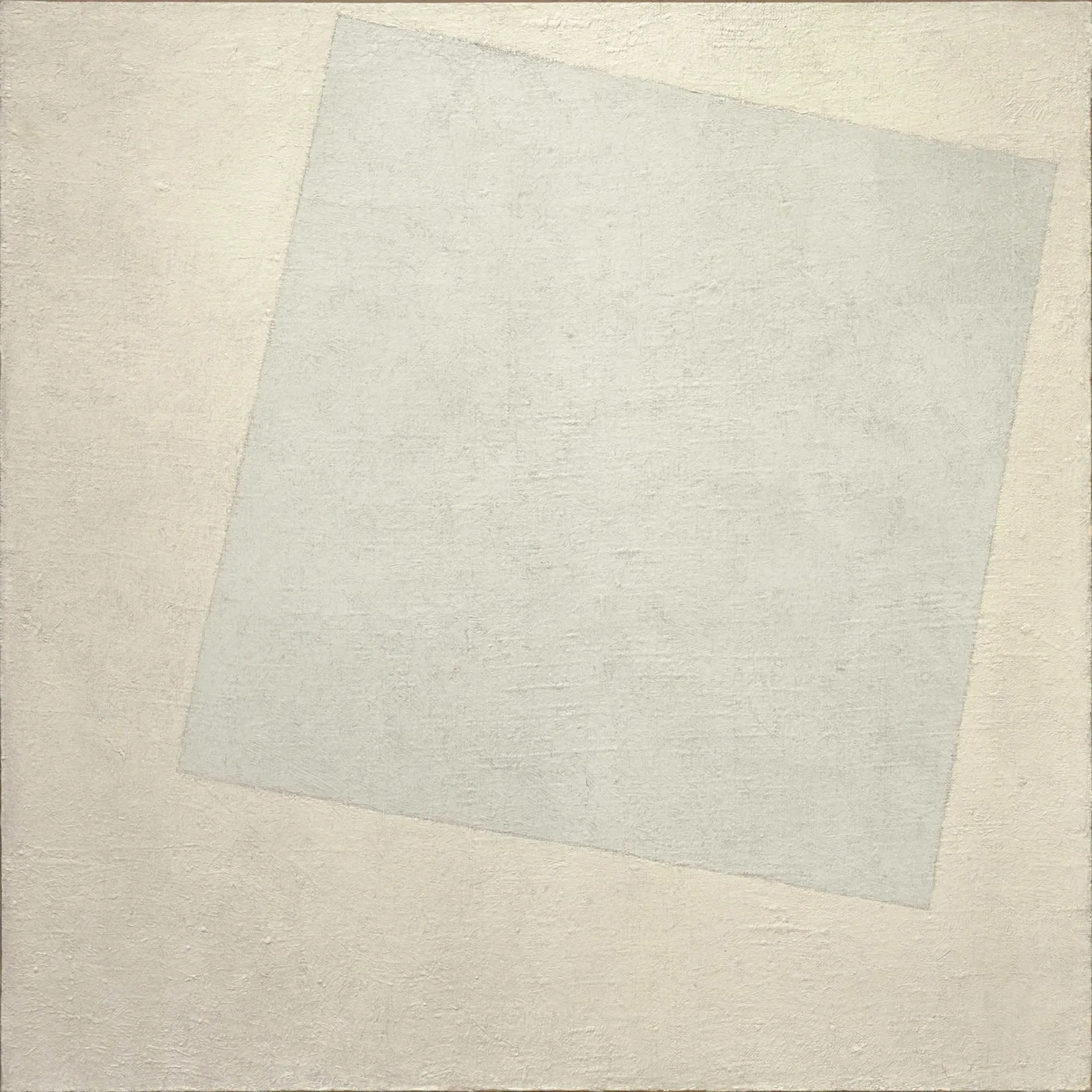
The two whites differ by a whisper: the background slightly warm, the square slightly cool and gently tilted as if drifting.
Highlights
Facts & legends
- Malevich painted a white square on a white ground — pushing painting to a near-absolute limit beyond which it seemed impossible to go.
- The two whites differ by a whisper: the background slightly warm, the square slightly cool and gently tilted as if drifting.
- It is the direct answer to his Black Square — from a black absolute he moved to white infinity and 'pure action.'
- Made in 1918, it anticipated minimalism and monochrome painting by half a century.
- For Malevich white was not emptiness but an image of boundless cosmic space dissolving all form.
More details Why White on White is not an empty canvas, how aviation helped Malevich imagine nonobjective space, and why hand-painted texture matters more than perfect geometry.
Two whites, not an absence of colour
A cooler inner square begins to move against a warmer field
In reproduction White on White can resemble a blank page. Before the canvas, difference becomes physical: the ground is slightly warmer, the inner square cooler and denser. Paint is not mechanically smooth. Brushmarks, irregularities and tonal shifts remain, forcing the eye to register very small events.
The inner form does not align with the canvas. It tilts, rises off centre and seems to shed weight. Its edge is not ruled perfectly and appears to breathe. A flawless diagram would be static; hand-made imprecision turns the square into a body afloat.
From black square to white abyss
In three years Suprematism moved from a sign to almost invisible space
Malevich publicly launched Suprematism in 1915 and placed Black Square high in the exhibition corner traditionally reserved for an icon in a Russian home. Black against white still established a forceful conflict between figure and ground. By 1918 he removed even that contrast: the square no longer sits on the field but begins to dissolve within it.
Suprematism meant the supremacy of pure feeling over the representation of things. Its geometry was not meant to signify a house, face or machine. White on White tests how much painting remains after subject, volume and strong colour have gone. It is not a final emptiness but an experiment at the medium's threshold.
The view from an airplane
The tilt belongs to a new experience of space
Malevich was fascinated by aviation and aerial photography. A view from above removed the horizon, flattened land and turned buildings and fields into detached shapes. White on White depicts no literal landscape, yet it carries a space without stable top, bottom or viewing point.
The tilt gives motion without indicating speed or destination. The square may approach, recede or rotate. Malevich treated white as the colour of infinity. The idea matters because the painting produces it: the eye finds no wall against which the form must stop.
1918 and the promise of a new world
Aesthetic release stood beside revolutionary utopia
The picture followed the 1917 Revolution, when artists debated not only a new style but a transformed life. In the manifesto accompanying the white series' first public exhibition in Moscow in 1919, Malevich invited readers to swim in a “white free abyss.” Release from objects sounded both artistic and social.
Yet the canvas is not an illustration of a political programme. Its tension lies between utopia and matter. The theory opens infinite space, while the viewer faces a canvas roughly 79 centimetres square bearing the touch of a brush. The future is announced not by a seamless machine but by a vulnerable hand.
A radical work entered a museum early
MoMA acquired it in 1935, before Malevich was familiar to American audiences
The Museum of Modern Art acquired White on White in 1935. For the young museum, this was a declaration: modernism would be told as a story of deliberate rupture. Ownership was later confirmed in a 1999 agreement with the Malevich estate.
The work is now an easy joke about “painting nothing.” That joke weakens when vision is allowed to adjust. First comes blank white, then two temperatures, tilt, texture and the unstable interval around the square. The picture does not require belief in theory; it trains attention until less becomes more.
Official sources
Where to check
- Official institution site Museum of Modern Art
- Official collection / archive Museum of Modern Art
- White on White: catalogue and curatorial textsMoMA
- Suprematism: term and artistic systemMoMA
- Kazimir Malevich and the development of SuprematismSolomon R. Guggenheim Museum
Visual context