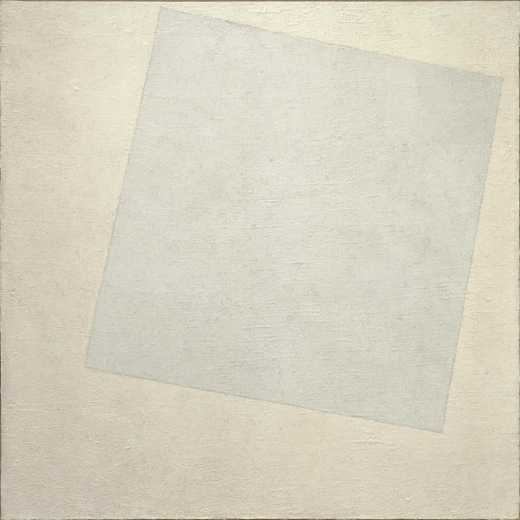
Intro source: Wikipedia (EN)
Malevich numbered and inscribed the backs of his canvases, and those notes now help experts tell real works from fakes.

Highlights
Facts & legends
- In 2018 a Suprematist Composition by Malevich sold for about 85 million dollars — a record for Russian art.
- Malevich numbered and inscribed the backs of his canvases, and those notes now help experts tell real works from fakes.
- He launched Suprematism as the 'zero of form' — pure color and geometry floating free of any real-world object.
- His heirs fought museums in court for decades over works smuggled out of the Soviet Union.
- The tilted, floating shapes were meant to convey weightlessness and cosmic space, imagined long before spaceflight.
Estimated value
What it is worth today
This very Suprematist Composition sold at Christie's in 2018 for $85,812,500, then a record for Russian art. It is now held in a private collection.
More details How Malevich turned coloured planes into a weightless universe, left the canvas in the West and, a century later, set an auction record for Russian art.
No fixed top or bottom
Geometry behaves like a cosmos
With no floor or horizon, blue, green, yellow, red and black planes appear to gather and disperse in a white void. Malevich wanted colour and form to act without representing objects.
The painting was displayed in different orientations in Warsaw and Berlin in 1927. Rotation changes gravity but not the relations between forms.
After Black Square
A radical sign became a complex system
Malevich introduced Suprematism at the 0.10 exhibition in December 1915. By 1916 a single emblem had expanded into dynamic constellations.
Edges remain painterly and asymmetry keeps the work from becoming a diagram.
A suitcase left in Berlin
The artist returned east without his paintings
Malevich took major works to Warsaw and Berlin in 1927, was ordered back to the Soviet Union and entrusted them to architect Hugo Häring. He never returned.
The Stedelijk acquired the picture around 1958, then restituted it to the artist's heirs in 2008.
Two auction records
Private ownership replaced the museum label
It sold for $60 million in 2008 and for $85,812,500 at Christie's in 2018, then a record for Russian art. The buyer was not disclosed.
Its value reflects rarity as well as a journey shaped by revolution, borders and restitution.
How to look
Follow weight, interruption and speed
The blue mass tilts, the dark beam arrests it, the green plane pulls elsewhere and small yellow-red marks quicken the eye. White is active distance, not empty wallpaper.
Imagine rotating the canvas: gravity changes while colour relationships endure.
Official sources
Where to check
- Catalogue, provenance and historyChristie's
- Malevich and the birth of SuprematismThe Malevich Society
Visual context