
Intro source: Wikipedia (EN)
Author
Artemisia Gentileschi
Movement / period
Baroque
Medium
painting
Location
Uffizi Gallery, Florence
There are actually two versions of this composition: the first (c. 1612, Capodimonte, Naples) is more tentative; the Uffizi version from 1613 is the one where Artemisia cranked up the blood, the muscle strain, and the sheer physical effort of actually overpowering and beheading a grown man — the kind of visceral struggle the earlier, more restrained version only hints at.

Highlights
Facts & legends
- Artemisia painted this in 1613, just two years after enduring a public rape trial against her teacher Agostino Tassi — the man is widely believed to be the face of Holofernes, and Judith's model was Artemisia herself.
- There are actually two versions of this composition: the first (c. 1612, Capodimonte, Naples) is more tentative; the Uffizi version from 1613 is the one where Artemisia cranked up the blood, the muscle strain, and the sheer physical effort of killing a man.
- X-ray analysis of the Naples version revealed Artemisia made significant pentimenti — she repositioned Judith's arm at least once, suggesting she kept working out exactly how a woman would hold a sword mid-decapitation.
- For about two centuries the painting sat in the Medici collections largely uncelebrated; serious critical attention to Artemisia as a distinct artistic personality only began in the 20th century, when feminist art historians in the 1970s brought her back into the conversation.
- The canvas measures 158.8 × 125.5 cm — large enough to be nearly life-size, which is part of why standing in front of it at the Uffizi hits differently than seeing a reproduction.
- Caravaggio painted the same scene around 1598–1599 (now in the Palazzo Barberini), and the comparison is instructive: his Judith looks mildly disgusted, while Artemisia's looks like she has been waiting for this moment her entire life.
More details What is actually happening on the canvas, how the Medici commission and the Tassi trial really connect, where Artemisia's bodily drama in the Caravaggesque tradition came from, how the painting survived the 1993 Uffizi bombing, and why it is now read as an icon of feminist art history.
What is happening on the canvas
A killing shown as shared physical labor, not a pose
The canvas does not show the end of an execution but its process. Judith braces her body and hauls the sword toward her; her maid Abra pins Holofernes to the bed with her full weight, gripping his wrist and shoulder with both hands. Both women's sleeves are rolled up past the elbow — a detail that reads not as a heroine posing with a trophy but as a worker in the middle of a hard physical task. Holofernes' body is twisted, one arm pressing into Abra's chest as if he were trying to push her off in this very instant — the struggle is not yet over.
The space is compressed: the crumpled sheet tilts toward the viewer, the arms of all three figures converge almost at a single point above the victim's neck, and blood shoots out in arcs, spattering Judith's sleeve and dress. The jets are not scattered at random — they echo the diagonals of the blade and forearms, turning a physiological detail into part of the drawing itself. Judith's bright yellow dress and Abra's cold blue cut through the dark background; the whiteness of the sheet sets off the red. The light picks out not the whole scene but specifically the faces, bare forearms, and folds of fabric — the points where decision and tension read fastest.
The canvas is relatively large for a subject of this kind — 146.5 by 108 cm, with the figures nearly life-size above the waist — and this is something a visitor feels physically in the gallery: from a few steps away, the viewer ends up at eye level with the scene itself, rather than looking down on it as an illustration to a text. There is no interior, landscape, or decorative drapery here: the background is almost entirely dark, and nothing distracts the eye from the three bodies and the blade.
How the work was made
A Medici commission, the Tassi trial, and a difficult road to payment
The Florentine version of Judith is usually dated to around 1620 and was commissioned by Cosimo II de' Medici, Grand Duke of Tuscany — most likely after he had seen the earlier Neapolitan version of the composition (c. 1612–1613) and wanted a version for his own collection, for the apartments of his wife, Maria Maddalena of Austria. Artemisia completed the work in Rome, where she had returned after several years in Florence; she was paid 50 scudi for it.
The commission fell in the years immediately following the 1612 trial in which Agostino Tassi, the perspective painter who had taught her, was accused of raping her; during the proceedings Artemisia herself was interrogated under torture with cords tightened around her fingers, apparently to test whether pain would make her retract her testimony. Tassi was found guilty and briefly banished from Rome. Because of this close timing, Judith is often read as a direct response to what she had lived through; but that link is an interpretation rather than a documented fact, and serious scholars, including curators at the National Gallery in London, explicitly note that it remains unproven.
The story of the payment is just as telling: when the canvas arrived in Florence, it did not immediately find a place in the grand-ducal collection, and the money promised by the court was delayed. According to the Uffizi, it was her friend Galileo Galilei — a man who moved in the same Florentine scientific and courtly circles — who helped the painter secure payment. Cosimo II died in 1621, shortly after the work was finished, so the payment episode fell in the last months of his life. Three years earlier, in 1616, Artemisia had become the first woman admitted to the Accademia del Disegno in Florence — meaning the Medici commission found her already an established professional, not a beginner.
Where this composition comes from
From Caravaggio and family tradition to Baroque bodily drama
Artemisia's direct painterly source was Caravaggio's own Judith Beheading Holofernes (c. 1598–1599, now in the Palazzo Barberini in Rome), a painting the young artist almost certainly saw and knew in detail. In Caravaggio's version the figures are arranged along a shallow stage, and Judith holds the sword at some distance from her body, recoiling slightly as if physically repelled by what she is doing. Artemisia brings the bodies together, tilts the bed toward the viewer, and makes the arms of all three figures converge almost at a single point — the drama stops being a spectacle observed from a distance and becomes a shared physical effort.
The second source is a family one. Artemisia's father, Orazio Gentileschi, who painted in a similar Caravaggesque manner, made his own Judith and Her Maidservant around 1610; the subject of Judith and Holofernes was an almost obligatory number in the repertoire of painters working in the Roman circle of Caravaggio's followers. Artemisia inherited not only the chiaroscuro technique but the very choice of subject — and pushed it to an extreme physical conviction: the bent elbows, rolled sleeves, and tense mass of the bodies explain why the killing takes time and two pairs of hands rather than a single dramatic gesture.
Tellingly, Artemisia's contemporaries were solving the problem of the 'frozen instant' outside painting as well. Bernini's sculptural group Apollo and Daphne (1622), a work from almost the same years, is built on the same Baroque principle: a body caught at the peak of motion rather than at rest. And set beside Velázquez's restrained courtly scene Las Meninas, it becomes clear how differently Italian and Spanish Baroque handled the distance between viewer and power, drama, and body: Velázquez keeps the viewer at the distance of protocol, Artemisia pulls the viewer directly into the action itself.
Provenance
From Maria Maddalena's apartments to the room shared with Caravaggio
This is not Artemisia's only Judith: an earlier, Neapolitan version (c. 1612–1613) is now held at the Museo di Capodimonte and has a separate history — its provenance before 1827, when the painting was described in the collection of Signora Saveria de Simone in Naples, is not documented at all, and the canvas itself was cropped at the top and left edge at some point. Everything described in this section concerns the other, Florentine version — the one held at the Uffizi.
After its completion around 1620, the canvas entered the collection of Cosimo II de' Medici and became part of a large group of paintings of biblical heroines decorating the rooms in the Palazzo Pitti intended for his wife, Maria Maddalena of Austria. It hung there for nearly two centuries. Toward the end of the eighteenth century, one of the Medici grand duchesses, according to the Uffizi, found the scene too violent for the formal rooms and had the painting moved to a remote, little-visited part of the gallery, where Judith remained largely forgotten until the twentieth century.
On 27 May 1993, the Mafia detonated a car bomb containing nearly 230 kilograms of explosives outside the Uffizi, on the Via dei Georgofili: five people were killed, and about a quarter of the works held in the gallery were damaged or destroyed outright, including works in the Vasari Corridor. According to several sources, Artemisia's Judith was among the damaged paintings; after restoration it returned to display. Today the canvas is listed in the Uffizi's collection under inventory number 1890, no. 1567, and hangs in room D29 — the very room where the gallery places Caravaggio and Artemisia Gentileschi together, giving her work a place among the major names of her generation rather than off to one side.
Cultural legacy
From centuries of neglect to an icon of feminist art history
The Florentine biographer Filippo Baldinucci, writing a generation later, said the painting inspired 'no small horror' — probably the earliest recorded reaction to the canvas, showing that its shock effect was deliberate and read immediately, not 'discovered' after the fact. For almost two centuries the painting stayed on the margins not only physically, in the Uffizi's back rooms, but in art history itself: Artemisia Gentileschi's name was long mentioned chiefly as 'Orazio's daughter,' and her works were sometimes confused with those of her father or his circle. Serious scholarly attention to her as an independent figure only took shape in the twentieth century, against the backdrop of a broader feminist revision of art history in the 1970s, when researchers began restoring to the canon women artists that earlier generations of historians had overlooked or undervalued.
A key role in that shift was played by Mary Garrard's 1989 monograph, which proposed reading Judith as a cathartic statement, one in which the suppressed rage of an artist who had survived the Tassi trial finds an outlet in the image of a woman physically destroying her attacker. This interpretation made the painting a textbook example in courses and articles on feminist art history — but it also drew pushback: scholars such as Griselda Pollock and Elena Ciletti have argued that tying the painting too rigidly to trauma reduces Artemisia to the role of victim and obscures her professional ambition, her mastery of composition, and her deliberate engagement with the Caravaggesque tradition.
In 2020, the major monographic exhibition Artemisia at the National Gallery in London — the artist's first solo exhibition at that museum — moved her name out of specialized feminist historiography and into the mainstream museum context. The composition itself continues to inspire contemporary artists: the Polish artist Anna Ostoya, in her series Slaying, turns the scene into something resembling a forensic crime-scene reconstruction, while Gia Del Duca's neon installation Judith's Revitalization translates the Baroque scene into a glowing three-dimensional object. The pairing of Caravaggio and Gentileschi has meanwhile become an almost obligatory example in discussions of how an artist's gender changes how the same violence on canvas is read.
Official sources
Where to check
- Official institution site The Uffizi Galleries
- Judith Beheading HolofernesUffizi Galleries
- Artemisia Gentileschi biographyNational Gallery, London
- Artemisia and biographical interpretationNational Gallery, London
Visual context
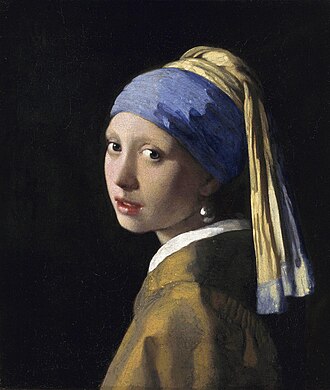 Girl with a Pearl Earring
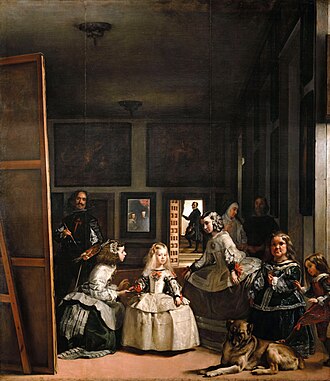 Las Meninas
