
Intro source: Wikipedia (EN)
Author
Pablo Picasso
Movement / period
Proto-Cubism
Medium
oil on canvas
Location
Museum of Modern Art (MoMA), New York
The two faces on the right are painted like African masks: Picasso had just discovered African and Iberian sculpture, and it shattered the European ideal of beauty.

Highlights
Facts & legends
- Picasso made hundreds of preparatory studies for the painting — more than for almost any other work of his.
- The two faces on the right are painted like African masks: Picasso had just discovered African and Iberian sculpture, and it shattered the European ideal of beauty.
- The canvas stayed rolled up for years and was not shown publicly until 1916 — even friends like Matisse and Braque were shocked.
- The title isn’t Picasso’s: he called it “The Avignon Brothel” (after Carrer d’Avinyó in Barcelona); a friend softened it to “Les Demoiselles d’Avignon.”
- The composition first included men — a sailor and a medical student; Picasso painted them out, leaving five women staring straight at the viewer.
More details Five nudes staring back, two faces turned into masks: the 1907 canvas that broke European painting.
On the canvas
Five women who stare straight back
The canvas is nearly square, 243.9 by 233.7 cm — taller than you are and just as wide. Five naked women fill it end to end, with no air left between them. The one on the left pulls back a dark hanging and steps in sideways: brick-red skin, the head in strict profile, the eye swivelled round to face you anyway. The two in the middle stand square on, arms flung up behind their heads, elbows in the air. It is the oldest pose in the museum, the pose of a hundred Venuses and odalisques. Except that the bodies are assembled from flat shards, and the eyes are lidless almonds set at different heights.
The two on the right look like the work of a different painter in a different year. The upper one has parallel gouges cut across cheek and nose, the face drawn out into a mask. The lower one squats with her back to us — and her head is wrenched round over her own shoulder blade to meet your eye. No spine does that, and Picasso does nothing to soften it: chin, nose and eye are separate pieces that refuse to line up.
Along the bottom edge there is a still life on a white cloth: a bunch of grapes, a pear, a wedge of melon curved like a sickle. It is the one passage painted by the old rules, and even it tips forward, as though the table had been stood on its end.
Spend a moment on the background. The blue and white folds have no weight and cast no shadow; they are as hard as sheet metal. There is no floor, no back wall, no depth — the drapery is as solid as the flesh and the flesh is as flat as the drapery. Pink, ochre and terracotta carry the colour, with blue arriving in short blows. And the truly uncomfortable part: all five look out. Not one is bathing, sleeping or lost in herself — not one is doing any of the things that European painting used to give a nude as an excuse for being there.
How it was made
809 sheets of paper for one picture
Nobody commissioned it. No deadline, no buyer, no exhibition in view: Picasso was twenty-five and painting for himself, in the Bateau-Lavoir at 13 rue Ravignan in Montmartre — an unheated timber wreck where studios went for almost nothing. The drawings began in the winter of 1906–07; MoMA dates the canvas itself to June–July 1907.
The scholars who assembled the 1988 catalogue for the Musée Picasso in Paris counted 809 preparatory sheets: drawings, watercolours, oil studies, pages torn out of pocket sketchbooks. Nothing else in his life was worked up at that length.
The composition changed out of all recognition along the way. Early versions had men in them: a sailor seated at the centre, and a medical student entering from the left, carrying a book in some sheets and a skull in others. In other words, Picasso began with a scene that had a plot and a moral attached. Both men were painted out, and the plot went with them; all that survives of the earlier arrangement is the corner of a table with fruit on it. No sitter has ever been documented — the five faces are not portraits of particular women.
X-rays show that the squatting figure's head was reworked at least twice, and that an Iberian face lies buried under the present mask. Picasso did not scrape back; he drove fresh paint over dried paint, leaving an entire earlier picture underneath this one. Pigment analysis turned up the ordinary studio kit of the period: lead white, bone black, vermilion, cadmium yellow, cobalt blue, emerald green and earth colours. He never varnished the surface — which matters, because other people later did it for him.
Where the images came from
Cézanne, Iberian stone and a suitcase of stolen goods
Start with the stone. From 1904 the Louvre had pre-Roman Iberian sculpture on show: heavy heads with enormous lids and a mouth cut in as a groove. In March 1907 Honoré-Joseph Géry-Pieret, a friend and sometime secretary of Apollinaire, walked two of those heads out of the museum. Picasso bought one; the second simply stayed with him. Fernande Olivier remembered them sitting in a studio cupboard. In 1911, after the Mona Lisa vanished and Géry-Pieret boasted in print about his thefts, the heads were handed back through the offices of Paris-Journal. Apollinaire was arrested on 7 September and released within days; Picasso was questioned as a witness. What happened on the night in between is known only from memoirs, so treat it as a story rather than a record.
The second source is Cézanne, dead in the autumn of 1906: the late bathers, with bodies sliced into planes and figures wedged into the landscape like joinery. The third is El Greco, whose Opening of the Fifth Seal Picasso had seen in Ignacio Zuloaga's Madrid studio — the vertical surge, the stretched nudes, the drapery behaving like something alive.
Then the Trocadéro. In the spring of 1907 Picasso found himself in the ethnographic museum there among African masks and figures. Almost seventy years later he described the day to André Malraux, who printed the conversation in 1974: the stench, the revulsion, and the sudden conviction that a mask is not decoration but a weapon, and that his own canvas was his first painting of exorcism. That account is a late reconstruction, not a diary entry — and in 1920, asked about African art by the magazine Action, Picasso flatly denied knowing anything about it.
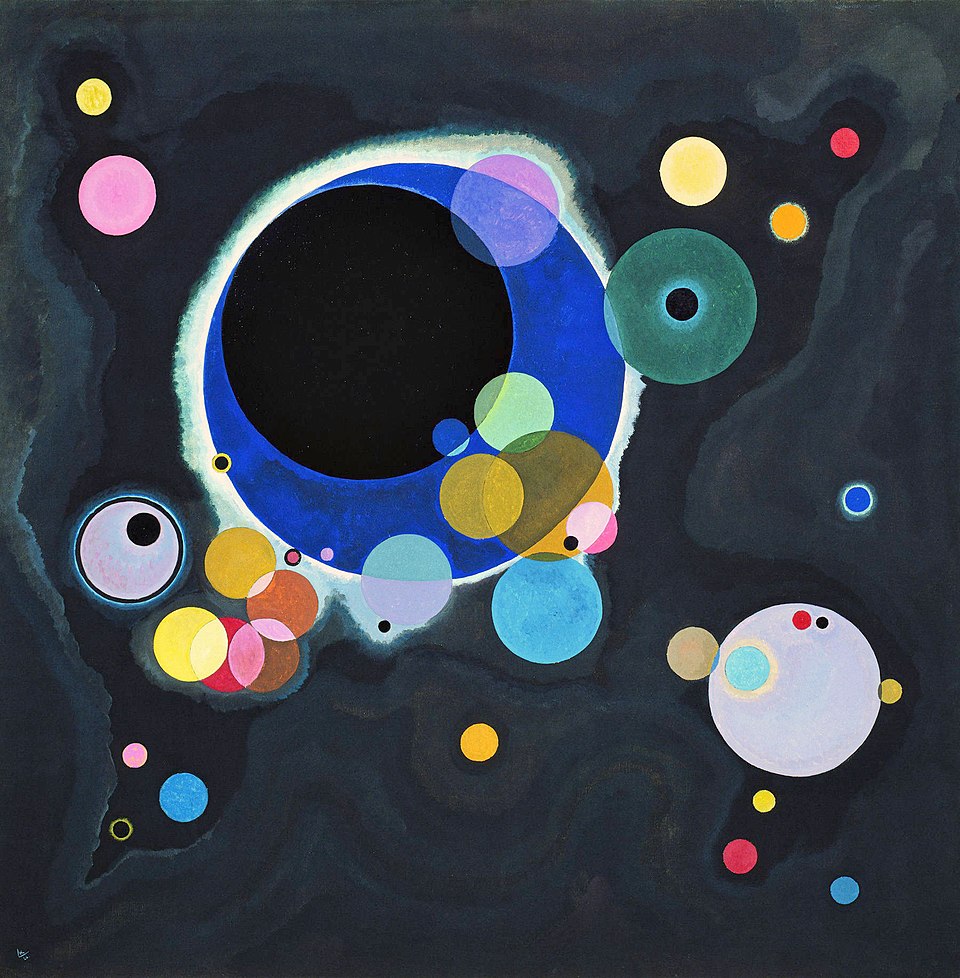
The break with likeness that starts here carries on without him. Fifteen years later it arrives at pure geometry in Kandinsky's Composition VIII, and the licence to deform a body without apology passes to the Surrealists — as far as the melting watches of Dalí's The Persistence of Memory.
What happened next
A rolled canvas, 25,000 francs and months of cotton swabs
A reproduction reached the public before the painting did: a black-and-white photograph in Gelett Burgess's article The Wild Men of Paris, published in The Architectural Record in May 1910. The canvas itself was not shown until July 1916, at the Salon d'Antin, in an exhibition of 166 works called L'Art moderne en France, put together by André Salmon. Salmon also changed the title. Picasso's own name for it was the brothel — of Avignon, or the philosophical one; the demoiselles were introduced to take the sting out of it. He went on preferring the Spanish phrase, las chicas de Avignon.
In 1924 the couturier Jacques Doucet bought it on the advice of André Breton, who was then running his collection. Sources put the price between 25,000 and 30,000 francs, modest for Picasso in the mid-twenties. One account holds that he let it go cheaply because Doucet promised to leave it to the Louvre. Doucet died in 1929, and the will said nothing about the painting.
New York followed. His widow sold the canvas to Jacques Seligmann & Co., who exhibited it in the autumn of 1937 under the banner of twenty years in the evolution of Picasso. The Museum of Modern Art paid $24,000, raising the money by selling a Degas from the collection Lillie P. Bliss had left the museum — hence the wording on the label, acquired through the Bliss bequest by exchange. Accession number 333.1939.
No theft, no vandalism, no courtroom drama. The real drama is conservation. In 1939 the picture was examined and described, nothing more. In 1950 losses were retouched and a synthetic varnish went on. In 1963 the lining canvas was impregnated with a wax-resin mixture and ironed from the back. By the early 2000s varnish and wax had yellowed and dulled the colour, and in 2003–04 conservators spent months lifting them off with solvent on cotton swabs, one swab at a time. The varnish was not put back: Picasso did not varnish his paintings, and the museum decided to respect that.
Its afterlife
A century on, artists are still answering it
The first responses came from the friends who saw it in the studio, and they were hostile. Braque is supposed to have said that looking at it felt like chewing rope and washing it down with paraffin. Derain, as Kahnweiler retold it, predicted that one day Picasso would be found hanged behind his own canvas. Matisse took the whole thing for a bad joke. Both remarks reach us through memoirs written much later, so they are not transcripts. What is not in doubt is that Braque painted his Large Nude the following year, and Cubism started from there.
Painters have kept arguing with the picture ever since. Robert Colescott rewrote it in 1985 as Les Demoiselles d'Alabama, moving the scene to the American South and swapping the melon for a watermelon, a direct hit at racist imagery. Faith Ringgold's 1991 story quilt Picasso's Studio puts a Black woman in the model's place and lets her say out loud that African forms made his reputation, not the reputation of the people who invented them.
The scholarly standing of the work has moved too. Since the 1980s it has been read through feminist criticism and through the study of colonial borrowing: the question is no longer whether the painting is good, but who is doing the looking and who paid for that freedom. MoMA now hangs it with those arguments attached rather than edited out.
For the centenary, from 9 May to 27 August 2007, the museum reunited the canvas with its preparatory studies and with the works around it; Newsweek called it the most influential artwork of the previous hundred years. It hangs today in its own room on the fifth floor, and most of what has happened to the human figure in Western art since runs back, one way or another, to those five stares. More of the artist's work is on his page.
Visual context


 Several Circles