Intro source: Wikipedia (EN)
Author
Leonardo da Vinci
Movement / period
High Renaissance
Medium
pen and ink on paper
Location
Gallerie dell'Accademia, Venice
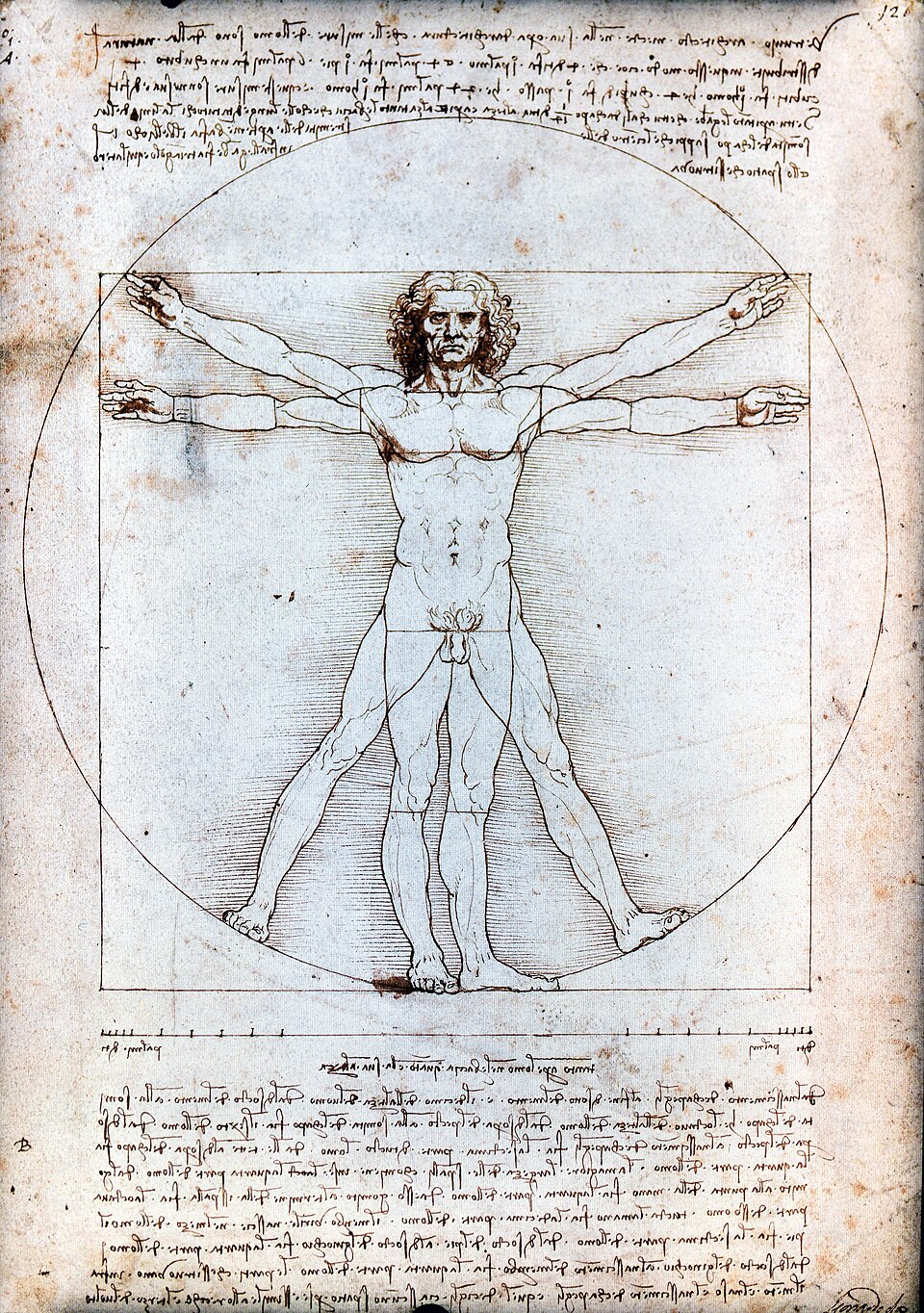
It's actually two drawings layered on one sheet: Leonardo sketched one position of the arms and legs, then overlaid the second without erasing, creating the eight-limb figure we know — the paper is only about 34 x 24 cm, roughly A4 size.
Highlights
Facts & legends
- In 2019 a Venice court, on a suit by Italia Nostra, first suspended the drawing’s loan to the Louvre but then dismissed the case — and the Vitruvian Man did travel to the Leonardo 500th-anniversary show.
- It's actually two drawings layered on one sheet: Leonardo sketched one position of the arms and legs, then overlaid the second without erasing, creating the eight-limb figure we know — the paper is only about 34 x 24 cm, roughly A4 size.
- The sheet sat in private hands for centuries before the Gallerie dell'Accademia acquired it in the 19th century; before that it passed through the estate of sculptor Giovanni Antonio Boltraffio and later the Venetian collector Giuseppe Bossi, who tried (unsuccessfully) to paint his own monumental version of it.
- Leonardo filled the margins with dense handwritten notes in his signature mirror script — right to left — detailing exact proportions: the face is one-tenth of total height, the foot is one-seventh, the forearm equals the foot.
- The model's identity has never been confirmed; a 2012 forensic anthropology study at Chieti University compared the proportions with known skeletal measurements and concluded Leonardo likely used himself as the reference — his own arm span matches the figure almost exactly.
- The drawing illustrates a specific ancient claim by Vitruvius that a well-proportioned man can be inscribed in both a circle (navel as center) and a square (genitals as center) — and Leonardo noticed these two centers don't align, quietly correcting Vitruvius rather than simply illustrating him.
More details Leonardo squared a circle no one else could, then spent five centuries hiding from the light.
What's on the page
One sheet, two men, no color at all
The sheet measures 34.4 by 24.5 centimeters, roughly the size of a large notebook page, not a canvas. There's no paint here, only pen and iron-gall ink gone rust-brown with age, a touch of wash laid over an underdrawing scored with a metal stylus. At its center stands a nude man, fitted into a circle and a square at once.
Look closer and there are actually two men, stacked on top of each other. One stands with his feet together and his arms out straight, palms brushing the sides of the square, feet planted on its base. The second is drawn over him: legs spread wide, arms raised on the diagonal, fingers and toes tracing the circle. The two shapes don't share a center, a genuinely unusual move: the circle centers on the navel, the square on the groin. Nobody before Leonardo had managed to fit one body into both figures without that split.
Dense mirror script fills the margins, running right to left, unreadable without a mirror and not meant for any viewer. It's Leonardo's own arithmetic: the ratio of a foot to a palm, a palm to a cubit, a cubit to full height. Along the top he spells out the whole chain he credits to Vitruvius: four fingers make a palm, four palms a foot, six palms a cubit, four cubits a man's height. He adds one more equation of his own: outstretched arm span equals height, the very equality that lets the figure touch all four sides of the square. Magnify the paper and you can still see pinpricks left by a compass and the ghost of the stylus beneath the ink, proof the circle and square were plotted, not eyeballed. Color barely enters into it. The page has yellowed, the ink has faded to a dull ochre. Nothing about this sheet was made to hang on a wall.
How it came together
Nobody commissioned this
Around 1490 Leonardo was pushing forty, living in Milan, on the payroll of Duke Ludovico Sforza, known as "Il Moro." No one ordered this drawing, not the court, not a church, not a publisher. It's a page out of his working notebooks, the kind where anatomy notes sit next to sketches for fortifications and gear trains. He'd already tried turning exact measurement into architecture a year or two earlier: in 1487 he entered a design for the tiburio, the crossing tower of Milan Cathedral, and built a wooden model of it, only for the commission to go to the local builders Amadeo and Dolcebuono, who handed the model back to him.
The trigger was Vitruvius: the Roman writer's "Ten Books on Architecture" claimed that a well-proportioned man's body fits into a circle and a square at the same time. Others at the Sforza court had already tried to draw that claim, including Leonardo's friend, the architect Giacomo Andrea da Ferrara, and the geometry never quite closed: give the circle and the square one shared center, and the figure either spills outside one shape or hangs loose inside it. Leonardo solved it like an engineer, by splitting the centers and adjusting the pose until one body satisfied both figures cleanly.
No preparatory studies for this sheet survive, if any ever existed. What does survive is evidence that the construction came first and the pen second: a metalpoint layer under the ink, and pinprick holes in the paper from a compass point, marking exactly where each arc began. Nobody has ever identified the model, either; no document names one, then or since.
Where it comes from
Solving a problem Vitruvius left open
Vitruvius wrote his treatise as a military engineer under Augustus, back in the first century BC, but Italy only really read him after printed editions of the "Ten Books" began circulating in the 1480s. The claim that a body's proportions follow the same laws as a building's rippled through a whole generation of humanists; Leonardo was simply the one who worked out how to draw it so the geometry actually held. The idea of fitting a man into a circle and a square wasn't new. The architect Francesco di Giorgio Martini had already tried to illustrate it in the 1480s, though his figures came out fairly crude next to Leonardo's solution. Leonardo almost certainly knew that earlier attempt firsthand: he owned a copy of Francesco di Giorgio's manuscript, and he had covered its margins with his own dense notes.
By 1490 he already had a decade of anatomical drawing behind him, done alongside commissioned portraits and altarpieces, not instead of them. The same fixation on measurement that sits out in the open here runs underneath work that looks nothing like a diagram. In the Mona Lisa, there's no compass or grid visible anywhere, yet the geometry of the face and hands answers to the same logic, just buried under paint instead of laid bare in ink.
Set beside that mathematical route to the ideal body is a completely different one: myth. Botticelli's Birth of Venus, painted a couple of decades earlier, looks for the perfect body not in measurement but in a goddess stepping out of a shell. Both painters were chasing the same Renaissance question, what a perfect human body looks like; Leonardo answered it in geometry, Botticelli in myth.
What happened to it
From a Milanese collector's shelf to a Venetian courtroom
When Leonardo died in 1519, his papers passed to his pupil and heir Francesco Melzi. From there the trail is unusually clean: by the seventeenth century the sheet belonged to the Milanese collector Cesare Monti, then to his heir Anna Luisa Monti, then in 1777 to Venanzio de Pagave and later his son Gaudenzio. Gaudenzio sold it to the painter and collector Giuseppe Bossi, who published and illustrated it in his own 1810 study of the Last Supper, the moment the drawing became genuinely known beyond a handful of private owners.
Bossi died in 1818, and Austrian authorities bought his entire collection, roughly 1,800 drawings, for the newly founded Academy of Fine Arts in Venice. The sheet formally entered the Gallerie dell'Accademia in 1822 and has stayed in the city ever since, though it's rarely shown: the paper is too fragile and the ink too light-sensitive for anything but brief, tightly limited appearances every several years. It surfaced in 2009 for the show "Leonardo: Vitruvian Man Between Art and Science," then again in 2013 for "Leonardo da Vinci: The Universal Man," its first public appearance in nearly thirty years. The next such showing didn't come until 2025, for the exhibition "Corpi Moderni."
The loudest chapter came in 2019. The Louvre was assembling a retrospective for the 500th anniversary of Leonardo's death and asked to borrow the sheet. The heritage group Italia Nostra sued in a Venice court, arguing the trip would damage irreplaceable paper. A judge suspended the loan, then, weeks before the show opened, an appeals court threw the suit out. The drawing went to Paris under strict lighting limits and a fixed display window, and the Louvre sent two Raphael paintings to Rome in return, for Raphael's own anniversary that year.
Its afterlife
The man everyone carries in their pocket
Since 2002 the drawing has ridden around in Italian wallets: Italy put it on the one-euro coin, the most-used denomination there is, and polls have repeatedly voted it the best-looking coin in the whole eurozone. A page from a private fifteenth-century notebook turned into one of the most reproduced images of the human body ever made; not much else comes close.
The figure in the circle and square broke loose from the actual sheet a long time ago and became shorthand for "a human being, generically": it shows up on hospital signage, fitness-brand logos, tech company branding, and endless parodies swapping the man for a robot, an athlete, a superhero in the same pose. Dan Brown's "The Da Vinci Code," in 2003, wrapped the image in golden-ratio mysticism and conspiracy, and after that it was recognized well outside art-history circles entirely.
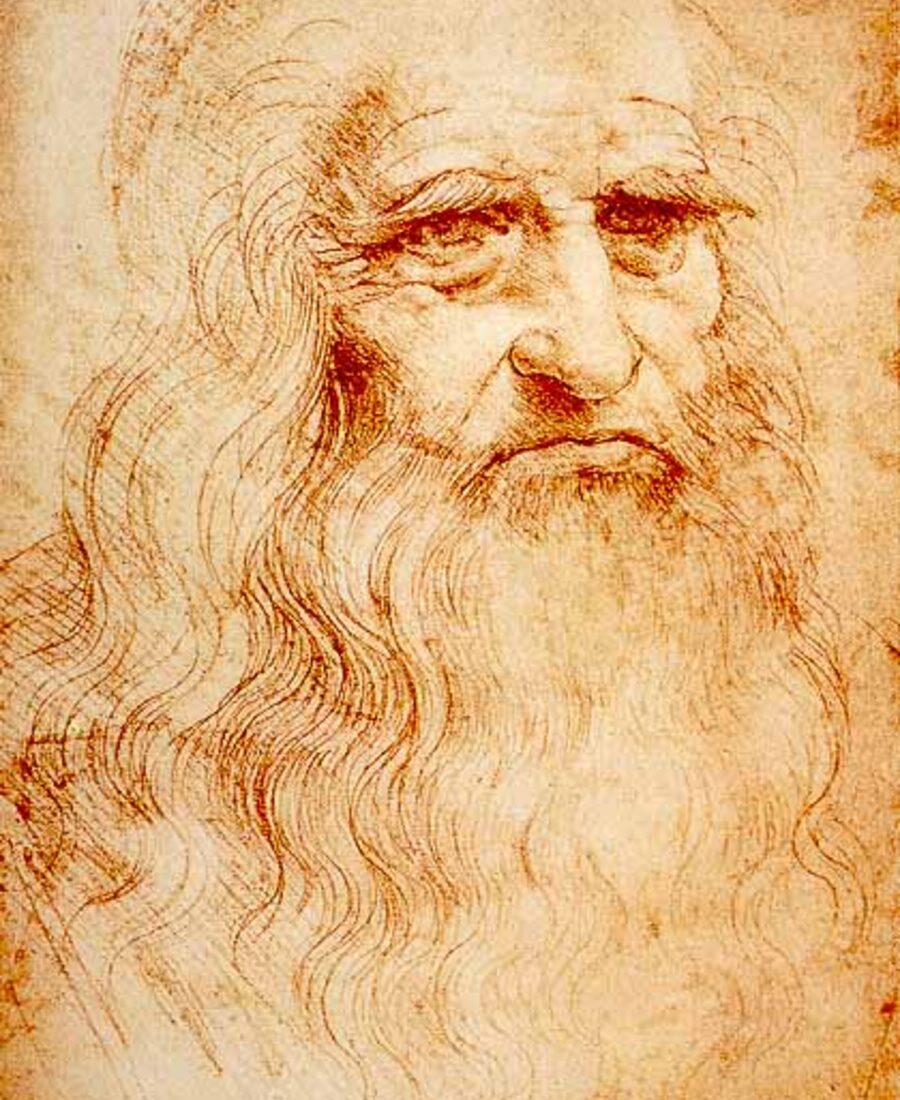
Who actually posed for it is still unsettled. One theory holds it's a self-portrait: Leonardo was around forty when he drew it, and the face echoes other likenesses believed to be his own. Another points to Salai, his longtime pupil and companion. Most scholars, including the art historian Martin Kemp, argue it isn't a portrait at all but an idealized, generalized figure, meaning the question has no answer coming. A third, less flattering theory holds that the model was a corpse: Leonardo did attend dissections, and could have taken the measurements from a cadaver rather than a living sitter. Meanwhile almost nobody has seen the actual sheet in person: it spends its years in the dark of storage, known to the world only through reproductions.
Official sources
Where to check
- Official institution site Gallerie dell'Accademia
Visual context