
Intro source: Wikipedia (EN)
Author
Leonardo da Vinci
Movement / period
High Renaissance
Medium
oil on poplar panel
Location
Louvre, Paris
The Mona Lisa is smaller than people expect — just 77 × 53 cm — though that’s noticeably larger than A2, closer to between A2 and A1.

Highlights
Facts & legends
- In August 1911, an Italian handyman named Vincenzo Peruggia walked out of the Louvre with the Mona Lisa hidden under his coat — the painting was missing for over two years before he tried to sell it to a Florence art dealer and got caught.
- The Mona Lisa is smaller than people expect — just 77 × 53 cm — though that’s noticeably larger than A2, closer to between A2 and A1.
- Under infrared and multispectral imaging, researchers have found at least three distinct compositional stages beneath the surface, including a version of the hands in a different position and what may be an earlier, more upright pose.
- She has no eyebrows and barely any eyelashes — this is not an oversight but almost certainly the result of overzealous cleaning sometime in the painting's 500-year history, since a high-resolution 2007 scan by engineer Pascal Cotte detected faint pigment traces where they once were.
- There was no gunshot: in 1956 the Mona Lisa was first splashed with acid, then the Bolivian Ugo Ungaza Villegas threw a rock at it, damaging the paint near the elbow. It was glazed for protection afterward.
- The panel is cracking: a horizontal split runs across the top third of the poplar board, and a full-time conservator monitors it because the wood continues to move with humidity changes inside the Louvre's climate-controlled room.
Estimated value
What it is worth today
The Mona Lisa can't be bought — it is not for sale and considered priceless. It was insured at $100 million back in 1962 (a Guinness record); adjusted for inflation that is over $1 billion today. The Louvre will never put it up for auction.
More details The panel Leonardo never delivered: thirty layers of glaze, a theft in 1911, and bulletproof glass.
On the panel
A balcony, two columns and a bridge over the water
It is wood, not canvas. A single poplar plank a little over a centimetre thick — the Louvre catalogues it at 79.4 by 53.4 cm, of which roughly 77 by 53 carries paint. The sitter is in a chair with an armrest, her body turned three-quarters away, her face brought back towards us. The right hand rests across the left wrist. She wears no jewellery at all: no rings, no earrings, no chain. A dark gown, gathered yellow sleeves, a narrow band of interlaced embroidery along the neckline, and over her hair a veil of gauze so fine that the eye skates past its edge on her forehead.
She has no eyebrows and no eyelashes. Vasari described them in detail in 1550; the panel has none. Whether centuries of cleaning wore them away or Leonardo never finished them is still argued over.
At either edge, hard against the frame, sit the bases of two small columns — the reason generations assumed the panel had been sawn down. Behind the parapet the land opens up: a road winding off to the left, a multi-arched bridge to the right, then lakes and blue mountains dissolving into haze. The horizon does not line up. It sits lower on the left than on the right, so the figure seems to shift slightly depending on which side of her you look past. The colour is not the colour that was mixed, either: darkened varnish has pulled everything towards brown and gold and eaten the cool greens underneath.
How it was made
Thirty coats of glaze, half a hair thick
No contract survives. The firmest evidence is a note scribbled in a margin. In October 1503 a Florentine chancery official, Agostino Vespucci, compared Leonardo to Apelles and mentioned in passing that he was at work on the head of Lisa del Giocondo. He wrote it into a 1477 edition of Cicero's letters, and the book sat quietly in the Heidelberg University Library until Armin Schlechter came across the line in 2005 while cataloguing incunabula for an exhibition. Lisa Gherardini was born in 1479 and married the silk merchant Francesco del Giocondo at sixteen. The commission is usually tied to the birth of their son Andrea in 1502, or to the purchase of a house — both remain guesses.
In 2010 Philippe Walter's team ran X-ray fluorescence over the faces in seven Leonardos and published the numbers. Up to thirty translucent glazes, each one or two microns thick; the whole stack under forty microns, about half the width of a human hair. Almost no individual brushstroke reads on the surface. That is what sfumato costs: not a trick of the wrist but months of building shadow one film at a time.
Leonardo never handed the picture over. Vasari says he worked on it for four years and left it unfinished. When he moved to France in 1516 the panel went with him; in October 1517 Antonio de Beatis, secretary to the Cardinal of Aragon, saw it at Cloux, near Amboise. The plank is a single piece, with no joins. A crack runs down from the top edge to the sitter's hairline; somewhere between the eighteenth and nineteenth century a restorer stopped it with two walnut butterfly inlays. A flexible oak frame was added in 1951, cross-braces in 1970.
Where the images come from
What Leonardo took from the Flemish
His first portrait was Ginevra de' Benci, painted in Verrocchio's workshop around 1474–78. The three-quarter turn is already there, in place of the profile Florence still treated as standard, and so is the landscape behind the shoulder. But the panel was later trimmed at the bottom by something like nine centimetres, and her hands went with the offcut. Thirty years on Leonardo returned to the same formula and this time built the whole picture around the hands.
The turned pose, hands on a parapet, distance opening behind: that idea travelled south from the Netherlands along the banking routes between Bruges and Florence. As early as 1434 Jan van Eyck had shown in the Arnolfini Portrait what oil could do that egg tempera could not — light that seems to pass through the paint rather than settle on top of it. Italian painters saw pictures like it in Florentine collections and taught themselves.
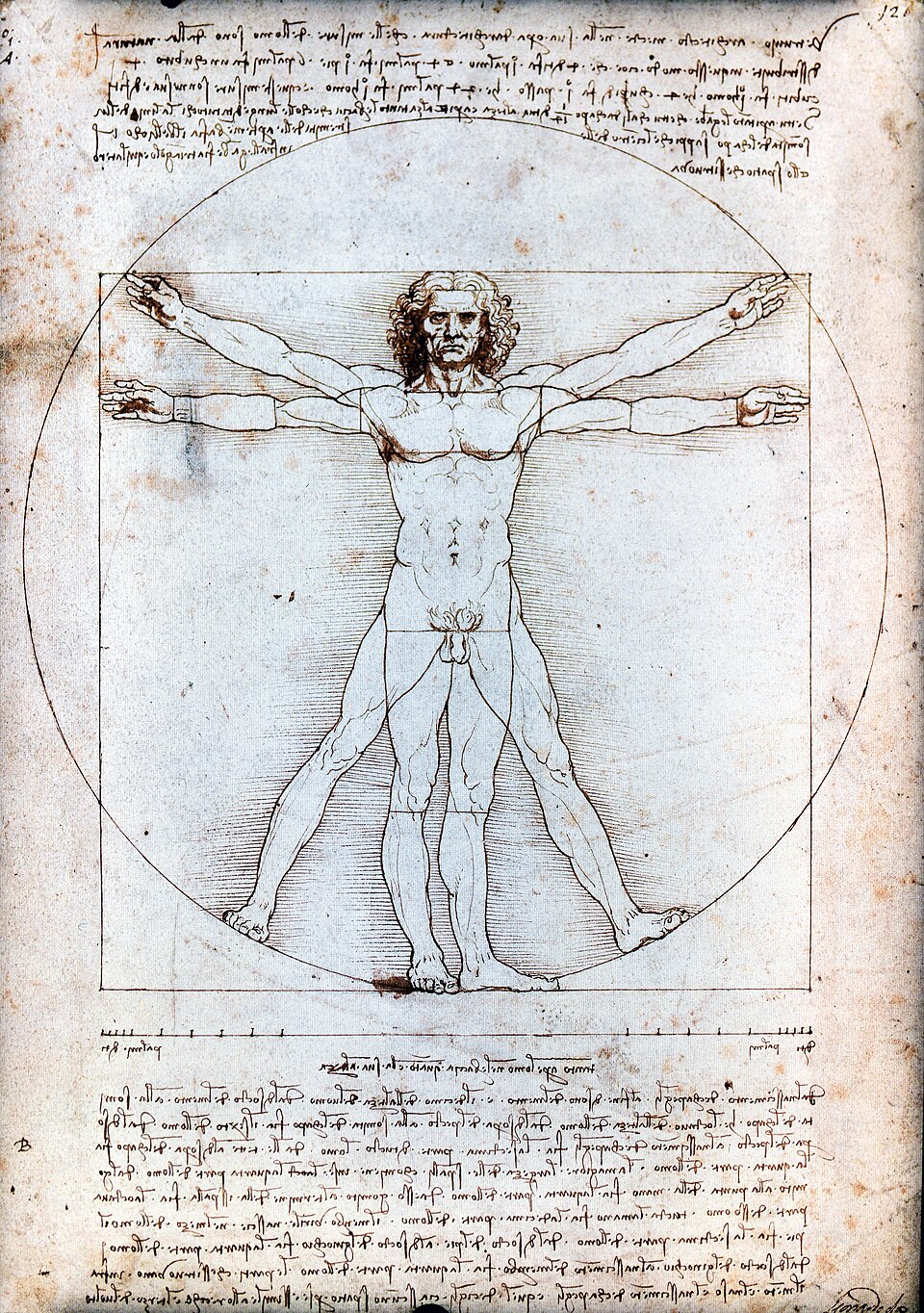
The other source is his own notebooks. By about 1490 he had drawn Vitruvian Man and was measuring the body against circle and square; later he dissected heads and drew the muscles that pull the corner of the mouth. That smile was painted by someone who knew exactly what lies under the skin. The same notebooks state the rule he applies to the mountains: distance eats the outline and turns everything blue.
What happened next
Five centuries of moving house, acid and a bowl of soup
The client never got the painting. Francis I acquired it in 1518 — the Louvre relies on a royal receipt of that year — for a sum sources put at 4,000 écus. It hung at Fontainebleau, moved to Versailles under Louis XIV, and entered the new museum in the Louvre in 1793.
Peruggia was caught in Florence on 11 December 1913, after offering the panel to the dealer Alfredo Geri. It was shown at the Uffizi for a few weeks, then returned to Paris on 4 January 1914. An Italian court gave him a year and fifteen days; he served roughly seven months.
1956 was a bad year twice over: acid thrown at the lower part while the picture was on show in Montauban, and on 30 December a rock from the Bolivian Ugo Ungaza Villegas. In 1962–63 it crossed the Atlantic with a valuation of 100 million dollars — still the Guinness record for an insurance valuation on a work of art. Washington's National Gallery showed it from 8 January to 3 February 1963, the Metropolitan from 7 February to 4 March; close to two million people queued. Tokyo and Moscow followed in 1974, and in Tokyo, on 21 April, Tomoko Yonezu sprayed red paint at the glass in protest against a museum that would not let disabled visitors in to see it. She was fined 3,000 yen; the paint never reached the wood.
Since 6 April 2005 it has had a wall to itself in the Salle des États, in an armoured case at 50% ±10% humidity and 18–21 degrees, lit by an LED lamp since 2013. That glass has since taken a ceramic mug (2009), a slice of cake (2022) and a bowl of soup (2024). In January 2025 the Louvre announced its New Renaissance plan: by 2031 the painting moves to a room of its own beneath the Cour Carrée, with a separate ticket.
Its life in culture
A postcard, a moustache and thirty identical Lisas
In 1919, the four-hundredth anniversary of Leonardo's death, Marcel Duchamp bought a cheap reproduction postcard, drew a moustache and goatee on it in pencil, and titled it with five letters: L.H.O.O.Q. Read aloud in French they make a crude sentence. A whole genre started there — the painting stopped being an image and became raw material.
In 1950 Jay Livingston and Ray Evans wrote "Mona Lisa" for the film Captain Carey, U.S.A.; it took the Oscar for best original song, and Nat King Cole's recording sat at number one on the Billboard chart for eight weeks. In 1954 Philippe Halsman built a photomontage that gave her Salvador Dalí's eyes and moustache, with Dalí's own hands full of coins coming out of the sleeves. In 1963, straight after the American tour, Andy Warhol silkscreened thirty identical black-and-white Lisas onto one canvas and called it Thirty Are Better Than One.
In 2012 the Prado finished cleaning a version painted in Leonardo's workshop alongside the original: under the blackened overpaint were bright colours and, this time, eyebrows. It is the closest thing we have to how the panel looked in the 1510s. In 2018 Beyoncé and Jay-Z shot the video for "Apeshit" overnight in a closed Louvre and stood in front of her in the opening frame; the museum reported record attendance afterwards. By the Louvre's own count, around 80% of ticket-holders end up in the Salle des États. Only The Birth of Venus is reproduced on anything like the same scale — but nobody has ever stolen the Botticelli, and it does not need bulletproof glass.
Official sources
Where to check
- Official institution site The Louvre
- Official collection / archive The Louvre
Visual context


 Vitruvian Man

