
Intro source: Uffizi
Author
Sandro Botticelli
Movement / period
Early Renaissance
Medium
tempera on canvas
Location
Uffizi Gallery, Florence
The model for Venus is widely believed to have been Simonetta Vespucci, a Genoese noblewoman who died of tuberculosis at 23 in 1476 and was so beloved in Florence that the entire city reportedly mourned her.

Highlights
Facts & legends
- The painting is enormous — roughly 172 by 278 cm — and Botticelli painted it on canvas rather than a wooden panel, which was highly unusual for Florence in the 1480s; the choice made the work lighter and easier to move between Medici villas.
- The model for Venus is widely believed to have been Simonetta Vespucci, a Genoese noblewoman who died of tuberculosis at 23 in 1476 and was so beloved in Florence that the entire city reportedly mourned her.
- The painting vanished from public record for almost 200 years after Botticelli's death in 1510 — it wasn't mentioned in any major inventory until Giorgio Vasari rediscovered it at the Medici Villa di Castello in the 1550s.
- Venus's neck is anatomically too long and her left shoulder drops at an impossible angle — Botticelli distorted the body deliberately so the silhouette would read as a flowing, unbroken S-curve from a distance.
- In the late 1980s, conservators discovered that Botticelli used a varnish containing egg white to give certain areas a subtle sheen — a technique not documented in any of his other surviving works.
- The painting hung for centuries in Medici private quarters rather than any gallery, which is partly why it survived in such good condition; it was never treated as a public showpiece until the Uffizi formally displayed it in the 19th century.
More details Nine feet of tempera on canvas: impossible anatomy, a wartime castle, a Mafia bomb and Adobe's logo.
On the canvas
A shell that could never float
The canvas runs 172.5 by 278.5 cm, roughly nine feet across, and Venus stands close to life size. It is two lengths of cloth stitched together before a drop of paint went on, so the scale of the scene was settled in advance. The ground beneath is gesso tinted blue, and it still glows up through the thin tempera.
Left of centre, two figures tangle in mid-air: Zephyr, the west wind, dark-winged, and a female companion whom scholars call Aura or Chloris, an argument that has never quite closed. Their breath is drawn as fine white lines, like scratches across the air. Roses travel with the gust, each given a gold heart. On the shore at right a Hora, goddess of a season, waits with a flowered mantle. Look at her feet: infrared work found an earlier state there, low classical sandals that Botticelli painted and then removed.
The sea is not observed, it is designed. Identical white chevrons repeat across the whole surface like a woven pattern. Beyond the waterline stand reeds and orange trees in white blossom; Florentines called the orange mala medica, and nobody at the time missed the pun on the patrons' name. Gold is everywhere too, in hair, wings, the ribs of the shell, tree trunks and cloth. It went on last, after the picture had been framed.
And here is what most eyes slide past: nobody can stand like that. The neck is longer than a neck, the left shoulder falls away at an impossible angle, the left arm meets the torso in defiance of anatomy, and no weight rests on the feet. The pose descends from antique Venus pudica statues; the distortions are Botticelli's own, traded knowingly for an unbroken contour.
How it was made
No contract, no receipt, no date
Not one document survives for the Birth of Venus: no contract, no record of payment, no mention in a letter. The first solid trace comes decades after the painter's death, when Giorgio Vasari saw the picture at the Medici villa at Castello and described it in his Lives, before 1550. Everything earlier is reconstruction.
In 1908 Herbert Horne proposed Lorenzo di Pierfrancesco de' Medici, who bought Castello in 1477, as the patron. It is a tidy theory with no paperwork under it, and there is a counter-argument: the 1499 inventory of Lorenzo di Pierfrancesco's property, published only in 1975, lists the Primavera and says nothing about a Venus. The canvas may have reached the family later.
The support tells you what the picture was for. Canvas was cheaper and lighter than panel, the normal choice for furnishing a country villa rather than a town palace; the Primavera, painted on wood, is slightly larger and vastly heavier. A varnish, probably egg-based, sits over the paint and has protected it better than fifteenth-century tempera has any right to expect. There have still been losses: the greens have darkened badly over the centuries and the blues of sea and sky have faded, while the strips that sat under the frame keep their original pitch.
A restoration in 1987, led by Alfio Del Serra, came with reflectography that caught Botticelli changing his mind mid-work: the size of Venus's eyes, the torso of Zephyr, the hair of the flying pair, a collar added to the Hora's cloak.
As for the model, one name is always offered: Simonetta Vespucci, who died in Florence in 1476 at twenty-three. That is tradition, not evidence. No document ties her to this canvas, painted roughly a decade after she died. Even her death is still argued over: in 2026, in Endocrinology, Diabetes & Metabolism, Paolo Pozzilli's group proposed pituitary apoplexy in place of the usual tuberculosis. A hypothesis too, with no tissue and no scans to test it.
Where the images come from
Rebuilding a picture nobody alive had seen
Botticelli was Alessandro di Mariano Filipepi, born in Florence around 1445 and apprenticed as a teenager to Fra Filippo Lippi. His first documented work is the Fortitude of 1470, slotted into somebody else's series of Virtues for the merchants' tribunal. In 1481-82 he was in Rome painting in the Sistine Chapel, where antiquity was not a book but the street outside. Back home, around 1482, he produced the Primavera with the same cast: Venus, Zephyr, wind, flowers, a goddess of the season.
The literary backing comes in layers. Angelo Poliziano's Stanze per la giostra, begun after Giuliano de' Medici's joust of 1475, stages the same arrival with wind, roses and welcoming goddesses. The Homeric Hymn to Aphrodite, where the Horae dress the goddess risen from the sea, matches even more closely, but the Greek text was not printed in Florence until 1488, after the painting. The story reached the painter through talk in a humanist circle, not off a page.
The most ambitious source is one nobody could see. Pliny the Elder described the Aphrodite Anadyomene of Apelles, the most celebrated painting of Greek antiquity, eventually destroyed by damp. Rebuilding a lost masterpiece from a verbal description was exactly the contest with the ancients that Florentine humanists prized.
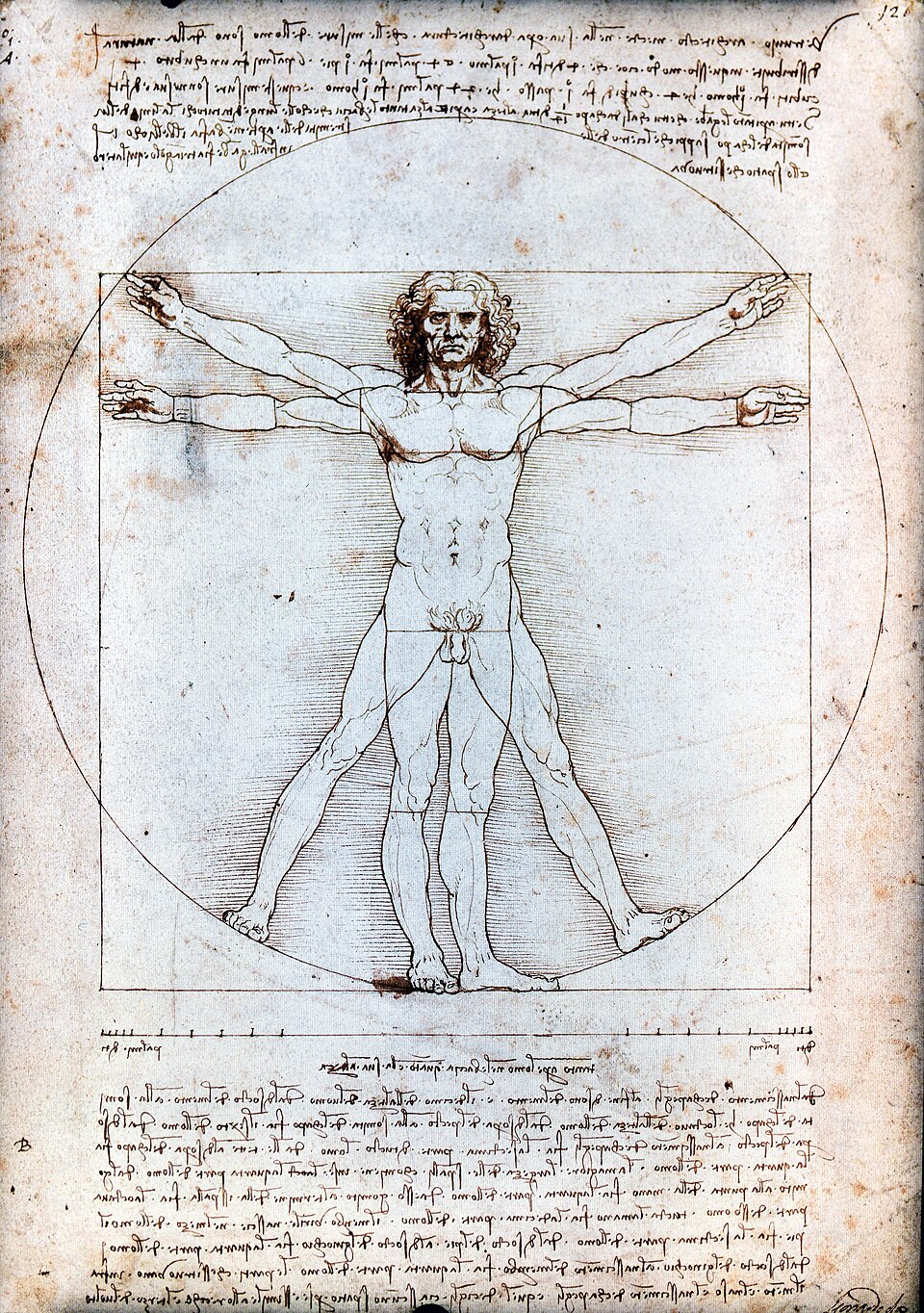
Set against his contemporaries, the distance is easy to measure. A few years later Leonardo would draw the Vitruvian Man, the body as a system of measurable ratios; Botticelli breaks those ratios on purpose, because line matters more to him. Half a century earlier in the north, Van Eyck built the Arnolfini Portrait out of oil, reflections and surface texture. There is not a single convincing shadow on the body of Venus, only contour and light.
What happened next
Three centuries in the country, then a war and a bomb
From its first appearance in the record until 1815 the painting stayed at Castello, some three hundred years out of public sight. In 1815 it moved to the Galleria dell'Accademia, and only in 1919 did it enter the Uffizi, where it hangs today under inventory 1890 no. 878.
By then its author had dropped out of history altogether. A 1602 decree by Grand Duke Ferdinand banned the export of works by Florence's most important painters; Botticelli's name was not on the list. The English brought him back. Edward Burne-Jones noticed his work in Italy as early as 1859, Walter Pater observed in 1870 that the name was only beginning to matter, and Ruskin followed.
The war nearly ended the story. Between November 1942 and January 1943 thousands of crates left Florence for the countryside; the Birth of Venus went to the castle of Poppi in the Casentino, the Primavera to Montegufoni. In the summer and autumn of 1944 the front came through that landscape. The pictures returned to the city after the liberation.
At 1.04 in the morning of 27 May 1993 a car bomb went off in Via dei Georgofili, immediately beside the Uffizi, a Mafia attack. Five people died, among them a nine-year-old girl and a newborn. Some 173 paintings and 56 sculptures were damaged and three canvases by followers of Caravaggio were destroyed outright. The Venus survived behind the protective glazing that visitors normally complain about.
On 13 February 2024 two Ultima Generazione activists taped photographs of the Campi Bisenzio flood to that same glass. The images came off without a mark and the room reopened within about a quarter of an hour.
Its afterlife
The face that loaded with the software
Adobe shipped Illustrator in 1987 and licensed a fragment of the painting from the Bettmann Archive: the face of Venus. John Warnock wanted a Renaissance image, having cast PostScript as a second age of printing. Luanne Seymour Cohen, who handled the early marketing, picked the hair, because those long unbroken strands were the perfect demonstration of tracing curves over a bitmap. Venus stayed on the splash screen until Illustrator CS in 2003, then retreated into an easter egg.
Since 2002 she has also been on the Italian ten-cent euro coin, a detail ringed by twelve stars, engraved by Claudia Momoni. The coin circulates across the eurozone, which probably makes it the most reproduced Renaissance image ever struck.
Pop culture took the rest. Warhol screenprinted details of Renaissance paintings in 1984, Venus's head repeating in acid colours. Uma Thurman rose from the shell in Terry Gilliam's Adventures of Baron Munchausen in 1988. Lady Gaga built the Applause video on the same iconography in 2013.
The cost of that fame showed in 2023. Italy's tourism ministry and the national board ENIT launched Open to Meraviglia, a campaign of roughly nine million euros in which Venus appeared in a miniskirt with a phone and a slice of pizza as a virtual influencer. Art historians hit back hard: Tomaso Montanari called the result grotesque, and the critic Vittorio Sgarbi remarked that there had been no need to dress the goddess at all. The row was less about taste than about who owns an image that became common property long before copyright existed.
In room A9 the crowd is permanent. The thing worth looking at is not the whole, which everyone already knows from reproductions, but the gold in the hair and that impossible left shoulder.
Official sources
Where to check
- Official institution site The Uffizi Galleries
Visual context


 Vitruvian Man
