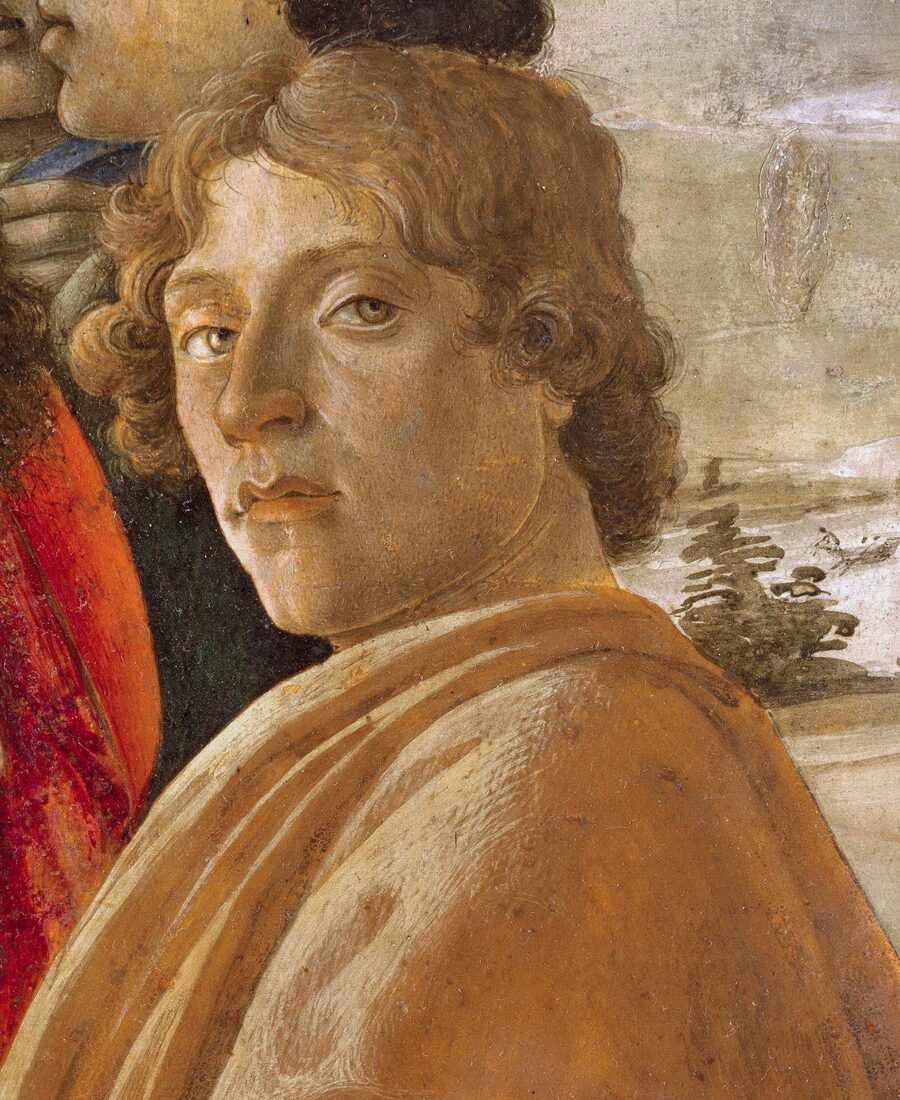
Author
Sandro Botticelli
Movement / period
Renaissance
Medium
painting
Location
Uffizi Gallery, Florence
Botanists counted over 500 plant species in the painting in 1980, about 190 of which are identifiable wildflowers from the hills around Florence — Botticelli apparently used real specimens.

Highlights
Facts & legends
- No one knows exactly what the painting means — scholars have been arguing since the 19th century, and there are at least a dozen competing interpretations involving Ovid, Poliziano's poetry, and Neoplatonic philosophy.
- Botanists counted over 500 plant species in the painting in 1980, about 190 of which are identifiable wildflowers from the hills around Florence — Botticelli apparently used real specimens.
- The painting spent roughly 300 years in storage and semi-obscurity after leaving the Medici villa; it wasn't publicly celebrated as a masterpiece until the 1850s, when art critic John Ruskin and the Pre-Raphaelites rediscovered it.
- It was commissioned for Lorenzo di Pierfrancesco de' Medici — Lorenzo the Magnificent's younger cousin — likely for his villa at Castello, and was probably hung above a day bed or lettuccio as a kind of philosophical decoration for a newly married young man.
- The three Graces on the right wear diaphanous drapery so sheer you can see their bodies underneath — an ancient Greek sculptural technique Botticelli translated into paint with almost no precedent in contemporary Italian art.
- At roughly 3.1 by 2 meters, it's enormous for a secular mythological painting of the 1480s; most panel paintings of this size in that era were altarpieces commissioned by the Church.
More details How nine classical figures entered a Medici orange grove, why 42 plant species have been identified, and what is genuinely known—and unknown—about Primavera's meaning.
Right to left
One garden holds several moments
Zephyr pursues Chloris, flowers leave her mouth and she reappears as Flora. Venus, Cupid, the Graces and Mercury extend the movement.
Botticelli combines myths into a passage from desire to fertility and order.
Ovid tells Chloris's transformation in the Fasti: Zephyrus takes the nymph by force, then marries her and grants power over flowers. Botticelli does not erase the chase—wind fingers reach her and her body bends—yet places sumptuous Flora beside it. The right group is beautiful and troubling at once: fertility grows from a story a modern viewer need not accept as uncomplicated love.
A later title
The picture does not decode itself
Vasari called it Spring in 1550; no authorial programme survives. The Uffizi says its complex meaning remains mysterious.
Wedding, Neoplatonic and political readings remain hypotheses, not settled facts.
Blindfold Cupid aims toward the central Grace, not vaguely into the garden. Their transparent dresses let Botticelli weave arms without making a heavy mass. The Graces were associated with giving, receiving, and returning gifts, but exact names and the arrow's target remain debated. What matters is love acting blindly within a carefully ordered dance.
Serious botany
An impossible season
At least 42 species have been identified, perhaps painted with the aid of herbals.
Plants flowering at different times coexist in an ideal, not documentary, garden.
Plants are more than a catalogue. Strawberry could evoke paradise, violet modesty, iris Florence, and myrtle belonged to Venus. Identifications are not all secure and simultaneous flowering is impossible. Botticelli makes a visual archive of spring in which each recognisable plant lends physical credibility to myth.
Above a lettuccio
A masterpiece in domestic space
By the late fifteenth century it hung above a chest-like bench in Lorenzo di Pierfrancesco de' Medici's family house.
It began among furniture, textiles and family ritual rather than museum walls.
At over three metres wide, the panel turned a domestic wall into an opened garden. Tempera on poplar supplied a matte, exact surface for hair, textile, and stem. Rather than receding in oily depth, figures are cut by line against the dark grove. The painting behaves like a ceremonial frieze whose actors pass before us on a shallow stage.
The grove darkened
Time changed the weather
The Uffizi attributes part of the deep vegetation to ageing pigments.
What we see is Botticelli's design transformed by five centuries of material history.
Medici ownership explains the antique learning but provides no single key. The panel may relate to Lorenzo di Pierfrancesco's marriage to Semiramide Appiani, yet documentation does not establish that commission. Neoplatonic readings are plausible reconstructions, not recovered instructions. The Uffizi's cautious formula is strongest: love, peace, and prosperity are celebrated while the full programme remains open.
Official sources
Where to check
- Spring: object record and interpretationUffizi Galleries
- Jewels and Medici context in PrimaveraUffizi Galleries
- Plants and flowers in PrimaveraUffizi Galleries
- Botticelli Rooms and present displayUffizi Galleries
- Botticelli and Florentine Renaissance contextThe Metropolitan Museum of Art
- PrimaveraEncyclopaedia Britannica
Visual context