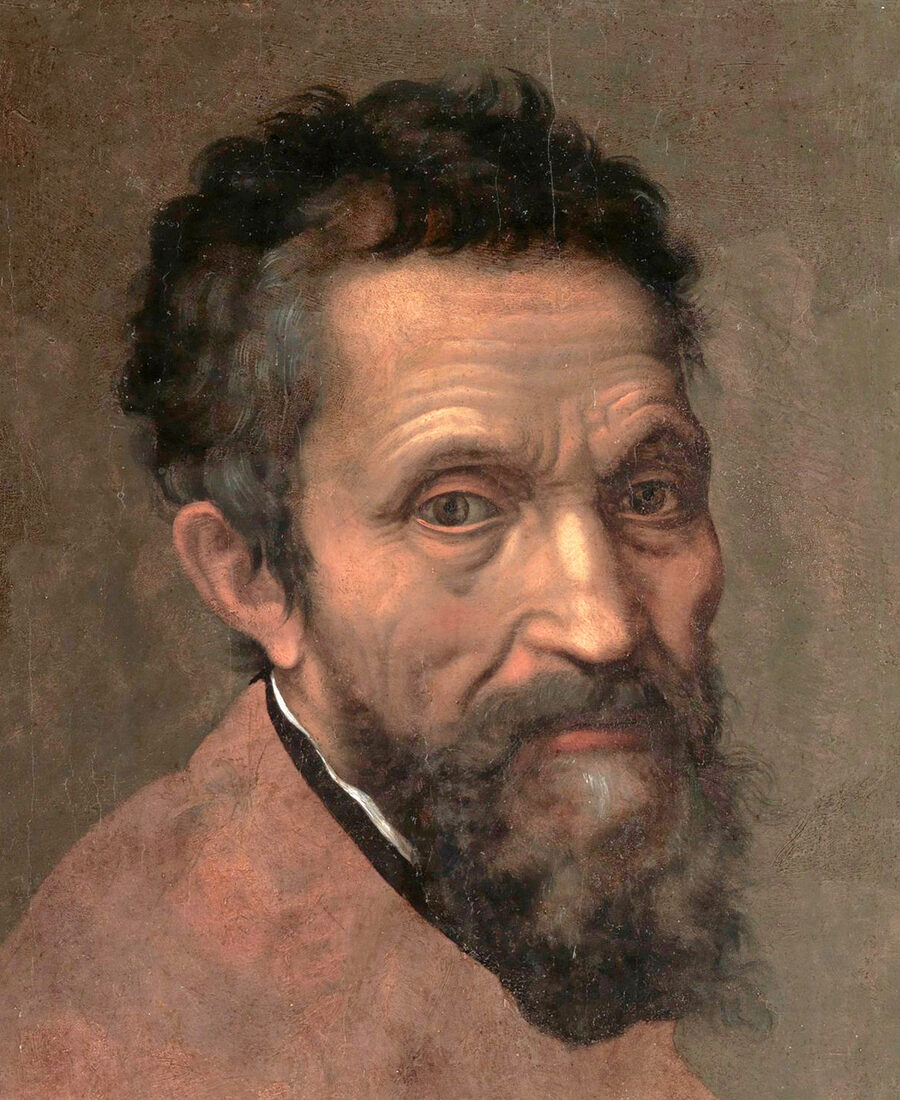
Author
Michelangelo
Movement / period
Sculpture and Form
Medium
sculpture
Location
Galleria dell'Accademia, Florence
He was only 26, and the finished 5-meter David made him the most famous sculptor in Italy almost overnight.

Highlights
Facts & legends
- Michelangelo carved the giant from a single block of marble that two other sculptors had already given up on as ruined.
- He was only 26, and the finished 5-meter David made him the most famous sculptor in Italy almost overnight.
- Unlike earlier Davids shown triumphant over Goliath's head, Michelangelo froze the tense moment before the fight — all nerve and concentration.
- In 1991 a man attacked the statue with a hammer and damaged a toe before being stopped.
- The hands and head are deliberately oversized — the figure was meant to stand high on the cathedral, seen from far below.
More details Michelangelo carved a rejected marble block into the tense second before battle, not the triumph after it.
What you see
Five Meters of Muscle Still Holding Its Breath
The museum's own numbers: 5.17 meters tall including the base, and roughly 5,660 kilograms of white Carrara marble threaded with faint rust and grey veining. David stands in a textbook contrapposto — full weight on the right leg, the left knee loose and slightly forward, the torso curving into a soft S. Behind that right leg sits a rough marble stump, cut from the same block: without it, the ankle alone could never have carried a five-ton figure, and Michelangelo solved the problem the same way sculptors had solved it two thousand years earlier.
The sling is easy to miss — a narrow strap crosses the left shoulder and runs down the back, its stone-loaded end gripped loosely in the lowered right hand, so the actual weapon of the story all but disappears. The face turns three-quarters, brows knotted, nostrils flared, the tendons of the neck pulled tight. The stranger detail is the gaze: stand to the left and David seems to look past you into the distance, his left eye half-hidden behind hair and sling; walk around to the right and a second, more focused eye takes over. For centuries Florentines swore that wary stare pointed toward Rome — a story no document can confirm or kill, five hundred years of talk at the statue's feet.
How it was made
Two Sculptors Gave Up On This Block Before Michelangelo Said Yes
On 16 August 1501 the cathedral's building authority, the Opera del Duomo, signed Michelangelo to a block that had sat in its yard for decades, already rejected twice. Agostino di Duccio had started roughing out a figure from it in the 1460s and abandoned it early; around 1476 the block was offered to Antonio Rossellino, who turned it down outright — too long, too thin, riddled with cracks and cavities, "ruined," in the word Florentines actually used. By 1501 it had stood untouched in the cathedral yard for almost forty years.
Michelangelo began that September, walling off a corner of the cathedral yard with a roofed wooden fence so no one — not even the men who had commissioned it — could see the work before it was finished. By most contemporary accounts he worked essentially alone, unusual for a commission of this size, which studios normally split among assistants. The job hadn't come out of nowhere: two years earlier, at twenty-four, he had finished the Roman Pietà, followed soon after by the marble Bacchus, and both had already made his name among the cathedral's patrons. The contract called for two years of work; it took nearly three — he did not finish until 1504.
Where the images come from
Donatello Showed the Winner. Michelangelo Showed the Second Before.
Florence already owned two bronze Davids by the time this commission was signed — Donatello's, cast around the 1440s at about 158 cm for the Medici palace courtyard, and Verrocchio's, from the 1470s, at about 125 cm. Both show the boy already victorious, Goliath's head resting at his feet, the pose almost relaxed. Michelangelo removed the severed head entirely and swapped bronze for a block of marble taller than any single standing figure a Florentine sculptor had dared carve before. The debts run deeper: as a teenager he studied ancient statuary in the sculpture garden Lorenzo de' Medici kept for young artists, and in Rome in the late 1490s he got permission to dissect corpses at the hospital attached to the monastery of Santo Spirito — an anatomical education almost no sculptor of his generation had, visible in every vein of David's right hand.
Choosing the moment before rather than after wasn't a technical decision, it was the whole argument: a body that hasn't yet released its tension turns out to be far more convincing than one that already has. That same bet on the instant before, rather than the moment of triumph, resurfaces centuries later — when Edgar Degas modeled his Little Dancer of Fourteen Years almost four hundred years after David, he caught an equally strung-out body, a teenager braced before a test rather than after passing it. And when Constantin Brâncuși, in the twentieth century, reduced the human figure to a single soaring line in Bird in Space, he was arguing directly with Michelangelo's method: where the Florentine measured out every vein, the Romanian threw the body away and kept only what it meant.
What happened next
A Modesty Garland, a Broken Arm, and a Move Indoors
On 25 January 1504, before the statue had even left the workshop, a committee met to decide where it would go — Leonardo da Vinci and Sandro Botticelli among them, along with Cosimo Rosselli and Piero di Cosimo. Nine possible sites came up for debate, and the architect Giuliano da Sangallo argued hard for the sheltered Loggia della Signoria, convinced the marble's flaws meant it wouldn't survive long in the open. His side lost. On 8 September 1504 David went up, uncovered, right at the entrance of the Palazzo Vecchio — and almost immediately someone hung a garland of twenty-eight copper leaves across his hips, which stayed there for decades before anyone took it down.
In April 1527, during an anti-Medici uprising, furniture thrown from the windows of that same Palazzo Vecchio rained down on the square below; a bench struck David's left arm and shattered it into three pieces. Vasari's account has the fragments lying in the piazza for days until the fighting died down, then being gathered up and pinned back on with copper rivets. The statue stood exposed on that square for another three and a half centuries — rain, wind, pigeons — before it was moved under the roof of the Galleria dell'Accademia in 1873; a marble copy by Luigi Arrighetti took its place outside in 1910. Even indoors, the peace didn't last: on 14 September 1991 a local artist named Piero Cannata smuggled in a hammer and knocked the second toe off David's left foot. The fragments were gathered and glued back on the same day.
Its afterlife in culture
Pornographic in 1504, Pornographic Again in 2023
When the Grand Duke of Tuscany gave Queen Victoria a plaster cast of David in 1857, for what later became the Victoria and Albert Museum, the museum had a fig leaf made to order — hung on hooks and lowered over the statue's hips whenever the Queen or other royal women came to visit, while on ordinary days it stayed off. The leaf stayed in service into the early twentieth century, and a cast of it still sits in the museum's own collection, a curiosity in its own right.
A nearly identical argument broke out in Florida in March 2023: Hope Carrasquilla, principal of Tallahassee Classical School, lost her job after several parents of sixth-graders called an image of David shown in an art-history lesson "pornographic." The official reason given was a missed parental notice about the lesson's content, but the public fight was entirely about nudity in classical sculpture. That May, Florence's city government and the Accademia invited her to Italy for a private viewing of the original — a gesture the statue itself might have appreciated, since five centuries haven't settled the argument over whether this particular body belongs in front of children. Meanwhile copies of David — marble, plaster, fiberglass, even snow — have spread across the world, from Las Vegas to a campus at the University of Pune in India, where the nude Florentine youth has stood unbothered in front of the administration building since 1975.
Official sources
Where to check
- Official institution site Galleria dell'Accademia
Visual context