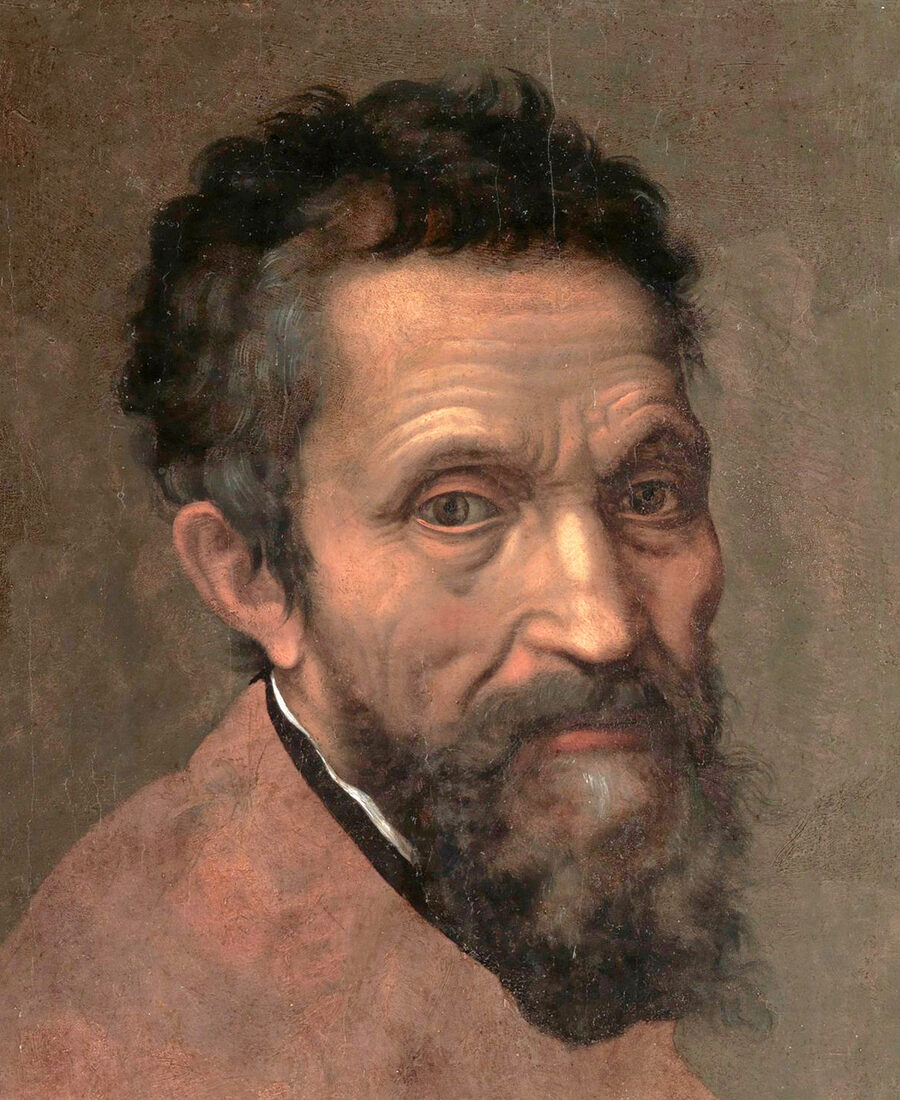
Author
Michelangelo
Movement / period
Sculpture and Form
Medium
sculpture
Location
San Pietro in Vincoli, Rome
The horns on Moses's head are intentional: Michelangelo followed the Latin Vulgate Bible, which mistranslated the Hebrew word "karan" (radiant/glowing) as "cornuta" (horned), so for centuries European art depicted Moses with actual horns.

Highlights
Facts & legends
- Moses was never meant to be seen alone — it was designed as part of a gigantic tomb for Pope Julius II that would have included 40 marble figures; Michelangelo spent 40 years on the project and called it "the tragedy of my life."
- The horns on Moses's head are intentional: Michelangelo followed the Latin Vulgate Bible, which mistranslated the Hebrew word "karan" (radiant/glowing) as "cornuta" (horned), so for centuries European art depicted Moses with actual horns.
- Sigmund Freud was so obsessed with this sculpture that he visited it every day for three weeks during a trip to Rome in 1913, ultimately writing a 13-page essay titled "The Moses of Michelangelo" — published anonymously because he wasn't sure it was serious enough for a scientist.
- The right knee of Moses shows deep scratch marks — legend holds that Michelangelo struck it with his hammer at the moment of completion and shouted "Why don't you speak?" because the figure felt so alive.
- The statue is roughly 2.35 meters tall (about 7.7 feet), but Michelangelo deliberately exaggerated the upper body so it reads correctly when viewed from below — it was designed to sit high above eye level in the original tomb design.
- When the tomb commission was scaled back and Moses was installed at San Pietro in Vincoli in 1545, Michelangelo personally supervised the installation at age 70 and reportedly wept at how much had been cut from his original vision.
More details How Julius II's forty-statue tomb shrank into a wall monument, why Moses has horns, at what moment he seems ready to rise, and whether Michelangelo really struck the marble knee with a hammer.
Meant for another tomb
A vast papal project shrank for forty years
The 1505 plan imagined a free-standing mausoleum with dozens of statues for Saint Peter's.
The reduced 1545 wall monument stands in San Pietro in Vincoli, while Julius II is actually buried at Saint Peter's.
The first contract promised a tomb in the form of a freestanding marble building one could walk around. Julius II's heirs demanded completion, while later popes diverted Michelangelo to the Sistine Chapel, San Lorenzo, and other commissions. He called the prolonged affair the 'tragedy of the tomb': every new agreement preserved the debt while cutting away another part of the original vision.
Still seated, already rising
Marble holds the second before action
Moses is often read as seeing the Golden Calf after descending Sinai.
Tablets, turned head, drawn-back leg, and tense arm suspend him between control and eruption.
The figure's restraint matters more than any guessed next action. Fingers pass through the heavy beard while helping secure the tablets; the other arm presses inward as drapery changes direction across the knees. These crossing movements resist a simple illustration of anger. Moses is thinking through what he sees, and the delayed decision gives the marble its modern psychological tension.
Horns were rays
An ancient word created a lasting icon
The radiance of Moses' face entered Latin and Western art in horn-like form.
Museo Omero explains them as divine light, not a demonic sign or merely a foolish error.
Jerome's Latin Vulgate used facies cornuta, a 'horned face', where most modern translations describe radiance. To a medieval viewer horn and ray could overlap as signs of force issuing from the head. Michelangelo keeps the projections small: they register only after the eyes and immense beard have already claimed attention.
Light belonged to the sculpture
A blocked window changed the effect
Natural light from the left was designed to move across beard, knee, and face.
A restoration project virtually reopened the later-blocked window and recovered Michelangelo's changing stage light.
The present frontal setting also disguises scale. Earlier schemes placed the figure higher, to be seen from below among many prophets and captives. Enlarged head, massive torso, and sharply stated knees were designed for architectural distance. Brought closer to floor and viewer, Moses no longer reads as one member of an ensemble but as master of the chapel.
Why don't you speak?
The best-known story is not documented
Legend says Michelangelo struck the knee and demanded speech from his lifelike statue.
No contemporary evidence proves it; the anecdote records the sculpture's fame rather than an established event.
The hammer anecdote endures because it renews an old myth of the sculptor who can animate stone. The documented history is no less dramatic: nearly forty years of contracts, resentment, and redesign ended in one figure eclipsing the unrealised mausoleum. A mark on the knee proves nothing; the real marvel is how movement survived every compromise around it.
Official sources
Where to check
- Tomb of Julius II: history and phasesCatalogo Generale dei Beni Culturali
- Moses in the monument to Julius IICatalogo Generale dei Beni Culturali
- Moses: form, iconography, and legendMuseo Omero
- San Pietro in VincoliRoma Capitale
- Restoring the tomb's natural-light effectMinistero della Cultura
- Moses by MichelangeloEncyclopaedia Britannica
Visual context