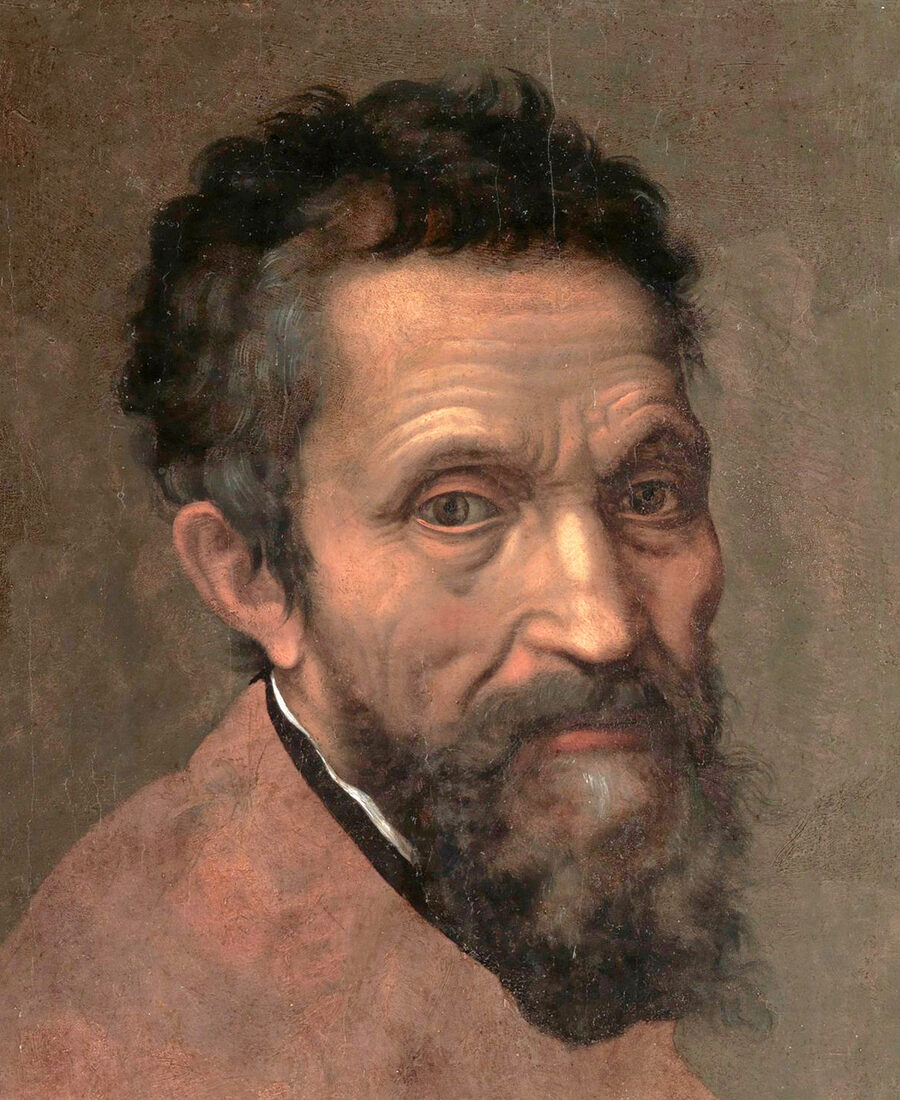
Intro source: Wikipedia (EN)
Author
Michelangelo
Movement / period
Sculpture and Form
Medium
sculpture
Location
St. Peter's Basilica, Vatican City
Mary looks younger than her son — deliberately. Michelangelo explained to his biographer Ascanio Condivi that virginal women don't age, so he made her appear closer to 18 than 40.

Highlights
Facts & legends
- Michelangelo was only 24 years old when he finished the Pietà in 1499 — and he was so furious that people were attributing it to other sculptors that he snuck into St. Peter's one night and carved his name across Mary's sash, making it the only work he ever signed.
- Mary looks younger than her son — deliberately. Michelangelo explained to his biographer Ascanio Condivi that virginal women don't age, so he made her appear closer to 18 than 40.
- On May 21, 1972, a geologist named Laszlo Toth jumped over the altar rail, pulled out a hammer, and struck the sculpture 15 times, knocking off Mary's arm and nose and gouging her eyelid. The Vatican restored it from fragments, but a few chips were stolen by spectators and never returned.
- The sculpture weighs roughly 18,000 pounds (about 8,200 kg) and was carved from a single block of Carrara marble that Michelangelo personally selected in the quarries himself — a journey he made on horseback in the winter of 1497.
- Cardinal Jean de Bilhères commissioned it for his own tomb monument, not for display in the basilica. He died in 1499, the same year the work was finished, and it was only moved to its current location centuries later.
- The marble surface was polished so finely that 19th-century critics genuinely debated whether Michelangelo had used some kind of wax or chemical treatment — modern analysis confirmed it's purely the result of hand-polishing with increasingly fine abrasives over months.
More details How the twenty-three-year-old Michelangelo carved two figures from one block, why he signed this work alone, and why the Pietà now stands behind protective glass.
For a vanished chapel
A French tomb commission
Cardinal Jean de Bilhères commissioned the group for his tomb in the old Saint Peter's.
Later moves transformed a private monument into a universal church image.
Michelangelo was about twenty-three, and Roman audiences knew him far less well than Florentine ones. The commission offered a rare chance to join the northern European Pietà type—Mary holding her dead son—to an Italian ideal of a unified marble group. A private memorial therefore became a professional trial: the young Florentine had to persuade a foreign court, the church, and Roman artists that he could rival antiquity.
One block, nine months
Calm conceals construction
Michelangelo carved Carrara marble in about nine months. Mary's broad drapery supports the adult Christ inside a stable pyramid.
Anatomical improbability becomes visual balance.
Mary's two hands explain more than her face. The right supports Christ through cloth, at once touching his body and protecting its sanctity; the left opens toward the viewer, inviting contemplation rather than assistance. Deeply drilled folds beside nearly polished skin distinguish materials even though everything comes from one block. Nine months seems astonishingly short because the carving changes texture so completely.
The only signature
A name across Mary's breast
MICHAEL ANGELUS BONAROTUS FLORENTINUS FACIEBAT is Michelangelo's only known signature.
Vasari's tale of misattribution explains its pride, though its dramatic details remain tradition.
FACIEBAT—'was making' or 'made'—echoes the formulas of ancient artists and differs subtly from a blunt declaration of completion. The name runs along the diagonal sash that links Mary's head to Christ's body and is also the most conspicuous part of her dress. The signature is not hidden on a base: artistic ambition enters the sacred image without breaking its compositional flow.
A young mother
Beauty serves theology
Michelangelo defended Mary's youth through the idea of immaculate purity.
Christ's almost unmarked body replaces physical horror with anticipated resurrection.
Mary's left hand does not clench in despair but opens quietly, changing the scene's emotional register. Saint Peter's official account notes that marks of scourging, thorns, and falls have almost vanished; only the nail holes and side wound retain symbolic force. Michelangelo does not deny death but refuses to let damage possess the body. Grief appears through weight, the fallen arm, and silence rather than gore.
Hammer and glass
The 1972 attack changed viewing
Laszlo Toth damaged Mary's face and arm; casts and photographs guided restoration.
Bullet-resistant glass now records both vulnerability and survival.
An accurate cast made before the attack proved crucial to restoration: it allowed specialists to compare missing forms instead of reinventing the face according to taste. Visitors and staff collected scattered marble; some fragments returned, while others required careful fills. Bullet-resistant glass now limits close looking, yet embodies a modern conservation lesson: fame does not make an original physically invulnerable.
Official sources
Where to check
- The Pietà of Saint Peter's: commission, carving, signature, and meaningFabbrica di San Pietro
- La Piedad de San PedroFabbrica di San Pietro
- La Pietà de Saint-PierreFabbrica di San Pietro
- The three Pietàs sculpted by MichelangeloVatican Museums
- Damage and restoration historyVatican Museums Publishing
- The pre-attack cast and its role in restorationFabbrica di San Pietro
Visual context