Intro source: Wikipedia (EN)
Plato's face is a portrait of Leonardo da Vinci, which Raphael slipped in as a tribute; you can confirm it by comparing the likeness to Leonardo's self-portrait drawings from the same decade.

Highlights
Facts & legends
- Raphael painted this enormous fresco — roughly 7.7 by 5.5 meters — when he was just 26 years old, and he had never tackled anything remotely this ambitious before.
- Plato's face is a portrait of Leonardo da Vinci, which Raphael slipped in as a tribute; you can confirm it by comparing the likeness to Leonardo's self-portrait drawings from the same decade.
- The brooding figure sitting on the steps in the foreground — chin resting on his fist, alone among the crowd — is Heraclitus, and art historians widely agree it's a portrait of Michelangelo, added after Raphael got a secret peek at the Sistine Chapel ceiling while it was still under scaffolding.
- The fresco sat directly across the hall from the room where Julius II kept his personal library, so the philosophy scene was designed to be read as a conversation with the theology on the opposite wall — Raphael planned the whole suite as a unified argument across four rooms.
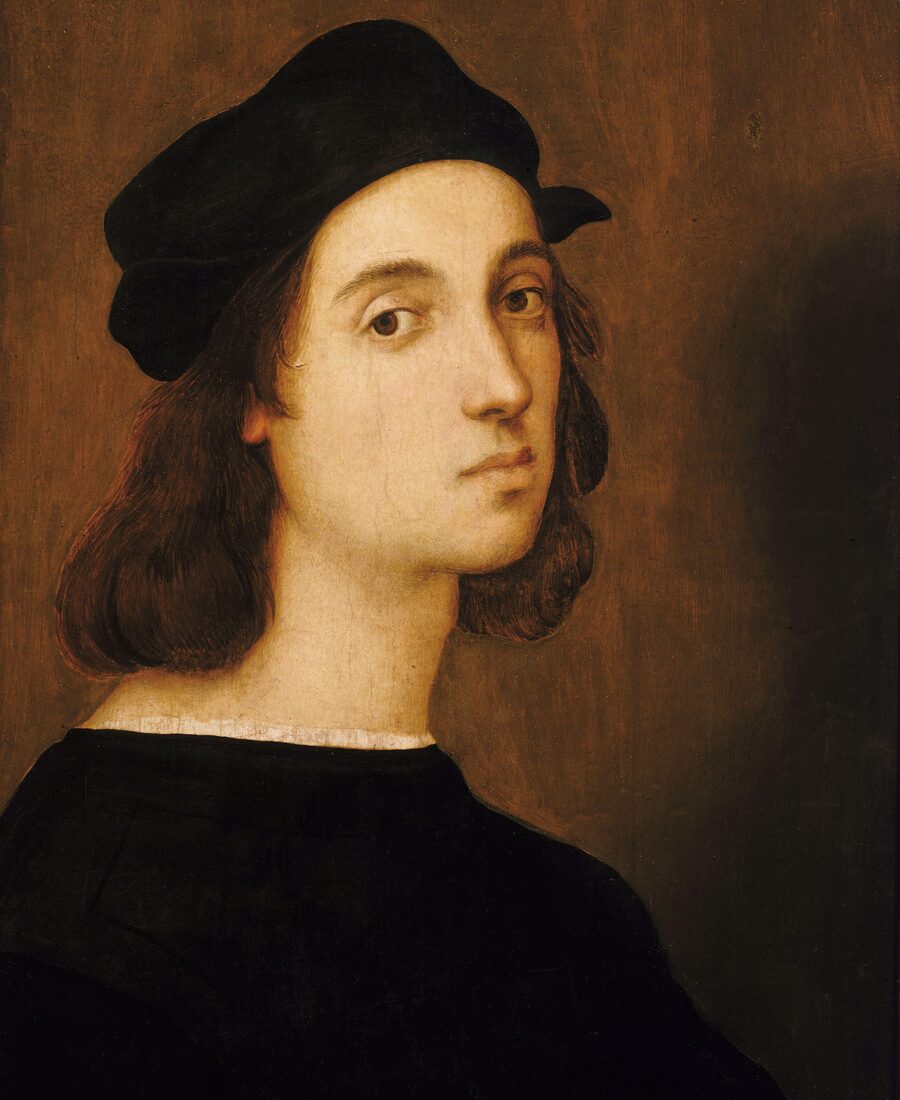
- Raphael included himself in the crowd: he's the young man on the far right edge, looking directly out at the viewer — the only figure who breaks the fourth wall.
- Unlike panel paintings, a fresco requires working into wet plaster section by section; Raphael completed the entire composition from cartoons (large preparatory drawings), several of which survive in the Ambrosiana in Milan.
More details Fifty Renaissance faces disguised as ancient philosophers, gathered inside a hall Raphael invented from nothing.
On the Wall
Fifty Sages Under a Vault That Never Existed
The fresco covers an entire wall — 500 × 770 cm, roughly the size of a small cinema screen. This is Pope Julius II's library, the Stanza della Segnatura, and Raphael filled it with a vaulted hall that never actually stood anywhere: the perspective recedes through massive coffered arches that echo Roman bathhouses, or perhaps Donato Bramante's plans for the new St. Peter's, which Bramante was drafting in that very same building at the time. The vanishing point sits exactly between Plato and Aristotle. Alberti's single-point perspective does its job so well that the wall reads like a window, and you feel you are standing at the threshold of the room itself.
About fifty figures populate the scene (counts run from around fifty to fifty-eight, depending who is counting), and each has a job to do. Sprawled alone on the steps, indifferent to everyone around him, is Diogenes. To the left, Pythagoras scribbles in a book while a boy beside him holds up a tablet of musical ratios. On the right, a man bent over a slate with a compass is Euclid, though Raphael gave him the face of Bramante. Farther back, two men each hold a globe — one celestial, held by Zoroaster, one terrestrial, held by Ptolemy, who has his back to us. Up in the niches above, statues of Apollo with his lyre and Minerva watch the whole gathering from a height no philosopher can reach. Right at the foot of the steps, apart from everyone else, sits a young man in white who alone looks away from the crowd instead of at it — scholars still argue over who he is: Julius II's nephew Francesco Maria della Rovere, or, on one bold reading, the Alexandrian mathematician Hypatia, the only woman anyone has managed to spot among the philosophers. Light falls from the left, exactly where the room's own real window sits.
How It Was Made
A Letter From Home That Opened the Vatican's Doors
Raphael was twenty-five in 1508 when a letter reached him from a fellow native of Urbino, the architect Donato Bramante, saying Pope Julius II was looking for painters to redo his private rooms. Other artists — Perugino, Signorelli, Sodoma, Lorenzo Lotto among them — had already started on the walls of the Stanza della Segnatura. The pope liked what the newcomer did on his first wall so much that he had the earlier work stripped away and handed him the whole room, keeping only Sodoma's ceiling compartments. Raphael went on to paint all four walls of that room, one for each branch of knowledge — theology, poetry, law — and The School of Athens, on the wall given to philosophy, eventually outshone the other three.
Raphael painted in true buon fresco, straight onto wet plaster, a patch at a time — whatever he could not finish before the plaster dried waited for the next day. Before touching the wall he built a cartoon 285 × 804 cm, the largest surviving Renaissance preparatory drawing, charcoal and white lead on 210 sheets of paper glued into one. It now lives at the Pinacoteca Ambrosiana in Milan. Oddly, that cartoon shows no vault and no arches — just a faint sketch of the architecture's foundation lines, so faint that scholars only spotted it in 1972. It looks as if Raphael settled on the room's final shape once he was already on the scaffolding, not on paper. The cartoon also lacks Raphael's own self-portrait and the figure on the far right sometimes read as Protogenes — both were added straight onto the plaster later, the same way Heraclitus was.
Where It Comes From
A Florentine Habit, Carried to Rome
Slipping living faces into an ancient scene was not Raphael's invention. He had spent years in Florence and Umbria watching Ghirlandaio and others tuck portraits of real Florentines into religious frescoes. In Rome he pushed the trick further than anyone: his gallery of philosophers amounts to a group portrait of his own circle, with Euclid's face borrowed from Bramante. Florence shows up elsewhere too — the tilt of Plato's head and the softness of his features echo the female portraits Leonardo was painting around then; Raphael had seen the Mona Lisa in Leonardo's studio before he ever left for Rome.
The other root is Neoplatonism, the philosophy that had obsessed Medici Florence for decades. The same ideas about ideal, intangible beauty had driven Botticelli when he painted The Birth of Venus — myth on one side, a philosophical treatise on the other, the same source underneath. The architecture, meanwhile, Raphael borrowed from Bramante directly: those barrel vaults and coffers all but repeat Bramante's own plans for the new St. Peter's Basilica, which in 1509 existed only on paper and in conversation — construction had barely begun. Which means The School of Athens places philosophers of the past inside architecture of the future that, at the time, only one man in Rome had actually seen.
The single vanishing point itself was a Quattrocento idea, worked out by Masaccio and Piero della Francesca, both of whom Raphael had studied before he ever reached Rome. Here, standing next to the actual architect of the new Vatican, the trick stopped being a classroom exercise and became a convincing illusion of real space. Around the same years, the papal court was also assembling a collection of genuine ancient statues for the new Belvedere courtyard, and Raphael had access to it — he painted the gods in the fresco's niches having seen real marble, not just prints and copies.
What Happened Next
A Fresco That Never Traveled — Unlike Its Blueprint
In one sense the fresco has a simple history: it never left the wall it was made for, because frescoes do not travel. The room itself changed names and functions — Julius II's private library eventually took the name Stanza della Segnatura, after the "Segnatura Gratiae et Iustitiae" tribunal that later met there, before becoming part of the Vatican Museums open to the public. Cleaning the soot and old varnish off the painting itself took centuries to get around to: chief restorer Gianluigi Colalucci spent 1980 to 1994 on the Sistine Chapel ceiling first, and only after that did his team move on to the Raphael Rooms. They reached The School of Athens around 1996, and underneath the grime turned out to be reds, blues and ochres considerably brighter than what visitors had been looking at for decades.
The preparatory cartoon had a far bumpier ride. It ended up in Cardinal Federico Borromeo's collection, sat on loan at the Pinacoteca Ambrosiana in Milan from 1610, and was formally purchased in 1626 from the widow of Fabio Borromeo Visconti for 600 imperial lire. It has stayed there ever since — the museum's largest single object — and underwent its own four-year conservation from 2015 to 2019, cleaned with surgical micro-suction tools to lift five centuries of old glue and grime off the paper.
There is no missing it today: the Vatican Museums' one-way route funnels visitors through the Stanza della Segnatura on their way to the Sistine Chapel, and the museums now draw six to seven million people a year — nearly all of whom pause in front of The School of Athens for at least a minute, even the ones in a hurry to reach Michelangelo's ceiling.
Legacy
From Grand Tourists to a Guns N' Roses Sleeve
People started quoting the fresco almost immediately — just not in paint. In 1751, Joshua Reynolds, himself touring Italy at the time, drew a caricature called Parody of Raphael's School of Athens, swapping the philosophers for a group of English and Irish Grand Tourists striking the same poses. It hangs today in the National Gallery of Ireland, proof that within two and a half centuries the composition had already become shorthand for a joke at one's own expense.
Copies spread everywhere. In 1689 the Gobelins workshop in France wove the scene into a tapestry that still hangs in the meeting chamber of the French National Assembly at the Palais Bourbon. In 1755 the German painter Anton Raphael Mengs produced a canvas roughly four by eight meters, now at the Victoria and Albert Museum in London. In 1902 the University of Virginia commissioned a full-size copy for its library rotunda, deliberately made a few inches smaller than the original, since reproducing a Vatican fresco at true scale was not something one simply did.
Then in 1991 two figures cropped from the fresco — a man slumped against a column and a young man writing in a book — turned up on the covers of both Use Your Illusion I and Use Your Illusion II by Guns N' Roses, reworked by the American artist Mark Kostabi. According to the band's manager at the time, Alan Niven, Axl Rose paid Kostabi $75,000 for the rights to the image, apparently without realizing Raphael's original had been public domain for centuries.
In 2020, the 500th anniversary of Raphael's death, Rome's Scuderie del Quirinale opened the largest exhibition of his work ever staged, Raffaello, 1520–1483. It closed three days later when the pandemic hit and did not reopen until June, after the Louvre, the Prado and London's National Gallery agreed to extend their loans by several months. The Vatican fresco itself never left the wall, of course, but its reputation kept the show afloat even without its most famous work in the room.
Official sources
Where to check
- Official institution site Vatican Museums
Visual context