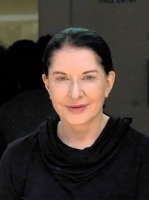
Intro source: MoMA
Author
Marina Abramović
Movement / period
Performance and the radical body
Medium
performance
Location
Museum of Modern Art, New York
Abramović sat for up to seven hours a day without breaks — no food, no water, no bathroom trips during gallery hours — a feat of physical endurance she prepared for with months of isolation and fasting.
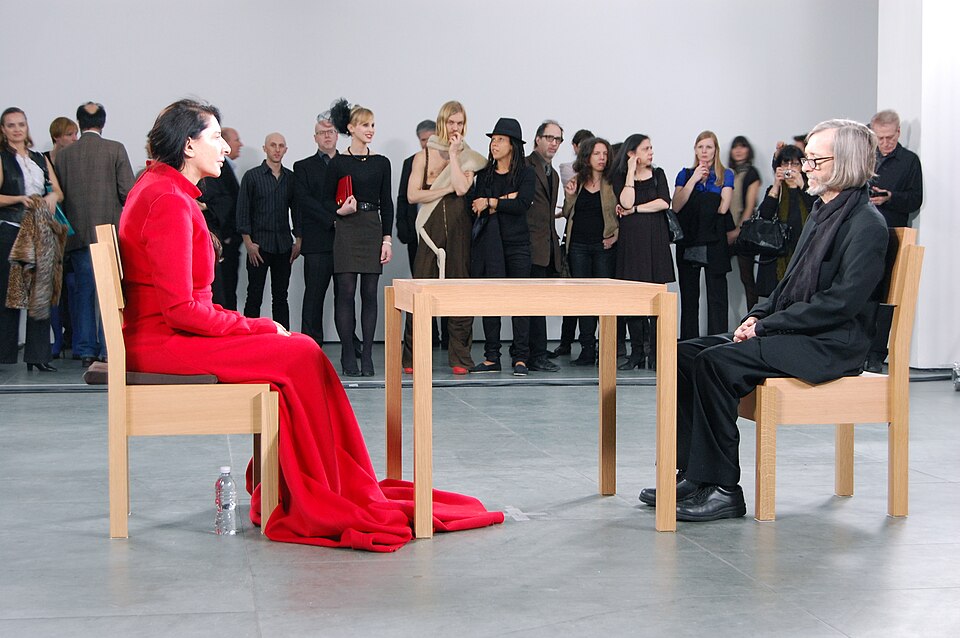
author: Andrew Russeth · license: CC BY-SA 2.0 · Wikimedia Commons
Highlights
Facts & legends
- Over the 79-day run at MoMA in 2010, roughly 1,500 people sat across from Abramović — and an estimated 750,000 visited the exhibition overall, making it one of the most attended solo shows in MoMA's history.
- Abramović sat for up to seven hours a day without breaks — no food, no water, no bathroom trips during gallery hours — a feat of physical endurance she prepared for with months of isolation and fasting.
- Many visitors wept. Not just a few — dozens per day. MoMA staff quietly placed a box of tissues near the table after the first week because so many people were crying without apparent cause.
- Her ex-partner Ulay — from whom she had separated in 1988 after walking the Great Wall of China toward each other and saying goodbye — showed up unannounced one day and sat down in the chair. Abramović, who had kept her eyes closed until each visitor sat, opened them and immediately started crying. It's on film.
- The documentary about the performance, directed by Matthew Akers and released in 2012, premiered at Sundance and went on to earn over $1.5 million at the box office — extraordinarily rare for a film about a single performance art piece.
- Abramović originally proposed the performance to run three months with no table — just two chairs and her gaze — but MoMA insisted on the table for practical crowd-control reasons. She agreed, then later said the table felt like a barrier she had to learn to forget was there.
More details Three months, one chair, and a stranger's gaze: how a simple rule turned MoMA's atrium into a work lasting hundreds of hours—complete with bodily discipline, overnight lines, Ulay, and unexpected tears.
The rule fit in one sentence
A visitor sat opposite while the artist remained silent for as long as the museum day allowed
The performance ran in MoMA's atrium from 14 March to 31 May 2010 as a new work within Marina Abramović's first major US retrospective. Each day she took her chair before opening and stayed beyond closing. One visitor could sit opposite; speaking and touch were excluded, and no meeting length was fixed in advance.
Its radical quality lay in refusing distraction. A glance between strangers usually lasts seconds before someone looks away. Here lighting, queue, and a ring of onlookers surrounded two still people. The visitor became a participant while being observed by the artist, the waiting crowd, and increasingly by the self.
Duration was the material
The familiar total of 736½ hours describes labor, not spectacle
Abramović's official biography says more than 700 hours; the final chronology is commonly given as 736 hours and 30 minutes. It was her longest solo work to date. Remaining seated through public hours without ordinary breaks made stillness physically punishing: back, legs, organs, breathing, and concentration all became working material.
She told MoMA that long encounters differed from short ones because participants lost their measurement of time. Marco Anelli's unofficial log records a maximum individual sitting of 420 minutes. The numbers are illuminating, but MoMA explicitly described the tally as unofficial and not fully fact-checked.
The queue became the second half
People arrived overnight, returned repeatedly, and formed their own community
At first participation resembled a museum line. Near the end, people began waiting from midnight or directly after closing, sleeping outside to reach the chair next morning. Abramović said waiting and sitting complemented each other: before receiving a moment of focused attention, a person had already given the work hours of life.
Anelli's unofficial total was 1,545 sittings, averaging roughly twenty-one a day. Some returned many times. Friendships, queue rules, arguments, and a core of regular participants emerged. A work built around a one-to-one encounter unexpectedly produced a collective through patience rather than shared spectacle.
Tears were not an instruction
Abramović described herself as a mirror returning visitors to their own vulnerability
Many sitters began to cry. The artist neither comforted them nor staged therapy; she preserved silence. In her MoMA interview she explained that the participant was watched by her, by the crowd, and by the self. External attention gradually turned inward, bringing personal memory and pain into view.
Photographer Marco Anelli made a portrait of every participant, producing a parallel archive of faces. These photographs prevent the work from collapsing into the famous image of Abramović in a red dress. A different person completed it each time—bored, tense, smiling, or in tears.
Ulay entered an existing history
Their brief meeting went viral, but the work also extended years of shared practice
Ulay, Abramović's former artistic and life partner, became one of the sitters. For twelve years they had made works about symmetry, endurance, and mutual gaze; in Nightsea Crossing they sat opposite each other for hours. Their silent MoMA encounter brought tears and became the project's most circulated fragment. It is best described as a powerful reunion without claiming, on insufficient evidence, that every organizer was surprised by the visit.
The retrospective also asked about forty performers to present Abramović and Ulay's earlier actions—the first museum project of live reperformance on this scale. The title therefore exceeds celebrity presence. It asks whether an ephemeral action can outlive its maker, pass into another body, and remain the same work.
Official sources
Where to check
- Official institution site Museum of Modern Art
- Official collection / archive Museum of Modern Art
- Exhibition dates, format, and live reperformancesMuseum of Modern Art
- Visitor participation and the silent encounterMuseum of Modern Art
- Abramović on duration, waiting, pain, and tearsMuseum of Modern Art
- Unofficial sitter and duration dataMuseum of Modern Art
- Relation in Time and the 2010 reperformanceMuseum of Modern Art
- Abramović and Ulay's collaborative historyMuseum of Modern Art
- More than 700 hours: artist biographyMarina Abramović official website
Visual context
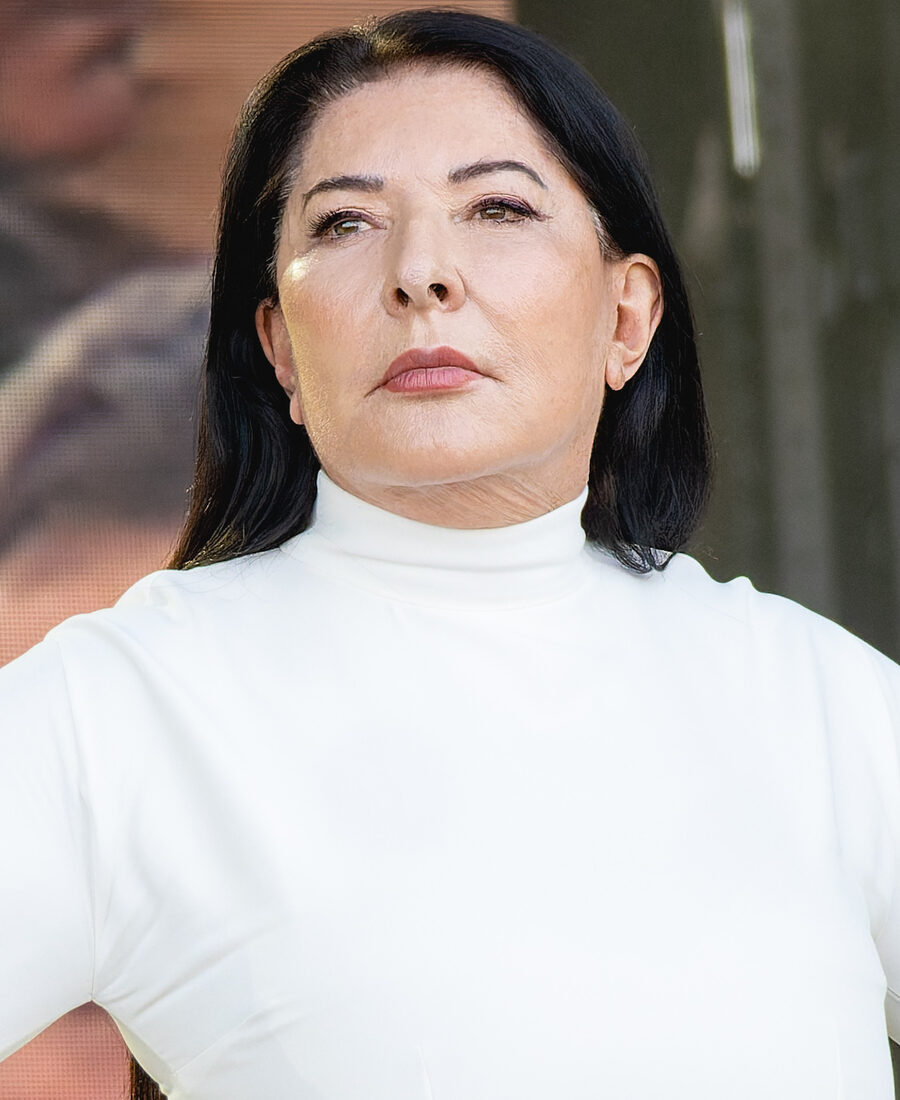 Marina Abramovic