Intro source: Wikipedia (EN)
Author
Marina Abramović
Movement / period
Performance and the radical body
Medium
performance and installation
Location
Venice Biennale, Venice
She won the Golden Lion for Best Artist at the 1997 Venice Biennale, making her the first performance artist — and one of very few women — to receive that award in the exhibition's century-long history.
author: StagiaireMGIMO · license: CC BY-SA 4.0 · Wikimedia Commons
Highlights
Facts & legends
- Abramović sat on a mound of roughly 1,500 freshly slaughtered, still-bloody cow bones for six hours a day over four consecutive days — the smell in the basement pavilion was reportedly overwhelming enough to make visitors leave within minutes.
- She won the Golden Lion for Best Artist at the 1997 Venice Biennale, making her the first performance artist — and one of very few women — to receive that award in the exhibition's century-long history.
- The performance had a third component most people never see in documentation: two large video projections showing her parents and herself dressed in Serbian folk costumes, speaking about a folk tale in which a wolf-child is created when its mother washes it in blood — a direct metaphor for how nationalist mythology breeds violence.
- Abramović wore a white lab coat throughout, an outfit she deliberately chose to evoke both a scientist and a surgeon — someone trying to perform a clinical procedure on something that cannot be made clean.
- The bones she used were real slaughterhouse waste purchased in Venice; after the performance ended, the entire installation — bones, blood, and all — had to be disposed of as biological hazard material.
- When the performance began on June 15, 1997, the Dayton Agreement had been signed only eighteen months earlier, meaning the war in Bosnia had technically just ended — most of the audience had been reading about mass graves in newspapers just the year before.
More details For four days Abramović scrubbed bloody cattle bones while her parents watched, silent, from three screens.
What you saw
A Basement That Smelled of War for a Week
To see Balkan Baroque, visitors walked down into the basement of the Italian Pavilion at the Giardini — dim light, one person at a time. Below lay a mound of roughly 1,500 fresh cattle bones, more than two tonnes of them, straight from the slaughterhouse, still carrying scraps of meat, fat and blood. Marina Abramović sat directly on the pile in a plain white dress, copper vessels of black water and buckets of soapy foam beside her, a metal brush in her hand. Bone after bone, she scraped the flesh away, hour after hour, without looking up at the crowd.
The dress lightened with soap and darkened with blood at the same time; by evening it carried more rust-brown stains than white. The whole time she sang — Serbian and Yugoslav folk songs she'd known since childhood, half under her breath, as if lulling the bones rather than scrubbing them. Some visitors later said the singing, not the smell, was the hardest part to sit with: too intimate a sound for such a merciless scene.
Behind her, three screens played on a loop. On the left and right, near-static close-ups of her father's and mother's faces, simply looking into the camera. On the centre screen Abramović appeared twice: first in a lab coat, narrating the story of rats that, crammed together under unbearable conditions, turn into "wolf-rats" and start killing and eating one another; then as a Balkan cabaret singer, spinning to the same music playing live downstairs. The screens stood like a triptych, an iconostasis with her parents and her own two masks instead of saints. Over everything hung the smell — fresh blood rotting in the Venetian heat, mixed with laundry soap — a smell witnesses said lingered in the pavilion for months.
How it was made
From a Skeleton on Her Lap to a Mountain of Bones
Balkan Baroque has a direct ancestor. Two years earlier, in 1995, Abramović had filmed Cleaning the Mirror, sitting with an actual human skeleton in her lap and scrubbing it for hours until the grey grime moved from the bones onto her own hands and clothes. For Venice she scaled that gesture up into a whole landscape: one skeleton became a heap of slaughterhouse bones, a quiet video became a live performance with an audience and three screens behind her.
The bones were ordered ahead of time and trucked to Venice; some had already begun to decay before the pavilion opened — nobody staged that smell, it simply happened. The video was shot separately: with her parents she just talked on camera about the war and life in Yugoslavia, while she played her own two roles, the "scientist" and the "singer," in different costumes on the same shoot day. Editing wove it all into a three-channel loop synchronized with the live half of the piece — while she scrubbed downstairs, the same stories cycled above her.
The performance ran through the opening week of the 47th Venice Biennale in June 1997: four days, six hours a day, twenty-four hours of live action stretched across a week. The Biennale jury awarded her the Golden Lion for best artist — several outlets that later wrote about the piece note she was the first woman to receive that prize in the Biennale's history. The jury's reasoning was blunt: the work addressed not abstract cruelty but an actual war being fought a few hundred kilometres from Venice at that very moment.
Where it comes from
A Body Standing In for History's Body
By 1997 Abramović had spent twenty years treating her own body as raw material — in the Rhythm cycle she cut and burned her skin, passed out testing where pain ends and art begins; with Ulay she turned the closeness between two people into performance for over a decade. Balkan Baroque marked a turn: for the first time, the body she offered the audience wasn't only hers. The bones are someone else's death, an animal's — not her wound. But the brush in her hands and the smell on her skin make that death feel just as personal as the cuts in Rhythm 0.
The lineage is body art and performance of the 1960s and 70s, where the artist traded brush and canvas for sheer presence. But Abramović is the daughter of two Yugoslav Partisan veterans — her father Vojin, a commander later decorated as a national hero, her mother Danica, who went on to run Belgrade's Museum of the Revolution — and that personal history of one war collided, fifty years on, with an actual war. Her parents on screen aren't illustration; they're a doubling: they lived through one Balkan conflict, their daughter is working through the wreckage of another.
Painting had another way of handling the unbearable — turning it into beauty you could take home. Van Gogh's Starry Night winds sleepless dread into spirals of paint that still settle into a pattern inside the frame. The painter of The Kiss wraps love in gold or marble until it sits outside time, untouched by war or decay. Abramović works against exactly that: she doesn't translate war into an image, she brings its literal, foul-smelling material into the room and refuses to let it become beautiful.
What became of it
A Performance You Can't Buy, Only Rebuild
The performance ended with the Biennale's opening week in 1997: Abramović scrubbed as many bones as the allotted hours allowed and never sat on that pile again. Balkan Baroque has no canvas and no signature in the corner to sell at auction — what exists is video footage, photographs, and the installation itself: the bones, the copper vessels, the three screens. That is how it has been shown ever since — as a reconstructed set piece, without the live performance inside it.
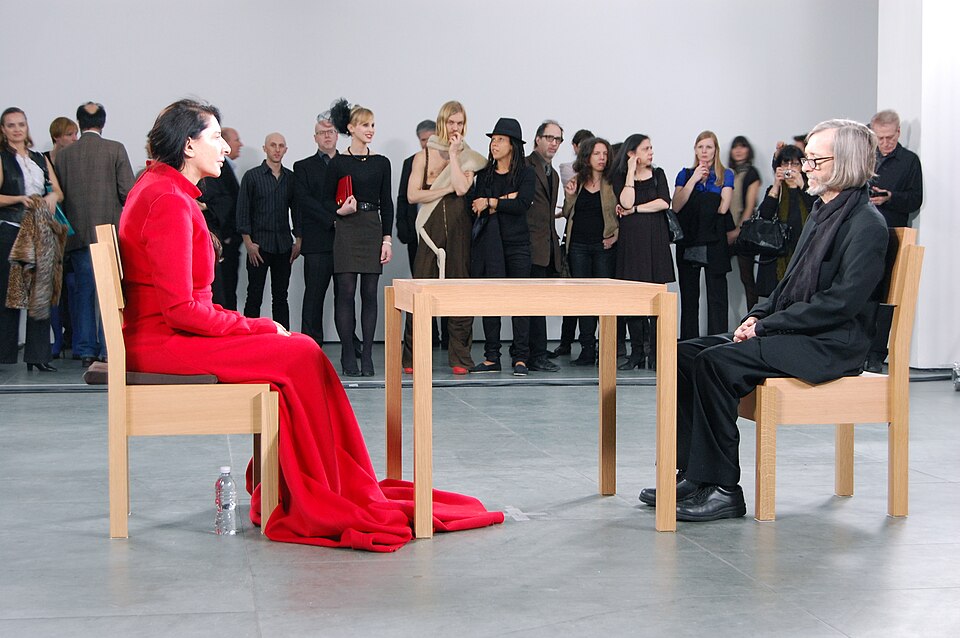
The best-known such showing was at MoMA in New York in 2010, for the retrospective The Artist Is Present. As early as 2008, two years before the show opened, six thousand pounds — nearly three tonnes — of cattle bones for that installation sat crated in a warehouse in the Netherlands, waiting to ship to New York: a detail that says plenty about the logistics of turning a performance into a museum piece. In MoMA's gallery, the bones and video stood without Abramović in them — she was sitting, at that very moment, in another room of the same museum, silently meeting visitors' eyes for The Artist Is Present, the piece that finally made her famous far beyond the art world.
The reconstructed installation later travelled with other major retrospectives too — including The Cleaner, which toured Stockholm, Copenhagen, Oslo, Bonn, Florence and Toruń from 2017 onward and reached Belgrade, Abramović's home city, in 2019. There, Balkan Baroque met an audience for whom the 1990s war isn't archival footage but lived memory.
Today most people know the work through photographs and video stills; very few ever saw the live version in that Venetian basement in 1997. Its archive and exhibition rights sit with the artist's institute and the gallery that represents her. Marina Abramović herself has returned to memory and war many times since, but never again quite so literally, sitting on the actual bones.
Its afterlife
How Balkan Baroque Became a Formula
In the history of 1990s performance, Balkan Baroque is one of the works that found a language for talking about war without narrating it, through a physical act that admits blood doesn't wash off that easily. Scholars of post-Yugoslav art, historian Marko Ilić among them, routinely treat it as a starting point: before it, art from the former Yugoslavia had almost no international gesture of this scale addressing the country's breakup.
The Marina Abramović Institute (MAI), which she founded in 2007 to preserve and study performance as an art form, still cites Balkan Baroque as a model for documenting a work that can't be repeated as it was — no live body, no smell — while keeping everything else exact: the same bones, the same copper vessels, the same three screens.
After Venice 1997, "scrubbing the bones" became something close to shorthand for the impossibility of washing collective guilt off your hands — a phrase critics later reached for when discussing other artists working with war and memory. The Golden Lion the piece won set Abramović up for the fame that arrived thirteen years later, in 2010; but it was the Venice work that first proved she could speak through the history of an entire country as well as through her own body.
Viewers with no knowledge of the Yugoslav Wars still read the piece without a translation: a mountain of bones and a brush that can't keep up with the job is an image that needs no footnote. That, more than anything, is probably why Balkan Baroque still turns up in museum programs and textbooks nearly three decades after Venice — long after the news footage of that war has faded from memory.
Visual context
 Marina Abramovic