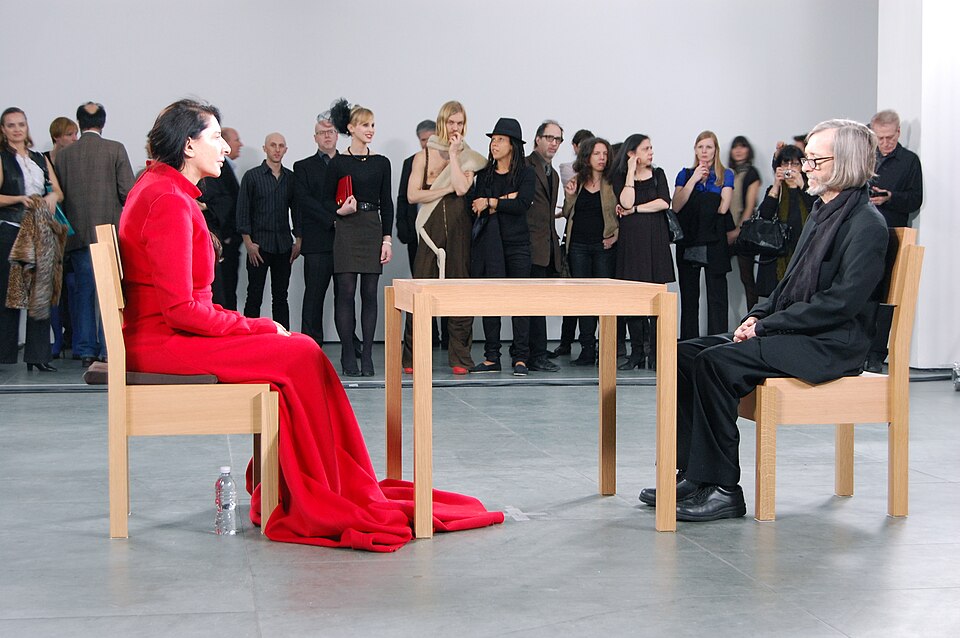
Intro source: Wikipedia (EN)
Author
Marina Abramović
Movement / period
Performance and the radical body
Medium
performance
Location
Studio Morra, Naples
For six hours Abramović remained passive under her written instruction, leaving every action—and its responsibility—to the audience.
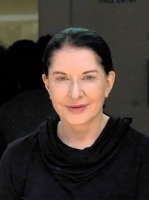
author: StagiaireMGIMO · license: CC BY-SA 4.0 · Wikimedia Commons
Highlights
Facts & legends
- The table held 72 objects, including a rose, feather, honey, scissors, scalpel, pistol, and a separate bullet; a participant loaded the gun during the action.
- For six hours Abramović did not resist. Her instruction stated: “I am the object. During this period I take full responsibility.”
- People cut her clothes, wounded her neck, carried her, and aimed the loaded pistol toward her head; other participants intervened in the conflict around the weapon.
- After the agreed six hours, the gallerist declared the work finished. When Abramović walked toward the audience as an active person, those present began to leave.
- The event survives in photographs and slides; MoMA also holds a print with text panel from the Performance Edition 1973–1994.
More details For six hours the artist declared herself an object and offered 72 items, from a rose and honey to a pistol and separate bullet. What happened in Naples—and why the work concerns transferred responsibility, not simply an 'evil crowd.'
The instruction removed ordinary protection
Abramović accepted responsibility for whatever the audience chose to do
At Studio Morra in Naples in 1974, Marina Abramović placed 72 objects on a table and declared herself an object for six hours. Visitors could apply anything to her body; a written instruction said the artist assumed full responsibility. She would neither resist nor respond.
This separates the work from a spontaneous assault or a theatrical scene. Gallery, time limit, and instruction formed an art contract, yet inside it a person appeared to lose the right to say no. Beyond pain, Abramović tested how spectators change when authority is formally transferred and consequences seem removed.
The objects offered pleasure and danger
A rose, grapes, and perfume sat beside a knife, scalpel, pistol, and one bullet
The table was carefully composed. Feather, honey, bread, wine, and rose allowed visitors to decorate, feed, or caress; scissors, nail, chain, whip, and blade could injure. One correction matters: pistol and bullet began as separate objects. A participant loaded the weapon during the performance.
The selection did not command violence. It offered choice and made each gesture an ethical decision. Early visitors behaved cautiously, giving Abramović a rose, touching her, or changing her pose. Care and aggression gradually existed together; the room never became one uniform anonymous crowd.
Escalation happened in stages
Clothes were cut, skin wounded, and the loaded pistol reached her head
Abramović recalled that people cut off her clothes, made a wound near her neck, drank the blood, and covered it with plaster. They carried her, placed her on a table, and drove a knife into the wood between her legs. One person loaded the pistol, put it in her hand, and aimed it toward her head to see whether she would resist.
Others intervened and conflict formed around the gun. This complicates the easy moral that a crowd inevitably becomes monstrous. Different people occupied the room: some intensified danger while others limited it. The work exposed a struggle between responsibility and permitted impunity rather than one fixed human nature.
The performance ended by its rule
After six hours the gallerist called time and the object became a person again
A common retelling says protective viewers stopped the action. Abramović's MoMA account is different: after the agreed six hours, the gallerist announced that the piece was finished. She then ceased to be passive, stood, and walked toward the audience—naked, bloodied, and in tears.
People left and avoided direct encounter. While the instruction named her an object, the body could be treated as material. Once she looked back and acted, a person capable of remembering stood before them. That final walk was not an afterthought but the decisive role reversal: responsibility returned at once.
The original was a situation, not a photograph
Museums now preserve slides, instructions, prints, and representative objects
Rhythm 0 cannot be seen again in exactly the same form. Studio Morra hosted the event; museums display documentation. MoMA owns a photograph with text panel from the Performance Edition 1973–1994 and presented a slide projection with examples of the objects in its 2010 retrospective.
The distinction is central to performance history. A photograph proves an event occurred but cannot transmit six hours, the room, spectator decisions, or the changing status of the body. The work survives through rules, testimony, and consequences, while its ethical risk belongs to one evening in 1974.
Official sources
Where to verify documentation and testimony
- Abramović recounts the six-hour performanceMuseum of Modern Art
- Objects, audience actions, and 2010 exhibition documentationMuseum of Modern Art
- Rhythm 0 in the Performance Edition 1973–1994Museum of Modern Art
- Audience participation and transferred controlMuseum of Modern Art
- Rhythm 0, Studio Morra, Naples, 1974Marina Abramović official website
- Abramović on losing control in Rhythm 0 and Rest EnergyMuseum of Modern Art
Visual context
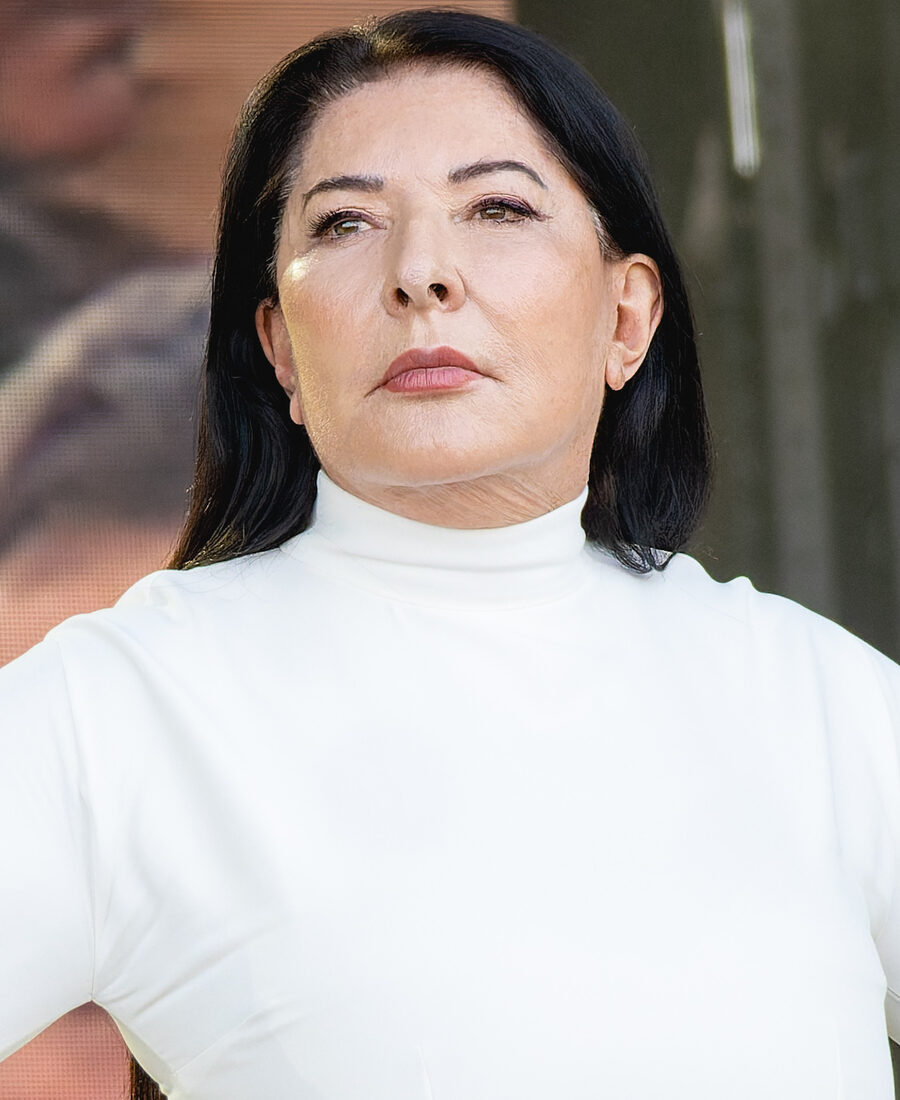 Marina Abramovic