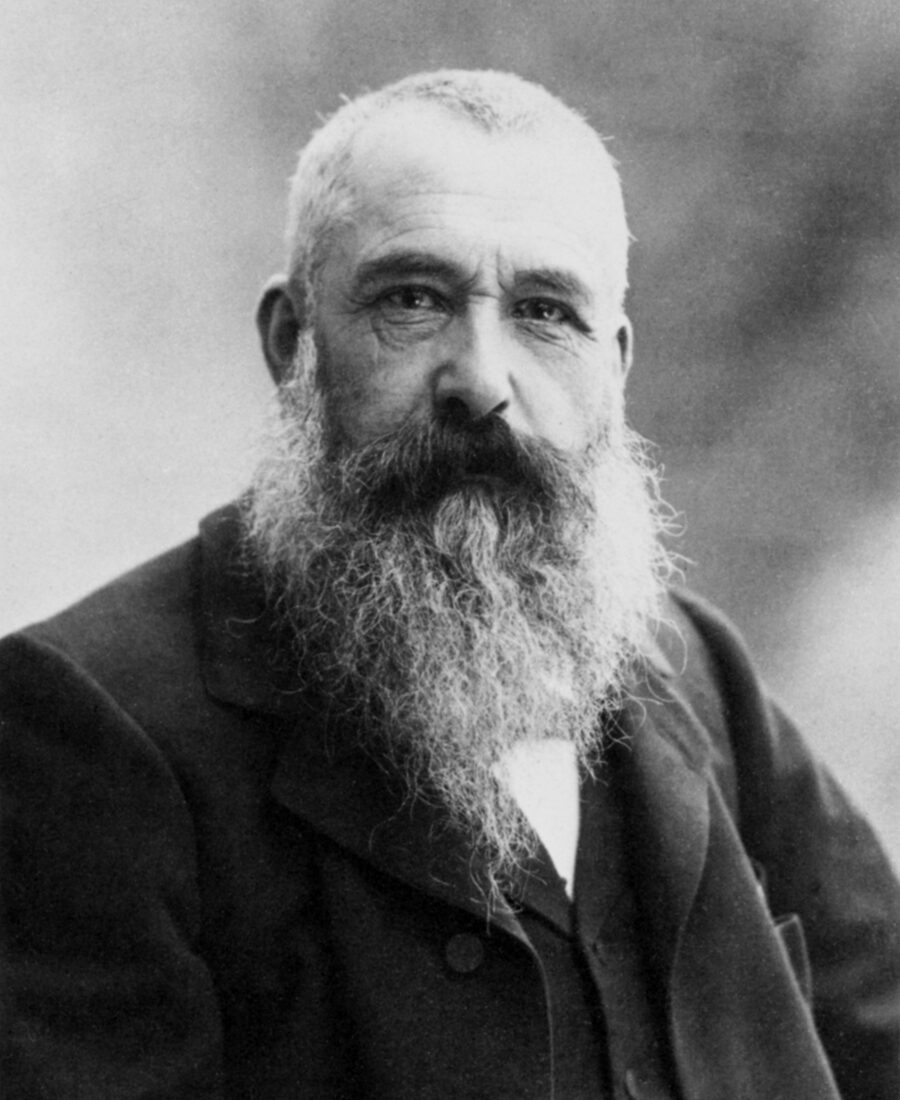
Author
Claude Monet
Movement / period
Impressionism
Medium
painting
Location
Musee de l'Orangerie, Paris
The Grand Decorations — the monumental cycle that lives at the Orangerie — almost never happened: in 1918 Monet agreed to donate them to France as a gift to mark the Armistice, but he spent another eight years fussing over the canvases and reworking them right up until his death in 1926, so the panels weren't actually installed at the Orangerie until the following year.

Highlights
Facts & legends
- Monet was nearly blind when he painted most of the large-scale Water Lilies panels — cataracts had turned his color perception severely yellow-brown, and he later admitted he repainted entire sections after his 1923 eye surgery when he realized what colors he had actually been using.
- The Grand Decorations — the monumental cycle that lives at the Orangerie — almost never happened: in 1918 Monet agreed to donate them to France as a gift to mark the Armistice, but he spent another eight years fussing over the canvases and didn't let them leave his studio until literally days before his death in December 1926.
- The oval rooms at the Orangerie were designed entirely around the paintings, not the other way around — architect Camille Lefèvre rebuilt the interior from scratch to Monet's exact specifications, including curved walls and specially angled skylights to eliminate direct sunlight on the surface.
- Monet destroyed a substantial number of his own Water Lilies canvases — he slashed at least 15 large panels with a knife in fits of dissatisfaction between 1908 and 1910, reportedly telling his dealer Paul Durand-Ruel that they were simply not good enough.
- During World War II the Orangerie panels were rolled up, removed from their frames, and hidden in rural châteaux to protect them from bombing and potential looting — they survived the occupation intact and were reinstalled in 1953.
- Monet's water garden at Giverny, the source of every lily painting, was not originally French: the Japanese-inspired bridge and the water plants were considered exotic and briefly caused friction with local authorities who worried the imported aquatic species would contaminate the river Epte.
Estimated value
What it is worth today
Monet gave the giant Orangerie Water Lilies to France — they are not for sale. Individual canvases from the series, however, have fetched over $80 million at auction.
More details How Monet first constructed a garden, then dissolved its horizon and turned a private pond into a vast peace memorial that visitors long ignored.
The artist made the motif first
Giverny's pond was designed rather than discovered
The Water Lilies look like an immediate encounter with nature, yet Monet carefully arranged that nature himself. After settling at Giverny in 1883, he developed a flower garden, acquired adjoining land and created a water garden. The pond was enlarged, water controlled and plants selected for colour and flowering season. Bridge, willows and lilies formed not a copy of wilderness but a living studio in which gardening became the first stage of painting.
This complicates the familiar image of an Impressionist simply catching accidental light. Monet spent years organising the conditions for that light: water, reflection, shade and changing plants. Water Lilies names not one canvas but nearly three hundred paintings made from the late 1890s until his death in 1926. One modest site supplied endless states without repeating a surface or a day.
A world without a horizon
The pond ceased to behave like a conventional landscape
Early Giverny views still tell us where we stand: a bridge crosses the pond and a bank secures depth. In the late Lilies the horizon disappears. We see the water surface, but sky, cloud, branch and dark depth occupy it together. Lilies rest on top, reflections fall downward and vertical willow strokes disturb both readings. The eye cannot decide whether it looks at the water or through it.
Monet did not abandon subject matter, although the late works mattered greatly to abstraction. Every stroke retains a physical cause: glint, plant, ripple or shadow. Yet the picture no longer provides a stable viewpoint. Colour describes an object and asserts its own presence at the same time. That threshold—nature remains recognisable while perspective loses command—made the cycle so fertile for mid-century painters.
A gift one day after war
The decoration became a peace memorial
On 12 November 1918, the day after the armistice, Monet wrote to his friend Georges Clemenceau offering the state two decorative panels as a sign of victory and peace. Clemenceau persuaded him to enlarge the gift. It grew into an environment; a 1922 deed covered nineteen panels. Monet wanted viewers surrounded by water and light rather than standing before a separate landscape.
Donation did not mean completion. Monet doubted, repainted and destroyed unsatisfactory passages, keeping the canvases until his death. Cataracts complicated his sight and operations altered aspects of colour perception, but illness alone cannot explain the late manner. Monumental scale and loosened space belonged to a project developed over decades. Clemenceau urged his friend to finish; resistance to finality gave the surfaces their restless density.
Rooms shaped like infinity
Architecture makes the painting continue
The Orangerie in the Tuileries was adapted for the panels. Two oval rooms join like an infinity sign. Eight compositions, extending roughly ninety-one metres, follow curved walls beneath natural overhead light. There is no privileged viewpoint: visitors must walk, turn and notice real daylight changing paint. Its scale is measured in duration as much as metres.
The rooms opened in 1927, months after Monet's death, without instant acclaim. To a generation of Cubism, Dada and Surrealism, Impressionism seemed old; attendance was sparse and temporary walls later hid parts of the panoramas. Renovations in the 1960s blocked the natural light Monet intended. The 2006 restoration finally recovered the original openness of the rooms.
A delayed rediscovery
America helped Europe see old Monet anew
After the Second World War the climate changed. Abstract Expressionists made canvases too large for a single glance, and late Monet suddenly looked prophetic. André Masson called the Orangerie the “Sistine Chapel of Impressionism” in 1952; New York's MoMA acquired a large panel in 1955. What had seemed belated in 1927 came to look like a radical painted environment.
The cycle should not be reduced to a stepping stone towards American abstraction. It grew from a specific garden, Monet's friendship with Clemenceau, memory of war, ageing and daily attention to water. In the Orangerie, do not hunt for one famous detail. Move slowly around both ovals. Lilies provide pauses, while the event unfolds between them: reflection becomes sky, depth becomes surface and one panel's ending passes into the next.
Official sources
Where to check
- Official institution site Musee de l'Orangerie
- History of the Water Lilies cycleMusée de l'Orangerie
- The Orangerie panoramas and Monet's designMusée de l'Orangerie
Visual context