
From the artist's life
Cataracts turned Monet's late vision yellow-red; after surgery he repainted some water-lily canvases, shocked at the blues he had been missing.
Source: Wikipedia / WikimediaImpressionism
Claude Monet (1840–1926) was the founder and most devoted practitioner of Impressionism. His painting Impression, Sunrise gave the movement its name, and he spent decades chasing changing light on haystacks, cathedrals and his water-lily pond at Giverny.
Monet freed colour from outline and turned perception itself into the subject of painting, opening the road to modern abstraction.
Cataracts turned Monet's late vision yellow-red; after surgery he repainted some water-lily canvases, shocked at the blues he had been missing.
Source: Wikipedia / Wikimedia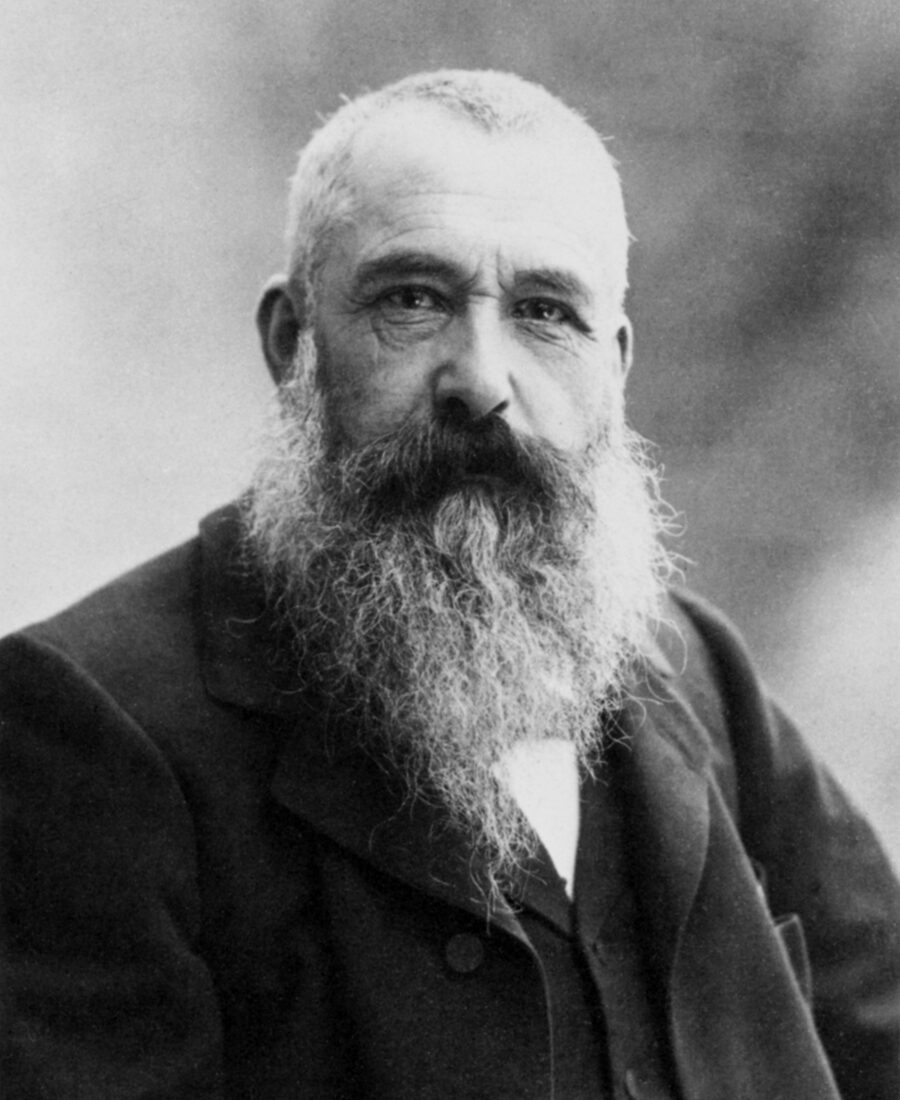

Key works
Works with a dedicated ArtAtlas page are highlighted in gold.
1872
Impression, Sunrise is an 1872 painting by Claude Monet first shown at what would become known as the "Exhibition of the Impressionists" in Paris in April, 1874. The painting is credited with inspiring the name of the Impressionist movement.
1877
Gare Saint-Lazare is a series of oil paintings by the French artist Claude Monet. The paintings depict the smoky interior of the eponymous railway station in varied atmospheric conditions and from various points of view.
FAQ
Quick answers to what people most often search about this artist.
Claude Monet was born in Paris on 14 November 1840 and died on 5 December 1926 at Giverny, the village where he had spent his last forty-three years. He was 86 and painted almost to the end.
Monet made light and weather the real subject of a painting: he worked outdoors in quick, separate strokes, gave up firm outlines and repeated one motif across dozens of canvases. Impressionism took both its name and its method from him.
His best-known painting is Impression, Sunrise (1872), the outer harbour of Le Havre in dawn mist, now in the Musée Marmottan Monet in Paris. The critic Louis Leroy mocked its title in 1874, and that is how Impressionism got its name.
For the Rouen Cathedral series of 1892–93 Monet rented rooms opposite the facade and kept several canvases going at once, switching from one to the next as the light shifted. He ended up with around thirty views of a single wall.