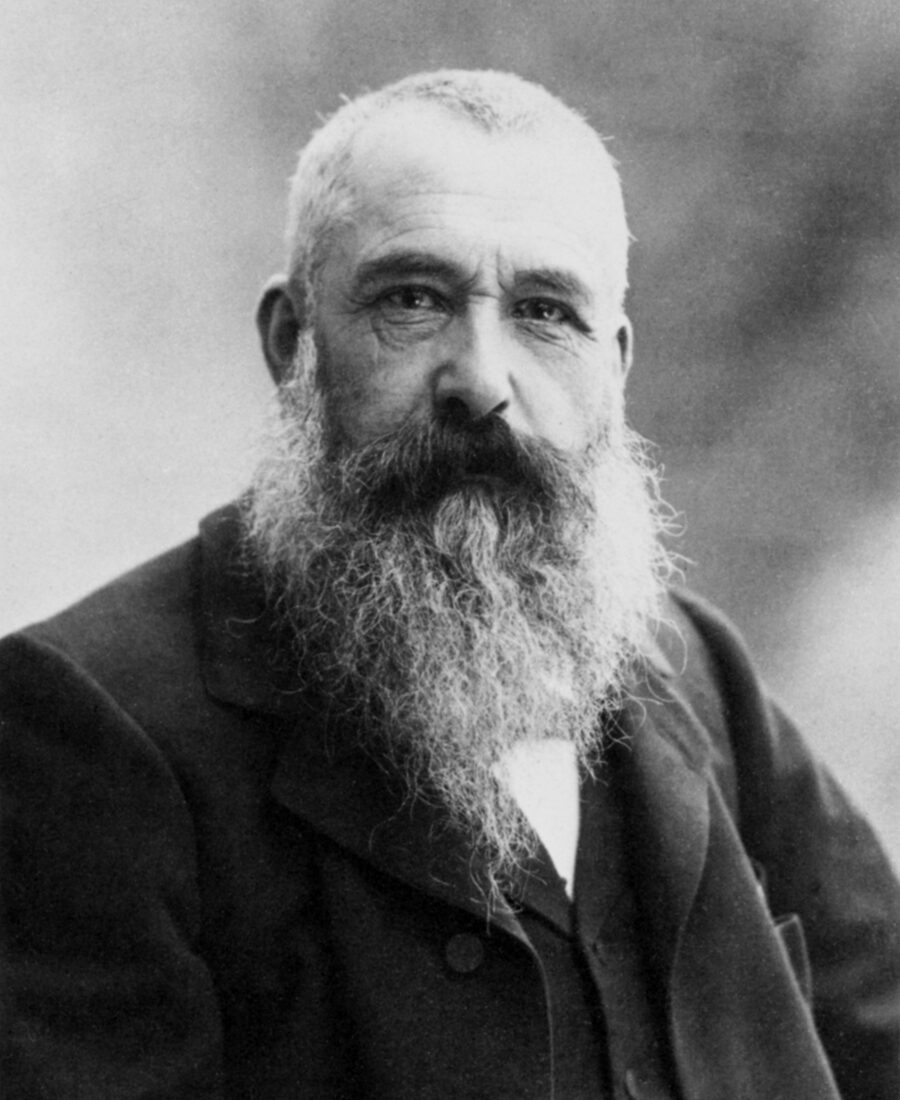
Intro source: Wikipedia (EN)
The series consists of 12 paintings made in roughly two months, all showing the same iron-and-glass shed, yet no two canvases share the same palette — Monet was obsessed with how the same cubic meters of air looked completely different depending on weather and time of day.

Highlights
Facts & legends
- To paint these canvases in early 1877, Monet talked his way into Gare Saint-Lazare by dressing up in his finest clothes and announcing to the station director that "the great painter Monet" had decided to immortalize this station — and it worked, they actually delayed trains and stoked extra steam for him.
- The series consists of 12 paintings made in roughly two months, all showing the same iron-and-glass shed, yet no two canvases share the same palette — Monet was obsessed with how the same cubic meters of air looked completely different depending on weather and time of day.
- When Monet showed seven of these works at the third Impressionist exhibition in April 1877, critic Georges Rivière wrote that the locomotives were depicted "like living creatures" — that line alone shifted how Parisian critics talked about industrial subjects in painting.
- The version now at the Musée d'Orsay (75.5 × 104 cm) was once owned by Gustave Caillebotte, the wealthy Impressionist painter who collected his friends' work obsessively and then bequeathed the whole lot to the French state in 1894 — a bequest that nearly caused a political scandal because the government wasn't sure it wanted Impressionism.
- Monet returned to the series format repeatedly for the rest of his career — haystacks, Rouen Cathedral, water lilies — but the Gare Saint-Lazare paintings from 1877 are the first time he systematically used serial repetition as a method, making this the conceptual prototype for everything that followed.
- The station itself still exists and is still Paris's busiest commuter hub; you can stand on roughly the same spot where Monet set up his easel, though the glass roof has been rebuilt and the steam locomotives are long gone.
More details How Monet gained access to a working station, turned steam into a new kind of landscape and made twelve distinct visions rather than one definitive view.
Landscape moves into town
In 1877 Monet traded Argenteuil for Paris and chose a subject that thundered, smoked and refused to stay still
Claude Monet settled in the Nouvelle Athènes district and obtained permission to work inside the Gare Saint-Lazare. This was not a picturesque prop but an operating terminus: trains kept their timetables, passengers crossed the platforms and engines discharged steam. Back in the capital after years in the suburbs, Monet tested whether an industrial interior could be painted with the freedom he had brought to water, snow and gardens.
The choice contained a neat reversal. Saint-Lazare carried artists towards Normandy, the coast and many celebrated Impressionist landscapes. Now the machine that delivered painters to nature became the landscape itself. Iron, glass, light and vapour were no longer background details; they became the material of vision.
Twelve attempts, not one answer
In a few months one station became a set of incompatible impressions
Monet gained access in January 1877 and made roughly twelve views by spring. Four were painted inside the train shed; others move along the tracks or outside the buildings. Viewpoint, steam, weather and finish all change. The series refuses to identify a single correct portrait of the place.
This working method anticipates Monet's later stacks, Rouen Cathedral and water lilies. Repetition is not duplication. It reveals how completely an object depends on hour, atmosphere and position. The station remains fixed while its visible identity multiplies.
Steam becomes indoor weather
Monet placed a clouded sky beneath the glass roof
In conventional landscape clouds float above the ground. Here white and blue vapour forms inside the engineering, masks locomotives and dissolves people. As the National Gallery observes, the roof contains an artificial weather system. Solid architecture can look less stable than the steam passing through it.
From a distance, wagons, figures and girders cohere into a convincing terminus. Close up they break into strokes and coloured patches. Monet balances document and near-abstraction: the exact locomotive matters less than the instant in which light, smoke and motion overwhelm a traveller's sight.
Eleven million passengers
The poetic haze belongs to a place of enormous daily traffic
By 1870 Saint-Lazare handled about eleven million suburban passengers a year. Behind the soft grey-blue atmosphere stands a new discipline of timetables, commuting and urban growth. People shrink to dark signs because the movement system, not an individual traveller, is the true protagonist.
Monet neither condemns the industrial city nor advertises it. He treats technology as a generator of unfamiliar optical effects. Beauty arises through soot and noise: glass cuts the light, iron vanishes into vapour and a few minutes of waiting acquire their own weather.
From Impressionist show to museum
The series demonstrated that one motif could change before the viewer's eyes
Monet listed seven station canvases for the third Impressionist exhibition in May 1877, although perhaps six were actually hung. Critics disputed the loose finish but noticed the variety of effects. Serial painting became an argument rather than a formula: each version tested another balance between architecture and atmosphere.
Gustave Caillebotte bought the Musée d’Orsay canvas from Monet on 10 March 1878 for 685 francs. It entered his famous bequest to the French state and was accepted in 1896. A painting that claimed a place in art for the modern railway is now a museum classic, yet it still feels as if an engine has just arrived.
Official sources
Where to check
- Official institution site Musee d'Orsay
- La Gare Saint-Lazare: catalogue and provenanceMusée d’Orsay
- The Gare St-Lazare: study of the 1877 seriesNational Gallery, London
Visual context