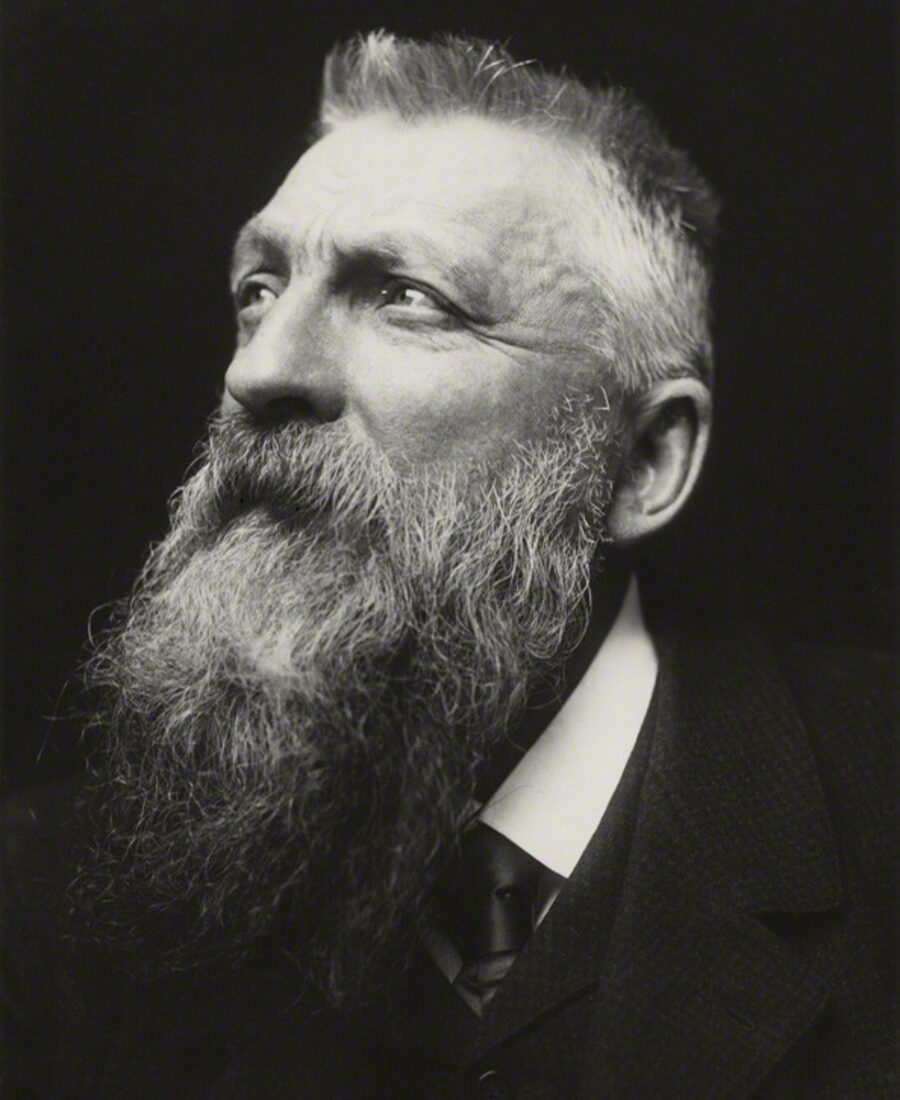
Intro source: Wikipedia (EN)
Author
Auguste Rodin
Movement / period
Sculpture and Form
Medium
sculpture
Location
Musee Rodin, Paris
He thinks with his whole body — every muscle is tensed, as if thought were physical labor.

Highlights
Facts & legends
- The Thinker began as a small figure at the top of Rodin's 'Gates of Hell,' meant to be the poet Dante brooding over the damned.
- He thinks with his whole body — every muscle is tensed, as if thought were physical labor.
- There are dozens of casts around the world; one in Cleveland was damaged by a bomb in 1970 and is still displayed with its blasted base.
- Rodin is buried beneath a cast of The Thinker at his home in Meudon, near Paris.
- The original figure on The Gates of Hell was about 70 cm tall; in 1904 it was enlarged to about 185 cm — to monumental scale.
Estimated value
What it is worth today
Casts of The Thinker are held in museums around the world and are not for sale; on the rare occasions Rodin bronzes come to auction they have reached tens of millions of dollars.
More details How Dante above The Gates of Hell became a universal thinker, why every muscle is tense, and why more than one bronze can be authentic.
He was not born a philosopher
The figure began life above the entrance to Hell
The Thinker now looks like a ready-made emblem of philosophy: a solitary man rests his chin on one hand and seems to shut out the world. Rodin began with something far more specific. In 1880 the French state commissioned a portal for a planned museum of decorative arts, based on Dante's Divine Comedy. Above the doors of The Gates of Hell, among bodies falling, clutching and desiring, Rodin placed a figure about seventy centimetres high. It was called The Poet. Dante leaned forward to inspect the Hell he had imagined.
That origin changes the familiar pose. This is not a scholar safely seated at a desk but an author surrounded by his own characters. His thought is physically precarious: folded forward and tightly compressed, he seems to hold himself over an abyss. Rodin gradually treated Dante as a point of departure rather than a script. The Gates became a vast storehouse of human passion in which bodies, fear and appetite overtook literary illustration. The Poet slowly acquired the freedom to leave the crowd below him.
Thought that hurts
Why every muscle participates
A comfortable thinker would support his back and let his feet rest. Rodin does the opposite. The right elbow meets the left knee, twisting the body across its own axis. Fingers buckle beneath the jaw, shoulders rise, the back makes a heavy arc and the toes grip the base. Even the oversized right hand offers no ease. Thought appears not as a light above the head but as pressure travelling from brow to feet.
The Musée Rodin points to two important precedents: Jean-Baptiste Carpeaux's Ugolino, Dante's imprisoned father driven to horror by starvation, and Michelangelo's seated Lorenzo de' Medici. Rodin did not copy a pose so much as borrow a contradiction. A monumental body remains still although it contains too much force. The figure can resemble an athlete, a labourer and a prisoner at once. Thinking does not release him from the body; it makes the body impossible to ignore.
Escape from the Gates
An independent exhibition changed the name and the meaning
In 1888 the figure was exhibited on its own. Without the portal or the damned around it, viewers no longer had to identify Dante. The Poet became The Thinker, and a literary character became humankind in general. This separation was central to Rodin's method. The Gates served as a laboratory of forms: he extracted figures, altered their scale and recombined them, turning one commission into many autonomous works. The Kiss and The Three Shades emerged from the same restless project.
The portal itself never occupied its intended museum entrance during Rodin's lifetime. The museum was not built, and the sculptor returned to the model for decades, keeping it mutable and unresolved. One of the world's most familiar sculptures therefore began as a detail in an architectural commission that never fulfilled its original purpose. The Thinker was not the project's final answer. It was the figure capable of walking out of its architecture and gathering meanings Rodin had not needed to specify.
Seven hundred kilograms of reflection
Enlargement turned private drama into a public monument
Around the turn of the century Rodin enlarged the figure to nearly three times its first scale. The enlargement was made in 1902–03 and the Alexis Rudier foundry cast the monumental bronze in 1904. It stands 189 centimetres high and weighs about 700 kilograms. Scale changed more than dimensions. The small Poet belonged to a crowded scene; the huge nude demanded civic space around him. The large version appeared publicly in London in 1904, and a cast was installed outside the Panthéon in Paris in 1906.
A naked figure beside a building of national memory was a bold choice. He has no book, robe, desk or professional attribute to explain his authority. Concentration itself becomes the monument. That cast later moved to the Musée Rodin garden. Another stands at Meudon over the grave of Rodin and his wife Rose. A character conceived as Dante above an imaginary realm of the dead thus became attached to the actual burial place of the sculptor who made him.
Why there is no single bronze original
Multiplicity belongs to the medium
Visitors meet The Thinker in several cities and naturally ask which one is real. Bronze sculpture does not work like a unique painted canvas. Rodin modelled in clay; moulds and plasters preserved the form; a specialist foundry cast it in metal. An authorised mould can produce several legitimate casts, while this work also exists at different scales. Provenance, date of casting and the role of the Musée Rodin matter more than the idea that only one bronze can be genuine.
Fame has reduced the figure to desk ornaments and jokes about overthinking, yet the large sculpture resists the cliché. Move to the side rather than staring only at the face. The elbow crosses the torso, the spine gathers the weight and the apparently idle hand closes the composition. Rodin needed an athlete's body because he was not making a portrait of intelligence. He was modelling the instant when thought takes possession of an entire person.
Official sources
Where to check
- Official institution site Musee Rodin
- The Thinker: history, dimensions and versionsMusée Rodin
- The Gates of Hell: interactive project archiveMusée Rodin
Visual context