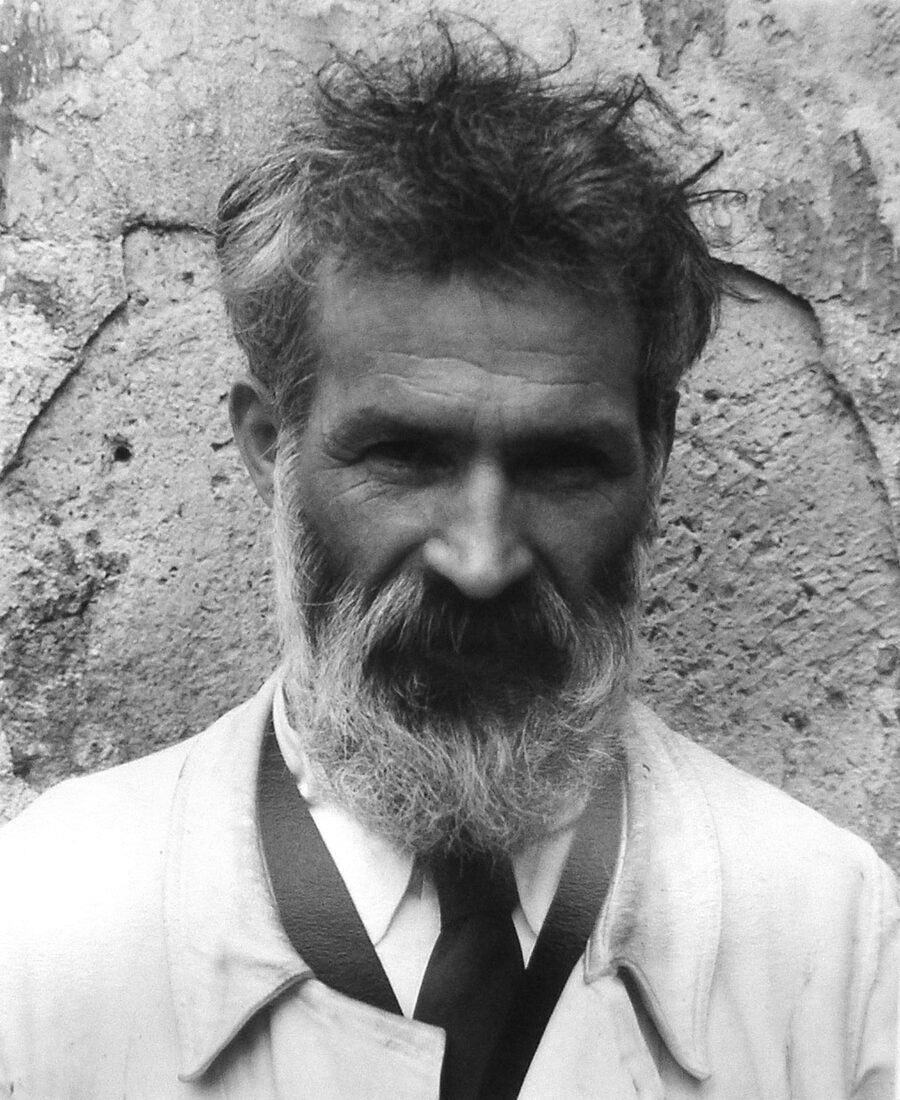
Author
Constantin Brâncuși
Movement / period
Sculpture and Form
Medium
sculpture
Location
National Museum of Art of Romania, Bucharest
The piece nearly caused a customs scandal in America: when U.S. officials tried to import a later Brancusi bronze in 1926, the government insisted it was "industrial metal," not art, and slapped it with a 40% tariff — triggering a famous trial in 1928 that ended with a U.S. court ruling that abstract sculpture could count as art after all, exempting it from duty.

Highlights
Facts & legends
- Brancusi carved the first version of The Kiss directly from a single limestone block in 1907 — no maquette, no assistants, just a chisel and a vision he later said came to him whole.
- The piece nearly caused a customs scandal in America: when U.S. officials tried to import a later Brancusi bronze in 1926, the government insisted it was "industrial metal," not art, and slapped it with a 40% tariff — triggering a famous trial that redefined what sculpture legally is.
- Rodin had actually offered the young Brancusi a studio apprenticeship, and Brancusi turned him down flat, reportedly saying "nothing grows in the shadow of a great tree" — The Kiss was partly his answer to Rodin's ornate, narrative style.
- There are at least four major versions of The Kiss in different materials and sizes; the one in the Montparnasse Cemetery in Paris sits as a gravestone over the tomb of Tatiana Rachewskaia, a young Russian woman who died in 1910.
- The two figures in The Kiss share a single eye carved across both faces — a deliberate choice that makes it impossible to read them as two separate people; they are formally inseparable in the stone itself.
- Philadelphia's version, acquired by the Museum of Art in 1933, was one of the first Brancusi sculptures to enter a major American public collection — bought for $4,000 at a time when curators were still debating whether abstract sculpture belonged in a museum at all.
More details Why Brancusi compressed a kiss into a stone block, how it answers Rodin, and how one motif expanded into a grave, a column and a monumental gate.
One stone, not two figures
The embrace begins with the block
Profiles meet at a central seam, arms circle a cube and two eyes form one oval sign.
Rough limestone remains visible, making intimacy weighty rather than illusionistic.
Brancusi began The Kiss around 1907, shortly after brief work in Rodin's studio. Instead of anatomically elaborate bodies he used a nearly intact block and few cuts. This was not lack of skill but an argument against sculpture as illusionistic flesh. Love had to occur within stone's own weight and limits.
An answer to Rodin
Drama is reduced to a sign
Where Rodin modelled twisting flesh, Brancusi kept frontal symmetry, tool marks and the integrity of stone.
One shows an event; the other makes the event into an object.
There is no single Kiss but a sequence. Philadelphia's 1916 sculpture is considered the fourth and most unified: two eyes make one oval, hairlines one arch, and arms close around the cube. Repetition tested how much difference could disappear without erasing encounter.
A series, not copies
The motif changed for decades
Brancusi began around 1907–08 and altered proportions, carving and the union of the faces. Philadelphia calls its 1916 sculpture the fourth and most formally unified version.
Different-looking photographs can therefore represent authentic but distinct Kisses.
Faces appear in profile and front at once, an optical impossibility familiar from archaic and folk art. A central line crosses the block without splitting it. Left and right exist together: the kiss is not a gesture between separate statues but a condition of one volume that remembers being two.
A kiss on a grave
Love acquired a tragic address
A 1909 version was placed on Tatiana Rachewska's grave at Montparnasse.
Later ownership disputes exposed its double identity as sculpture, tomb and public memory.
Brancusi treated the base as part of the work and recommended a simple display. The Arensbergs later placed it on a low bench among Pre-Columbian carvings. That arrangement records a search beyond European naturalism, but also the period's problematic habit of grouping distinct cultures as 'primitive'.
From couple to gateway
An intimate sign becomes architecture
Brancusi repeated the motif in the Column and Gate of the Kiss at Târgu Jiu.
Reduction did not shrink meaning; it allowed the form to change scale.
The motif grew into architecture through columns of repeated couples, while a version on Tania Rachevskaia's grave turned embrace into memorial. One cube became intimate sculpture, column module, and funerary sign, changing meaning without adding complexity.
Official sources
Where to check
- The Kiss, 1916Philadelphia Museum of Art
- Constantin BrancusiMuseum of Modern Art
- View of the Artist's StudioMuseum of Modern Art
- Constantin BrancusiCentre Pompidou
- Constantin BrancusiGuggenheim Museum
- Constantin BrancusiEncyclopaedia Britannica
Visual context