
Author
Ilya Repin
Movement / period
Russian Realism
Technique
oil on canvas
Where it is
Russian Museum, St Petersburg
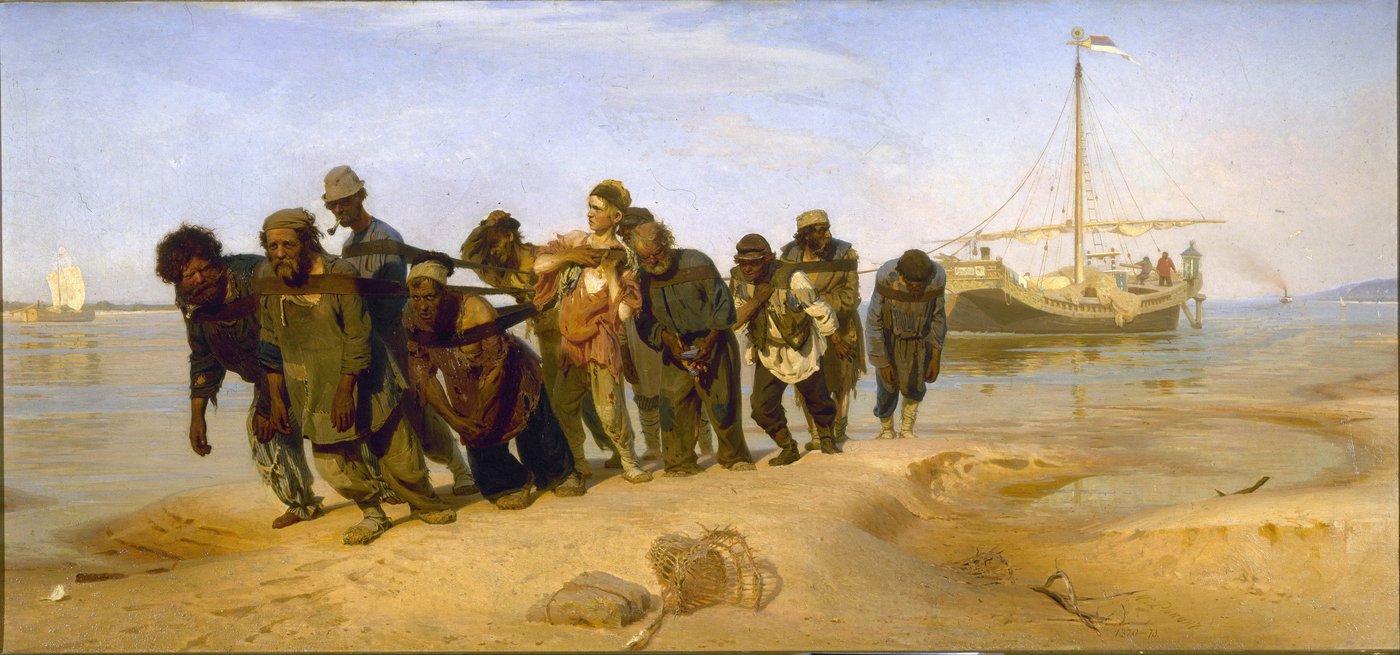
The crew numbers eleven haulers — each painted from a specific individual and easily distinguished by face and pose.
Highlights
Facts & legends
- Repin studied real barge haulers on the Volga over three consecutive summer seasons rather than inventing the figures in his studio.
- The crew numbers eleven haulers — each painted from a specific individual and easily distinguished by face and pose.
- The painting brought Repin fame in 1873, when it was shown (including at the Vienna World’s Fair): he was about 28–29 and had already graduated from the Imperial Academy of Arts (1871).
- Among the haulers are a former priest and a young man adjusting his harness strap — a detail critics called the picture's emotional centre.
- The work became a banner of the Peredvizhniki (The Wanderers) and a benchmark of socially engaged Russian Realism.
More details Eleven real haulers, two Volga summers, and a canvas that broke the Academy's own rules.
What's on the canvas
Eleven backs under one sun
Eleven haulers drag a barge along a sandbank, each man leaning his weight into the same rope, no two faces alike. At the front, breaking the line of pull, walks Kanin, a defrocked priest — stocky, heavily bearded, the only one looking ahead rather than down at the sand. Beside him Ilka the sailor glares straight out of the canvas, as if the viewer were somehow to blame for the heat and the harness. A step behind is Larka, the youngest of the crew, shirt torn, adjusting on the move a strap that has slipped off his shoulder — a small gesture critics later singled out as the most human motion on the whole canvas. There's a retired soldier named Zotov, a red-haired strongman from near Nizhny Novgorod, and a pipe-smoker who hauls with the flat indifference of a man clocking in for a shift he has done a thousand times.
Behind them the loaded barge sits low in the water; the sun is at its highest, and the sand is painted grain by grain until it looks hot to the touch. There's no storm, no dramatic sky — just an ordinary summer haze, and that's the point: Repin doesn't need bad weather to manufacture tragedy, the tragedy is in the sheer routineness of the effort. The shadows are short, so it's noon, the harshest hour of the shift. Eleven figures, no two sharing a pose — the picture holds together not as a crowd but as eleven separate lives currently moving in the same direction.
How it was made
Two Volga summers and one superstitious refusal
The subject found Repin almost by accident: in 1868, boating on the Neva in St Petersburg, he saw a gang of barge haulers pass close to a crowd of well-dressed strollers, and the contrast lodged in his head. In the spring of 1870, still a student at the Imperial Academy of Arts, he travelled down the Volga with the painter Fyodor Vasilyev, the artist Yevgeny Makarov, and his younger brother Vasily. They landed at Stavropol-on-Volga on 17–18 June and spent the summer in the village of Shiryayevo, sketching from life and getting to know real haulers — talking with them at rest, walking alongside them at work, catching quick studies on the move.
One of the earliest sketches was enough to interest Grand Duke Vladimir Alexandrovich, Alexander II's second son, who commissioned the finished picture and paid 3,000 roubles — a serious sum for a painter who hadn't even graduated yet (his Academy diploma came in 1871). Finding models among the haulers themselves wasn't simple: a folk belief held that a painted likeness took away part of a person's soul, and not everyone would sit still for it. Kanin, the defrocked priest who ended up leading the group on canvas, sat for Repin, according to surviving notes, on 19 July 1870.
Repin returned to the Volga a second time in the summer of 1872, now with his wife Vera Alexeyevna, travelling by steamer as far as Samara to finish gathering material. A whole set of preparatory work survives from these trips: a graphic sketch and an oil study from 1870 measuring 28.7 × 42 cm (now in the Russian Museum), another 1870 oil sketch on board, 23.5 × 50.5 cm (in the Tretyakov Gallery), and a separate compositional variant, Barge Haulers Wading (1872, 62 × 97 cm) — evidence that Repin tried several arrangements of the group before settling on the final one. He showed an unfinished version at the Society for the Encouragement of Artists exhibition in 1871 and won first prize in genre painting for what was, strictly speaking, still a large study. The finished canvas, 131.5 × 281 cm, was completed by early 1873.
Where it came from
Not a type, a person: breaking with the Academy
In 1870 Repin was still an Academy student, trained in a system that measured a painting's seriousness by its subject: scripture, antiquity, capital-H History. A canvas the size of a history painting was permitted for tsars and saints, not for a gang of ragged haulers on a Volga sandbank. By choosing exactly that subject at exactly that scale — 131.5 × 281 cm, the footprint of a history painting — Repin effectively borrowed the Academy's own visual grammar and pointed it at contemporary, socially uncomfortable material. The critic Vladimir Stasov later wrote that no one in Russia had dared do this before.
He wasn't the first in Europe to raise an ordinary laborer to the scale of serious art, though. A little earlier, Jean-François Millet had already filled French painting with figures doing exactly this kind of work — women bent over stray stalks after the harvest in The Gleaners, or a couple frozen in evening prayer in the middle of a field in The Angelus. Millet's labor is quiet, almost liturgical; Repin's is loud and sweaty, with Ilka the sailor staring straight at the viewer — but the aim is similar: make people look at those a painting usually looks past. Earlier still, Pieter Bruegel the Elder had given ordinary work and weather a similarly monumental treatment in The Hunters in the Snow, where small figures carry the full weight of a winter day and the landscape itself acts rather than decorates.
Repin had no single teacher pushing him toward this subject — it was more a collision of a theme already in the air (the Wanderers were already looking for heroes like this) with the personal jolt of that afternoon on the Neva in 1868. But after Barge Haulers, Repin's reputation was set: a painter who could put a specific person on canvas, not a type.
What happened to it
From a grand duke's billiard room to Room 33
The finished canvas hung in the billiard room of the Vladimir Palace in St Petersburg — a picture about poverty and strain furnishing a leisure room for one of the wealthiest men in the empire. In March 1873 it went on show at the Academy of Arts exhibition, where Repin received the Vigée-Lebrun gold medal "for expression," then travelled to the Vienna World's Fair, where it won a bronze medal; the German critic Friedrich Pecht called it "the sunniest picture at the whole exhibition."
After the 1917 revolution the palace and the grand duke's collection were nationalized, and in 1918 Barge Haulers moved to the State Russian Museum, where it has stayed since. During the Second World War it was evacuated, along with other museum holdings, to Molotov (present-day Perm) and kept in the regional art gallery until the war ended. In 1963 art historians Milda Viktorina and Lidia Gladkova X-rayed the canvas and found traces of changes under the surface paint — Repin, it seems, kept adjusting poses and details well past the sketch stage. In 1968 the restorer Ananiy Brindarov carried out a major treatment: consolidating flaking paint, transferring the canvas onto a new support, and removing discolored varnish.
Today the painting hangs in Room 33 of the Mikhailovsky Palace, and in recent years it has travelled for loan exhibitions to Stockholm (2011–2012), Chemnitz (2012), Moscow's Tretyakov Gallery (2019), Helsinki (2021), and Paris (2021–2022) — an unusual amount of travel for a museum piece of this size and fragility.
Its afterlife
A harness strap that reached as far as Helsinki
In the Soviet decades Barge Haulers became a teaching aid: every school textbook used it to illustrate the misery of life under the tsars, even though Repin himself left no manifesto behind — he simply painted what he'd seen on the Neva and the Volga. The painting is also where a common Russian phrase comes from, "pulling the hauler's strap," meaning grinding through joyless, obligatory work.
Its loudest international echo happened far from Russia. In 1958 the Finnish cartoonist Kari Suomalainen published a drawing in Helsingin Sanomat showing Nikita Khrushchev riding a Volga barge pulled, instead of haulers, by the leaders of the Soviet bloc — a direct quotation of Repin's composition. The cartoon spread through Western newspapers and turned up on posters in London during Prime Minister Macmillan's visit to Moscow; the USSR lodged a protest, and Khrushchev personally complained to Finnish president Urho Kekkonen about the "irresponsible" Finnish press — an ordinary newspaper cartoon briefly became a Cold War diplomatic incident.
Inside Russia the image lives on in gentler form: it's one of the most parodied paintings on the Russian internet, with meme generators built specifically around it, the haulers' faces dropped into any situation that calls for shared, obligatory gloom. Serious art historians cite it differently — as the moment Russian painting stopped flinching from depicting the present without embellishment, opening the door for the Wanderers' realism that defined Russian art through the rest of the 1870s.