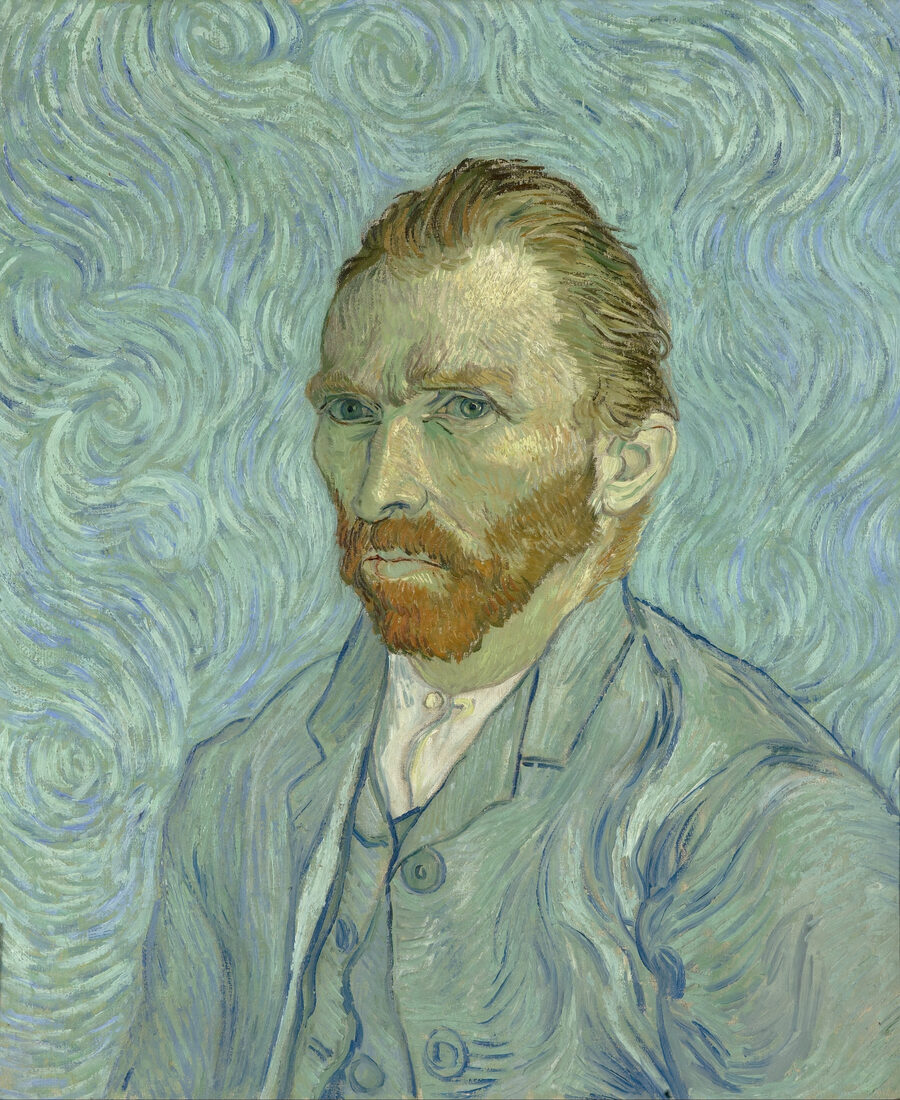
Intro source: Wikipedia (EN)
Author
Vincent van Gogh
Movement / period
Post-Impressionism
Medium
painting
Location
Courtauld Gallery, London
The bandage covers his right ear, but he worked from a mirror: the ear he actually mutilated was the left one.

Highlights
Facts & legends
- Van Gogh painted it in January 1889, only weeks after he cut off part of his own ear with a razor during a breakdown in Arles.
- The bandage covers his right ear, but he worked from a mirror: the ear he actually mutilated was the left one.
- A Japanese woodblock print hangs on the wall behind him, a reminder that even in crisis he kept the art he revered within sight.
- By one persistent account he carried the severed ear to a brothel and handed it to a woman there, telling her to guard it carefully.
- Despite the fresh wound he shows himself composed: fur cap, buttoned coat, pipe smoking quietly, as if proving he was in control again.
- The picture belongs to the Courtauld Institute of Art in London and hangs in its gallery at Somerset House.
More details How Van Gogh painted, one week after hospital, not a report of injury but a declaration of return—with mirrored bandage, winter cap, easel and Japanese print.
A week after hospital
The portrait followed his return to the Yellow House in January 1889
After a severe crisis and quarrel with Gauguin on 23 December 1888, Van Gogh injured his left ear and spent about two weeks in hospital. Gauguin had left and the Studio of the South dream had collapsed.
The image does not reenact the wound. The bandage records damage, while the act of painting announces that work has resumed.
Van Gogh painted two related but distinct bandaged-ear self-portraits that January. The Courtauld version places easel and Japanese print behind him; the other, now privately held, has a simpler background and pipe. They are not mechanical duplicates. Different signs of daily life and profession change the meaning of the same traumatic fact.
The apparently wrong ear
A mirror reversed the sides, not history
The left ear was injured, but appears at the viewer's right because Van Gogh painted his reflection. The Courtauld explicitly confirms this simple source of confusion.
Self-portraiture supplied an affordable model and experimental laboratory; more than thirty painted examples survive from only a few years.
Mirror reversal also reminds us that this is not a police record. Van Gogh saw a working reflection, not himself through another person's eyes. Bandage and winter clothing are factual, but the face is organised through colour and composition. Demanding photographic evidence misses the method of self-observation.
A practical hat
Fur held the bandage and resisted the January cold
The dark cap and green coat belong to harsh working conditions, not theatrical costume. Short strokes and charged green, yellow, red and white hold vulnerability together with discipline.
He looks less posed as a martyr than equipped to keep working.
The bandage runs beside ear, cheek, and chin as a bright geometric form. White is not empty: cool and warm strokes argue with green coat and orange wall. A medical object becomes the centre of chromatic balance without being hidden or allowed to destroy the whole picture.
Two paths behind him
Easel and Japanese print define his artistic identity
A new canvas stands at left and a print by Sato Torakiyo hangs at right. Van Gogh valued Japanese contour, flat colour and cropping as tools for renewing European painting.
The artist stands between work in progress and a continuing source of inspiration. Gauguin's departure ended one project, not painting itself.
The print is identified with a Japanese image of women associated with Sato Torakiyo. Van Gogh crops it with his portrait's frame, just as Japanese artists taught him to crop space. Influence works twice: the print appears as an object and changes the composition containing it.
Return, not diagnosis
Its central verb is to continue
Later biography tempts viewers to treat every mark as a symptom, but no diagnosis can be read from an expression. The factual action is clearer: Van Gogh reorganised his studio and painted.
Bandage, easel and print say three things at once: harm occurred; the artist remains; work continues.
Popular culture uses the portrait as an emblem of the 'mad artist', erasing the labour after hospital. Brushwork is not uncontrolled: cap, bandage, and face are calculated; colours bind; background is apportioned. A person in crisis constructs a complex work. Biographical tragedy and professional will coexist.
Official sources
Where to check
- Self-Portrait with Bandaged Ear: object recordThe Courtauld Gallery
- The Courtauld collection catalogueThe Courtauld Institute of Art
- Mirror, bandage, and the two portraitsThe Courtauld Gallery
- Portrait, studio, and Japanese printThe Courtauld Gallery
- Van Gogh's self-portraitsVan Gogh Museum
- Vincent van Gogh: the lettersVan Gogh Museum and Huygens Institute
Visual context