
Author
Yayoi Kusama
Movement / period
Contemporary art
Technique
fibreglass or bronze, painted
Where it is
various sites and collections
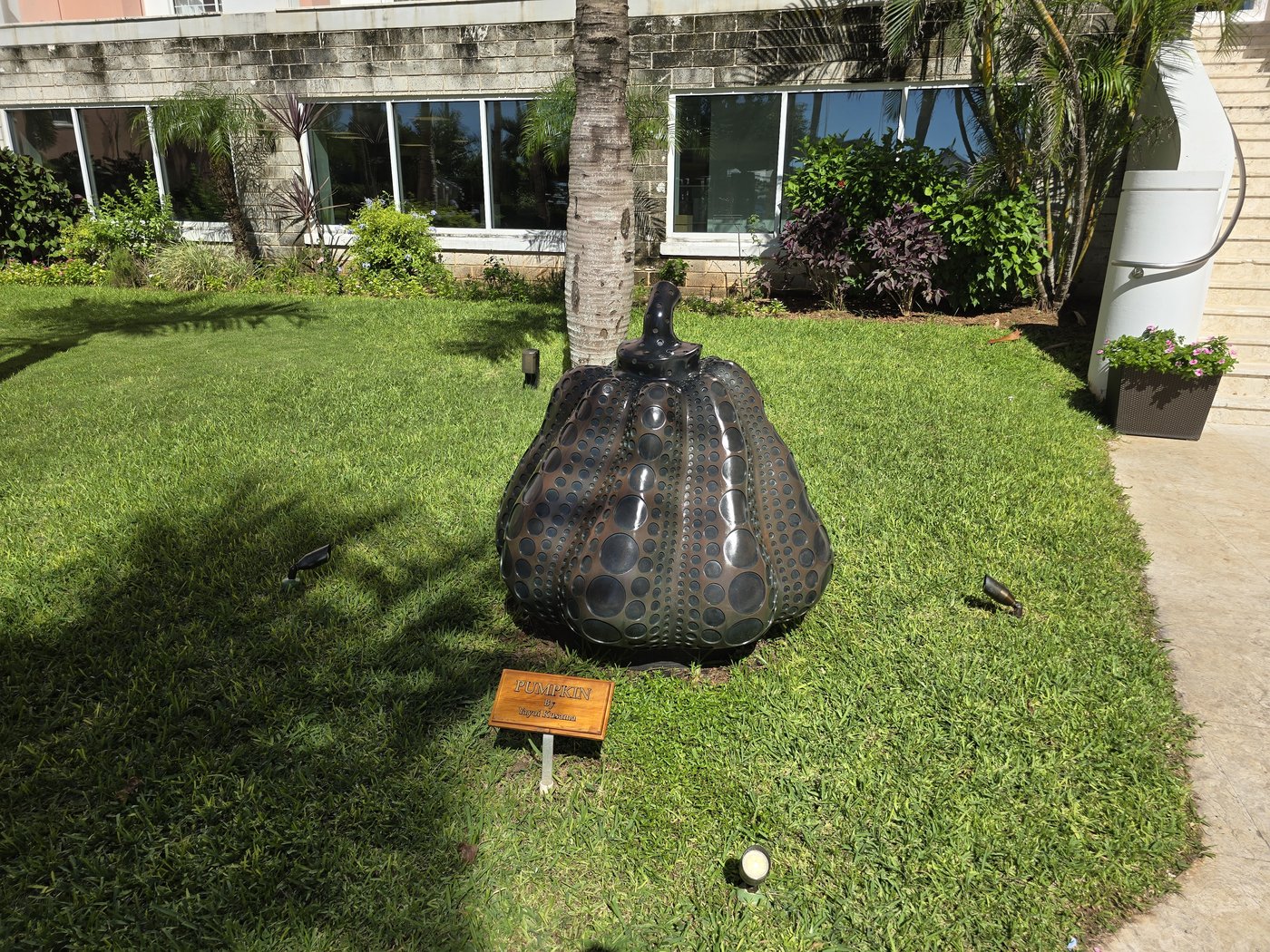
The artist calls the pumpkin a source of comfort that helps her cope with hallucinations she has experienced since childhood.
Highlights
Facts & legends
- Kusama has worked with the pumpkin motif since the 1940s — her personal emblem and a form of self-portraiture.
- The artist calls the pumpkin a source of comfort that helps her cope with hallucinations she has experienced since childhood.
- Different versions of Pumpkin have been installed as large-scale sculptures in museums and public spaces around the world.
- One famous yellow pumpkin on Naoshima Island in Japan was destroyed by a typhoon in 2021 and later recreated.
- Kusama has voluntarily lived at a psychiatric hospital in Tokyo since 1977, continuing to work at her nearby studio.
Estimated value
What it is worth today
Kusama's Pumpkins are in museums and collections worldwide; her works have reached several million dollars at auction, and the famous Naoshima pumpkin is a public landmark.
More details How a familiar vegetable became Kusama's companion, self-portrait, and cosmos; why a mirrored pumpkin restored her international career; and how Naoshima's icon was once swept into the sea.
A childhood fear became a friendly figure
Kusama painted her first pumpkin at eleven
Her family ran plant nurseries and a seed farm in Matsumoto. Kusama recalled encountering a pumpkin almost as large as a human head and hearing it speak. Unlike the flowers and patterns that could become frightening visions, it felt calm, humorous, and reassuring.
Drawing and repetition helped her order these experiences. Ribs gave the body stability, dots turned skin into rhythm, and the vegetable became a comic self-portrait: grounded, odd, and stubbornly alive.
It is not a single object
Pumpkin is a family of works across materials and scales
Kusama revisits pumpkins in drawings, paintings, soft sculptures, bronze, fibreglass, and mirror rooms. Some fit in a hand; others occupy public squares or a pier.
Dots follow each bulge and hollow, making the heavy body seem to pulse. The pattern defines the object while also dissolving its edge, echoing her nets and infinity environments.
A mirror room restored her visibility
Pumpkins carried Kusama back to the international stage
After her celebrated New York years, Kusama returned to Japan and her global profile receded. Mirror Room (Pumpkin), made for a Tokyo exhibition in 1991, placed a small crop inside a mirrored cube and multiplied it beyond sight.
Shown at the 1993 Venice Biennale, it introduced a new generation to her work and opened the path to later Infinity Rooms. A modest vegetable became the vehicle for a major artistic return.
Naoshima turned the image into landscape
The yellow sculpture first occupied the old pier in 1994
Created for Open Air ’94, the yellow-and-black Pumpkin stood between blue sea and green island outside Benesse House Museum. The view became a symbol of the whole island.
At the boundary of land and water, it appears both absurd visitor and natural resident, preserving domestic humour even at monument scale.
A storm swept the icon away
The damaged sculpture was remade and returned
In August 2021 a typhoon wave tore Pumpkin from the pier and battered it along the shore. Staff recovered it, while video of the famous sculpture tumbling in the sea travelled worldwide.
After consultation with the artist and stronger safeguards, a newly made work returned on 4 October 2022. A motif of growth and survival acquired a real biography of destruction and renewal.
Official sources
Where to check
- Yayoi Kusama Inc. Yayoi Kusama Inc.
- Kusama and the infinity roomsNational Gallery of Australia
- Pumpkin returns to NaoshimaBenesse Art Site Naoshima
- The pumpkin on the pierBenesse Art Site Naoshima
Visual context


