
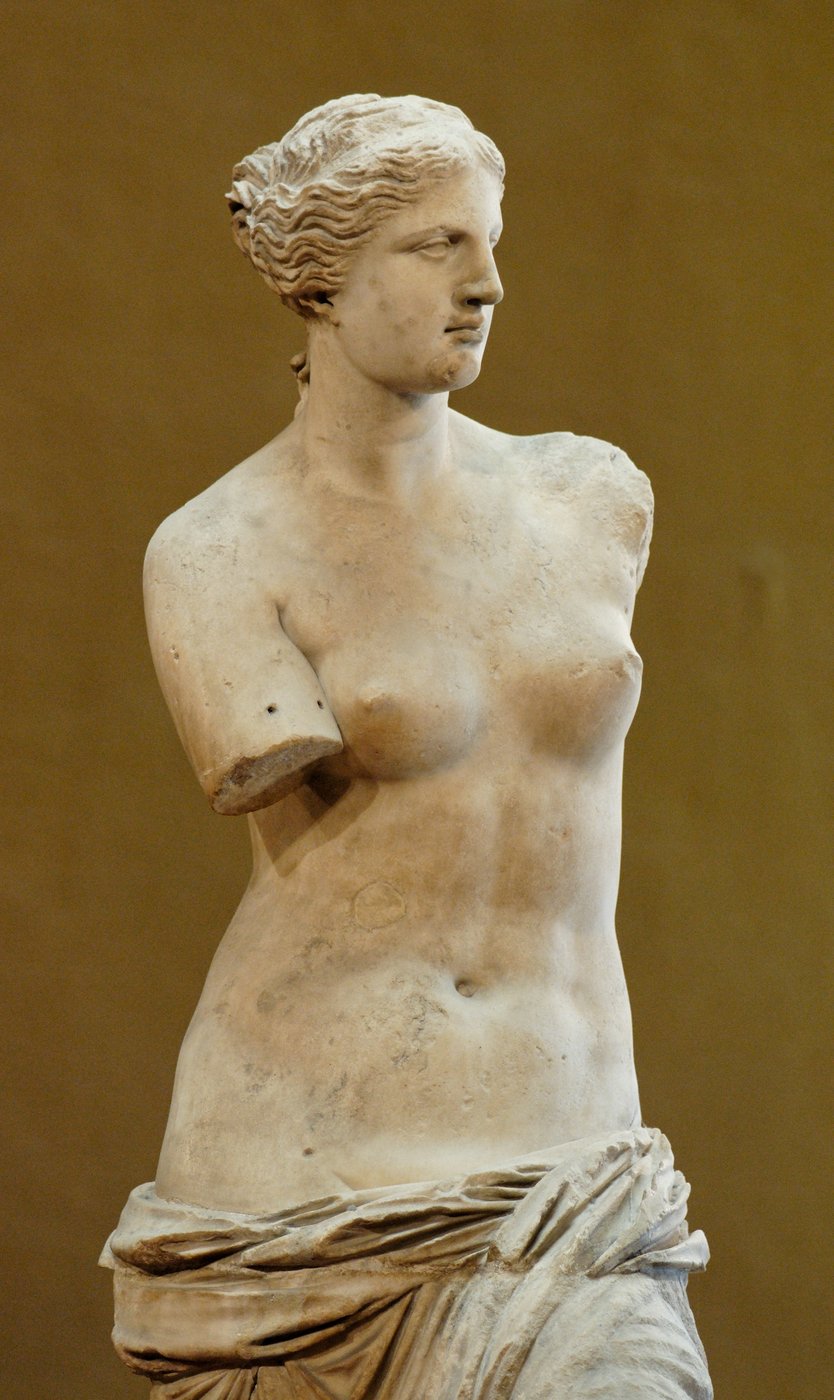
Both arms are missing and have never been found — their absence became part of the statue's enigmatic appeal.
Highlights
Facts & legends
- The statue was found on the island of Milos in 1820 by local farmers digging on their land.
- Both arms are missing and have never been found — their absence became part of the statue's enigmatic appeal.
- The statue was acquired by the French ambassador, the Marquis de Rivière, who presented it to Louis XVIII; the king gave it to the Louvre in 1821, where it became an emblem of the museum alongside the Mona Lisa.
- The statue was likely originally painted and adorned with metal jewellery — today we see only bare marble.
- Authorship was traced to an inscription naming the sculptor Alexandros of Antioch on a pedestal fragment, which was later lost.
More details How a fragmented statue from Melos became the Louvre's timely new star, why its arms were deliberately left unrestored, and what an apple, a shield, and jewellery holes reveal about its lost appearance.
It was found in pieces
The marble emerged near the ancient gymnasium in 1820
Discovered on Melos, now Milos, the statue dates to about 150–125 BCE and was originally assembled from separate blocks of Parian marble.
Drapery hides the waist joint; a mortise proves the left arm was attached separately, while holes indicate a metal diadem and bracelet.
The assembled figure stands 204 centimetres high. The Louvre also records a missing left arm, much of the right arm, the left foot, and chips on the back; the chignon was reattached and the tip of the nose restored in plaster. These interventions are discreet but remind us that the viewer meets ancient marble after breakage, excavation, transport, and modern conservation rather than untouched antiquity.
The sculptor is unknown
A confident attribution to Alexandros is misleading
The Louvre catalogues the work as anonymous. Alexandros of Antioch was linked through reports of an inscribed plinth found nearby, but its relationship to the statue is disputed and the fragment is lost.
Documented material, technique, and findspot should therefore be separated from a convenient name.
The lost plinth often becomes a conspiracy story: the signature was supposedly hidden to make the statue older. Reliable evidence does not support such certainty. The Louvre dates the sculpture to the third quarter of the second century BCE and lists no artist. Alexandros remains a historical hypothesis useful to the discovery story, not a secure signature for the museum label.
The arms were deliberately not restored
An early restorer wanted to complete the figure
Once in France, several reconstructions were considered, but no pose proved convincing. The Louvre chose not to make modern invention part of the ancient object.
A hand with an apple could identify Aphrodite after the Judgment of Paris; the left leg also permits a shield in which Venus, lover of Mars, might admire her reflection.
A hand with an apple was carved from the same Parian marble and found nearby, but proximity does not prove attachment. The shield theory explains the turning torso and raised left knee: the goddess may have leaned on a shield or viewed her reflection. Other reconstructions exist. Refusing new arms keeps the question open and makes curatorial honesty part of the statue's present form.
Even the goddess is not certain
Aphrodite prevailed over local Amphitrite
The half-nude body and apple support Aphrodite, Roman Venus. Yet Amphitrite was worshipped on Melos, and lost arms removed the decisive attribute.
The famous name records both an interpretation and the island that gave the statue its modern biography.
Mounting holes show an image less colourless and pure than later taste imagined. A metal diadem adorned the head and a bracelet the right arm; ancient sculpture may also have carried lost colour. Aphrodite is favoured through the half-nude type, possible apple, and pose, but the Louvre preserves Amphitrite as an alternative. 'Venus' is the Roman name of a Greek goddess and a product of museum tradition.
The Louvre needed a new antique star
She arrived after Napoleonic restitutions
The Marquis de Rivière gave the find to Louis XVIII, who donated it to the Louvre in 1821. After Waterloo, France had returned thousands of seized works and the museum had lost major antiquities.
The new Greek original arrived at the perfect institutional moment. Missing arms became an icon rather than merely damage, and the statue now stands for near-circular viewing.
Instant fame was not purely aesthetic. After the restitution of Napoleonic seizures, the Louvre needed an indisputably Greek original to fill a symbolic absence. Later artists turned recognition into material: Dalí gave a plaster Venus drawers, Magritte painted her in colours, and Niki de Saint Phalle shot a version containing paint. Missing arms did not halt the biography; they made the silhouette endlessly quotable.
Official sources
Where to check
- Collection record: date, dimensions, material, condition, and mountingMusée du Louvre
- Discovery, identification, restoration, construction, and displayMusée du Louvre
- Arrival after the Napoleonic restitutions and arm hypothesesMusée du Louvre
- Modern artistic responses to the VenusMusée du Louvre
- Discovery and acquisition dossierMusée du Louvre
- Louvre press dossier on the Venus de MiloMusée du Louvre
Visual context
