
Author
Ivan Aivazovsky
Movement / period
Russian Romanticism
Technique
oil on canvas
Where it is
Russian Museum, St Petersburg
According to sailors' folklore, the 'ninth wave' was believed to be the deadliest, final wave of a nine-point storm.
Highlights
Facts & legends
- Aivazovsky painted the sea entirely from memory, without working from life, relying on an exceptional visual memory.
- According to sailors' folklore, the 'ninth wave' was believed to be the deadliest, final wave of a nine-point storm.
- Over his lifetime the artist painted roughly 6,000 canvases — an extraordinary output even among marine painters of his era.
- The shipwreck survivors cling to the broken mast rather than drown — Aivazovsky deliberately left them a chance of rescue.
- The painting is held at the Russian Museum and remains one of the most reproduced images in Russian art.
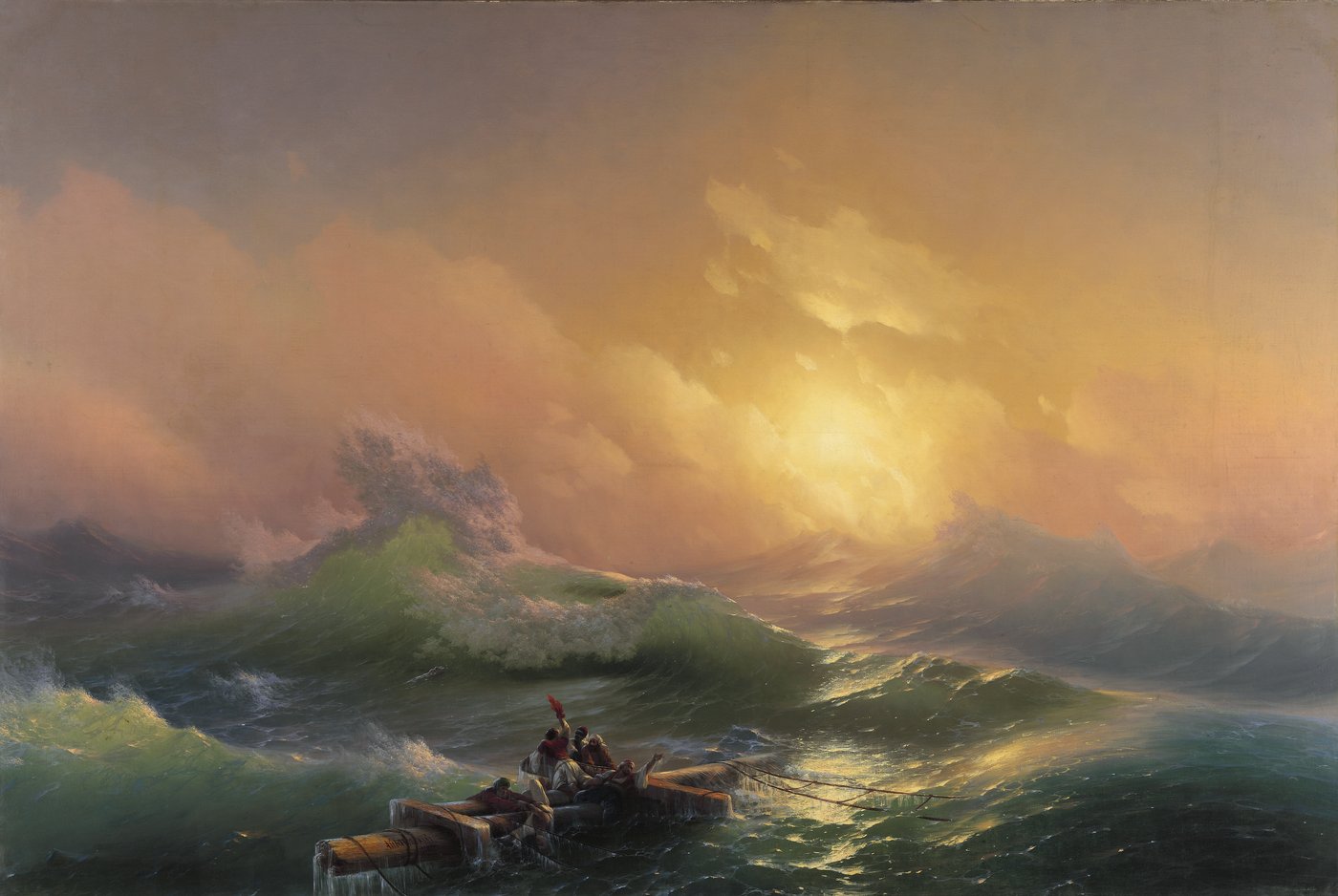
More details Six people meet dawn after shipwreck, clinging to a broken mast before another wave. Aivazovsky turned maritime folklore into a Romantic drama of fear, memory, and hope—and in 2026 the canvas entered its first comprehensive restoration.
The disaster precedes the painting
Survivors meet morning on a broken mast while the greatest wave still approaches
Aivazovsky painted The Ninth Wave in Feodosia in 1850 on a vast canvas measuring 221 by 332 centimetres. The ship has vanished: night and wreck lie outside the frame, while six people cling to crossed timbers. One raises red cloth and another nearly slips into the water. Their scale is so small that the sea first appears as landscape and only then as human catastrophe.
'Ninth wave' comes from sailors' folklore about a sequence in which one wave—numbered differently in different traditions—was believed largest and most dangerous. It is not an oceanographic law. Aivazovsky uses the idea of an ultimate blow. The wave has not yet broken, so the drama rests on anticipation: survivors and viewer see the threat together.
The artist did not paint the storm from life
Observed water became a sea reconstructed from memory
The Virtual Russian Museum recounts a severe storm Aivazovsky experienced during European travel. The vessel survived and he retained the movement, light, and fear. The Ninth Wave is not reportage of that one episode. Years, many observations, and deliberate invention separate event from canvas.
Aivazovsky considered rapidly changing water unsuitable for literal copying: a wave disappears before it can be painted. He studied the sea ashore and afloat, then built compositions in the studio. The Russian Museum calls these works products of imagination grounded in personal observation. The great wave is therefore emotionally convincing without claiming photographic accuracy.
Danger is painted in the colours of rescue
Dawn makes the lethal wave gold, rose, and almost beautiful
The sun remains behind cloud and shines through the crest. Green water turns amber, foam pink-violet, and distant waves dissolve in warm air. It is the first light after night. Aivazovsky joins danger and beauty: the sea may kill, yet it is not rendered as black despair.
The wreckage resembles a cross, though the museum record does not impose one religious meaning. It is both mast and visual sign of hope. Figures support one another, red cloth may signal rescue, and light has already defeated darkness. The Russian Museum reads the image through Romantic faith in humanity's victory over the elements—not assured, but still possible.
The masterpiece entered museum history through the Hermitage
In 1897 it became one of the first paintings in the new Russian Museum
The canvas was acquired for the Russian Gallery of the Imperial Hermitage. When the Emperor Alexander III Russian Museum formed its collection in 1897, The Ninth Wave moved there with other key works of the national school. This early transfer helps explain its place in the Russian nineteenth-century canon, although Aivazovsky was born and spent much of his life in Feodosia.
For more than 120 years it held a central place in permanent display. Its fame grew through public access, school reproductions, and the near-synonymy of Aivazovsky and the sea, not auction scarcity. Scale still matters: on screen it becomes an illustration; before a three-metre canvas the viewer nearly shares the space of those on the mast.
In 2026 the painting entered its first comprehensive restoration
Work began on 29 May before a major Aivazovsky exhibition
The Russian Museum announced the first complete scientific restoration in the work's history. Conservators are examining and consolidating paint and ground, treating lifting, and studying uneven darkened varnish. The historic gilded frame is being restored separately, including many missing carved elements.
Thus the familiar phrase 'on permanent display' is temporarily incomplete. As of August 2026, the canvas is being prepared for a major Aivazovsky exhibition scheduled for October in the Benois Wing; visitors should check the museum site. Restoration is a new chapter, preserving a material surface altered for more than a century by varnish, frame, and display conditions.
Official sources
Where to check
- The Ninth Wave: dimensions, acquisition, and interpretationState Russian Museum
- The Ninth Wave in the museum collectionState Russian Museum
- First comprehensive restoration, begun 29 May 2026State Russian Museum
- Aivazovsky, memory, Romantic drama, and hopeState Russian Museum
- Aivazovsky's working method and marine paintingState Russian Museum
- Aivazovsky's storm experience and visual memoryVirtual Russian Museum
Visual context
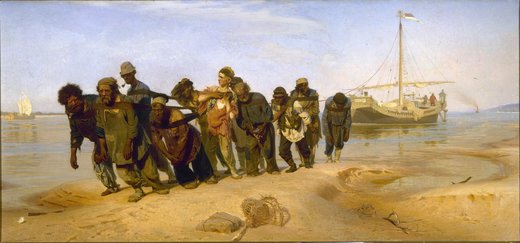 Barge Haulers on the Volga