
Intro source: Wikipedia (EN)
Author
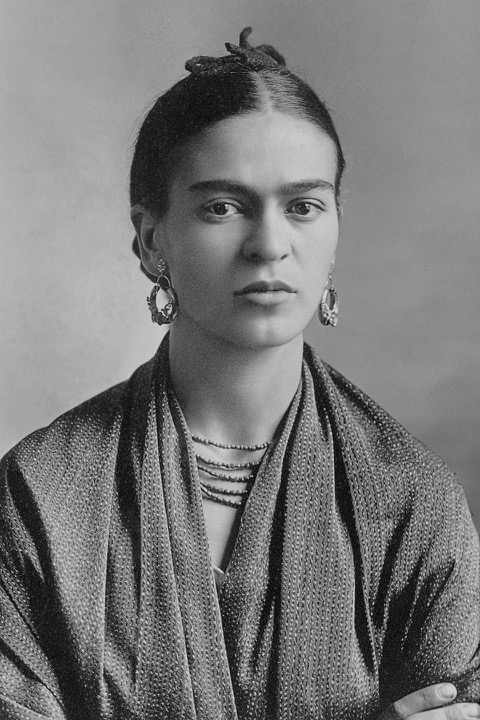
Frida Kahlo
Movement / period
Modernism and personal mythology
Medium
oil on canvas
Location
Museo Dolores Olmedo, Mexico City
She made The Broken Column in 1944 after yet another operation on the spine she had shattered in a 1925 streetcar crash, and spent months laced into a steel corset.

Highlights
Facts & legends
- In place of her spine Kahlo painted a fractured classical column, its drum-like sections cracked and ready to give way inside her opened body.
- She made The Broken Column in 1944 after yet another operation on the spine she had shattered in a 1925 streetcar crash, and spent months laced into a steel corset.
- Nails are driven into her skin and face, yet her expression stays perfectly composed; only the tears on her cheeks give the pain away.
- An earlier state of the picture showed her entirely nude. Kahlo added the white drapery over her hips only afterwards.
- For such a brutal image it is remarkably small: oil on masonite, roughly 40 by 30 centimetres, close to the scale of a devotional panel.
- It belongs to the Museo Dolores Olmedo in Mexico City, home to the largest private holding of Kahlo's work.
More details Only about forty centimeters high, this self-portrait turns an orthopedic brace, tears, and a shattered column into an exact scene of chronic pain. Kahlo shows vulnerability without surrendering control.
1944 marked another medical turning point
Kahlo painted a present condition, not simply a memory of the accident
The 1925 bus accident severely injured Frida Kahlo, but The Broken Column appeared in 1944. Between lay years of pain, examinations, operations, and different orthopedic braces. The painting therefore does not illustrate one dramatic event; it represents an accumulated life in a body that repeatedly demanded support and intervention.
Museo Frida Kahlo connects the work with renewed surgery and treatment. In 1944 Kahlo also began her celebrated diary. Painting and diary both expose an interior, but differently: the notebook permits a stream of words, while the small Masonite panel compresses pain into a still, frontal image close to an icon.
The brace saves and confines
Metal bands hold the figure together while dividing it into rigid sections
Kahlo presents the medical device with cold clarity: straps encircle chest, waist, and pelvis. A brace is meant to stabilize the spine, yet here it looks both like support and cage. The opened torso forces the viewer to see what clothing and social courtesy usually conceal.
Kahlo wore plaster, leather, and metal corsets and sometimes painted them. In Juan Guzmán's later photographs they become part of her public image, bearing fabric, political emblems, and personal signs. The Broken Column precedes those photographs and captures the conversion of a clinical object into artistic language.
The column is not an X-ray
A classical support replaces the spine to express collapse, not diagnose it
An Ionic column occupies the split body, broken in several places. It does not reproduce anatomy or prove any modern theory about Kahlo's condition. It is a structural metaphor: an architectural element made to bear weight now needs to be held together.
The classical reference adds irony. In European art an intact column signals order, dignity, and permanence; here the canonical support has failed. The figure nevertheless remains upright. Face, hands, and gaze stay composed while the supposedly ideal architectural body proves more fragile than living flesh.
Nails turn pain into surface
The image recalls Saint Sebastian, but its heroine does not ask to be rescued
Small nails cover face and body, with the largest close to the heart. Scholars relate them to Saint Sebastian, conventionally shown pierced by arrows. Kahlo transfers the visual language of religious martyrdom to a modern woman wearing a medical brace.
She does not paint swoon or ecstasy. Tears are entirely visible, while the gaze remains direct. The barren fissured landscape repeats the column's fractures and intensifies solitude. Unlike many Kahlo self-portraits, there are no monkeys, plants, jewelry, or Diego Rivera—no companion softens the encounter with pain.
A small original confronts a giant myth
The picture entered the Dolores Olmedo collection and became an emblem of disability art
Painted in oil on Masonite, the work measures roughly 40 by 30.7 centimeters. Posters often enlarge it, but the original's intimacy matters. The viewer faces a body as if before a mirror or medical image, not a monumental history painting.
The work belongs to Museo Dolores Olmedo in Xochimilco. After six years of closure, the museum reopened at the historic La Noria estate on 30 May 2026. The Broken Column is now read not only through celebrity biography but as an early image of disability experience: the support is visible, vulnerability does not cancel authorship, and the artist controls how pain becomes knowledge.
Official sources
Where to verify the museum and historical context
- 1944 chronology and The Broken ColumnMuseo Frida Kahlo
- Medical history and the painting's unusual solitudeInstituto Nacional de Bellas Artes y Literatura
- Saint Sebastian imagery and disability in Kahlo's artGoogle Arts & Culture editorial
- Kahlo's corsets and Juan Guzmán's photographsFundación Televisa
- Collection and current museum locationMuseo Dolores Olmedo
- Museum reopening on 30 May 2026Secretaría de Cultura de México
- Kahlo's oeuvre as Mexican artistic heritageInstituto Nacional de Bellas Artes y Literatura
Visual context
 Frida Kahlo


