
Intro source: Wikipedia (EN)
Author
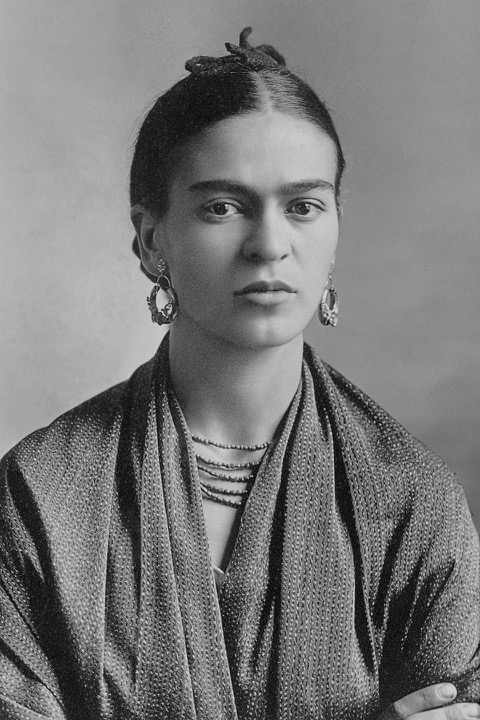
Frida Kahlo
Movement / period
Modernism and personal mythology
Medium
oil on canvas
Location
Museum of Modern Art, Mexico City
One Frida wears a European lace dress, the other the Tehuana costume that Diego Rivera loved.

Highlights
Facts & legends
- At roughly 170 by 170 cm this is the largest canvas Kahlo ever made — unusual for her, since she normally worked small.
- One Frida wears a European lace dress, the other the Tehuana costume that Diego Rivera loved.
- The European Frida holds a surgical clamp, and a cut vein drips blood onto the hem of her white dress.
- Both hearts are exposed and joined by a single artery — the picture was painted the year she divorced Rivera.
- In 1947 Mexico's National Institute of Fine Arts bought the work: the first time the state acquired a major Kahlo.
More details Painted during Kahlo's break with Diego Rivera, this double self-portrait grew from private pain into a complex account of body, dress, and national identity—far richer than the formula of a loved and rejected Frida.
Painted in a year of rupture
Kahlo worked between her return from Paris and the completion of her divorce
Early in 1939 Frida Kahlo traveled to Paris, where Marcel Duchamp helped arrange her exhibition and she met members of the European avant-garde. Back in Mexico, her marriage to Diego Rivera was collapsing. She painted The Two Fridas roughly between October and December, as separation became fact and the divorce was finalized in November.
Rivera is plainly present: a tiny portrait of Diego rests in the Tehuana Frida's hand, and a vessel leads from it toward her exposed heart. Yet the canvas is larger than a diary complaint. For the first time Kahlo enlarged herself nearly to life-size and doubled the figure, turning a private change into a scene in which a person literally holds her own hand.
Two dresses are not two simple halves
European lace and Tehuana clothing reveal how Kahlo constructed her public self
At left Kahlo wears a white European-style lace dress, compared with her mother's wedding gown; the museum notes that the skirt was violet in an earlier state. At right she wears Tehuana clothing from southern Mexico, a style Rivera particularly admired. After the Revolution it became a sign of Mexican cultural identity and powerful womanhood.
The common reading—rejected European Frida versus beloved Mexican Frida—is therefore only a beginning. Kahlo's father was German-born; her mother had Mexican, Spanish, and Indigenous ancestry. The artist deliberately altered dress, hairstyle, and even her public birth date. The double is not a diagnosis of split personality but a self assembled from family history, politics, desire, and staged invention.
Anatomy becomes plot
Hearts and vessels convert emotional connection into a physical system
Both hearts lie exposed over the clothing. The heart at right remains whole; a thin artery runs to Rivera's miniature, crosses both figures, and ends beside surgical forceps in the left Frida's hand. The vessel is cut and blood stains the white skirt. Meanwhile the women grip each other's hands, closing the composition through a second, human bond.
Kahlo knew medical imagery after the 1925 bus accident, repeated operations, and years among doctors. This is not textbook anatomy: organs and vessels are deliberately impossible. The body becomes a relationship map. Metal forceps attempt to stop the loss, but the painting's true stability comes not from the instrument or the man's portrait—it comes from the hand of the other self.
The Surrealists claimed her
Kahlo joined their exhibition but rejected the idea that she painted dreams
André Breton labeled Kahlo's work Surrealist in 1938. In January 1940 The Two Fridas appeared in the International Exhibition of Surrealism at the Gallery of Mexican Art, organized by Breton, Wolfgang Paalen, and César Moro. Storm clouds, doubled faces, and open hearts met the movement's appetite for uncanny images.
Kahlo resisted the convenient label and later insisted she painted her own reality, not dreams. That distinction is the key. Fantasy does not escape biography here; it makes divorce, bodily pain, and the cultural role of clothing visible. The impossible scene is delivered with portrait-like directness: both Fridas meet the viewer without theatrical hysteria.
The state bought it from the artist
The painting became a public monument before global Fridamania
In 1947 Mexico's National Institute of Fine Arts purchased The Two Fridas directly from Kahlo. It was transferred to the new Museo de Arte Moderno in 1966. The sequence matters: today's international fame suggests instant recognition, but this major public acquisition came eight years after the work was painted.
Now a centerpiece of the museum and an artistic monument of Mexico, it is reproduced as a universal emblem of dual identity. The original returns the idea to the body: a square nearly 1.73 meters across surrounds the viewer, the bloodline reads from a distance, and the joined hands occupy the most stable center. Popularity has not erased the painting's complexity; it has made its private language public.
Official sources
Where to verify the museum and historical context
- Las dos Fridas: official collection interpretationMuseo de Arte Moderno, Mexico City
- The Two Fridas, 1939: painting, symbols, and acquisitionMuseo de Arte Moderno de México
- Paris, Rivera, and the double self-portraitInstituto Nacional de Bellas Artes y Literatura
- First exhibition and place in Mexican modern artInstituto Nacional de Bellas Artes y Literatura
- The painting in the Museo de Arte Moderno collectionMuseo de Arte Moderno
- Frida Kahlo's works as Mexican artistic monumentsInstituto Nacional de Bellas Artes y Literatura
Visual context
 Frida Kahlo


