
Author
Diego Rivera
Movement / period
Mexican Muralism
Technique
fresco
Where it is
Palacio de Bellas Artes, Mexico City
The patrons destroyed the New York fresco over its portrait of Lenin, which Rivera refused to remove.
Highlights
Facts & legends
- Rivera created the first version, Man at the Crossroads, for Rockefeller Center in New York in 1933.
- The patrons destroyed the New York fresco over its portrait of Lenin, which Rivera refused to remove.
- In 1934 Rivera recreated the composition from photographs in Mexico City, renaming it Man, Controller of the Universe and sharpening its political imagery.
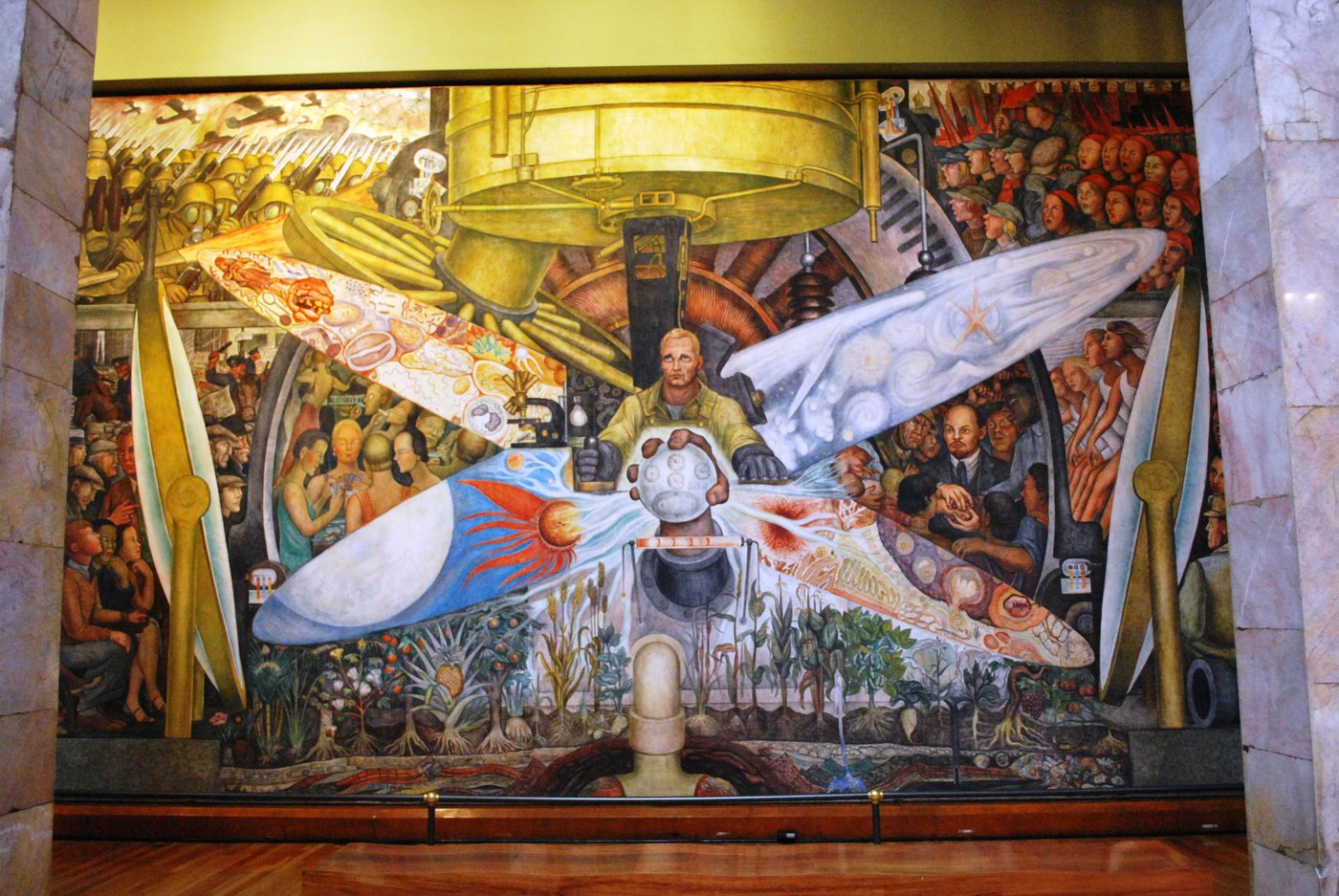
- The fresco contrasts capitalist and socialist worlds through parallel scenes flanking the central figure of a worker at the controls.
- The work became one of the defining statements of 20th-century Mexican Muralism.
More details How a Rockefeller commission became a landmark censorship dispute, why Rivera restored Lenin in Mexico, and why the true centre of the political battle is an anonymous worker at the controls.
The commission began in New York
Rockefeller wanted a mural about choosing the future
In 1931 Nelson Rockefeller planned three monumental works for Radio City. Picasso, Matisse, and Diego Rivera were invited; only Rivera accepted. His assigned theme was humanity at the crossroads, looking toward a new and better future.
Rivera brought his own modernity into a luxury business complex. A worker operates a machine while optical ellipses reveal cells and the telescopic cosmos. Science is not decoration but a means of seeing and reshaping the world.
The original title—Man at the Crossroads Looking with Hope and High Vision to the Choosing of a New and Better Future—already contained the dispute. Rockefeller Center wanted progress celebrated inside a capitalist skyscraper; Rivera understood progress as social choice. Agreement held while sketches stayed general. On wet plaster, political abstraction acquired recognisable faces.
One portrait stopped the work
Lenin proved stronger than the contract
The appearance of Vladimir Lenin triggered hostile press and a demand that Rivera remove him. He refused. The unfinished mural was covered and then destroyed in 1934, an exceptional case in which a dispute over one face erased an entire wall.
This was more than a simple artist-versus-capitalist story. Rivera accepted a private commission yet denied the patron final control over its political meaning. The wall itself paid the price.
Before destruction, Rivera's assistant Lucienne Bloch secretly photographed the mural. Her images became working memory rather than souvenirs: vanished positions could be reconstructed from them. The dispute is therefore not only a legend told by its winner. Visual documents survive, allowing comparison between the New York design and the Mexican reply.
Photographs rescued the composition
Mexico received an answer, not a copy
Back in Mexico, Rivera reconstructed the idea in the Palace of Fine Arts. INBAL connects the second version with drawings, documents, and photographs, including images by Lucienne Bloch. The demolished wall survived as an archive from which the work could be rebuilt.
The title changed: humanity no longer stands at a crossroads but controls the universe. Rivera sharpened the political contrasts and made the Mexican fresco a public reply to New York.
At the Palacio de Bellas Artes Rivera painted fresco on a transportable metal framework. Unlike the destroyed work bound to Rockefeller architecture, the new version could enter the museum building as an independent monument. He retained the compositional skeleton, sharpened the conflict, and added figures no New York patron could now restrict.
The worker, not a leader, occupies the centre
Microscope and telescope converge at his hands
Capitalist and socialist worlds, police and demonstrations, elite leisure and organised labour collide on either side. Yet the geometric centre belongs to an unnamed operator rather than Lenin, Trotsky, or Rockefeller.
INBAL describes microscopic forms and the solar system as a union of microcosm and macrocosm. The machine resembles a console, wings, and an enormous lens: technology has power, but human hands choose its direction.
Four elongated ellipses around the worker resemble blades, lenses, and a diagram of force. Dividing cells, disease, planets, and stars occupy them, while crowds repeat conflict on the social plane. Rivera joins biology, astronomy, and politics without a neutral zone: knowledge increases power but does not decide whom power should serve.
The scandal became part of the artwork
Viewers now encounter both fresco and destruction
The Mexican version was painted for the 1934 opening of the Palace of Fine Arts and remains there. INBAL lists it among Mexico's declared artistic monuments, while exhibitions continue to revisit the New York documents.
The work therefore lives in two times: as a surviving fresco and as the memory of a lost wall. Rivera made censorship not an ending but a story about who controls images, technology, and the future.
The title Man, Controller of the Universe sounds triumphant, yet the central worker's face remains intent and uncertain. The museum describes him as looking hopefully toward a better world while choosing between capitalism's threat and socialism's promise. The panel offers no completed utopia; it turns the viewer into the next person at the controls.