
From the artist's life
Turner claimed he had himself lashed to a ship's mast during a storm so he could paint the blizzard from inside it.
Source: Wikipedia / WikimediaRomanticism
J. M. W. Turner (1775–1851) was the supreme painter of light, sea and storm, who dissolved landscape into radiant atmosphere. His daring late works anticipated Impressionism and even abstraction.
Turner freed colour and light from precise form decades before the Impressionists; Monet studied him closely.
Turner claimed he had himself lashed to a ship's mast during a storm so he could paint the blizzard from inside it.
Source: Wikipedia / Wikimedia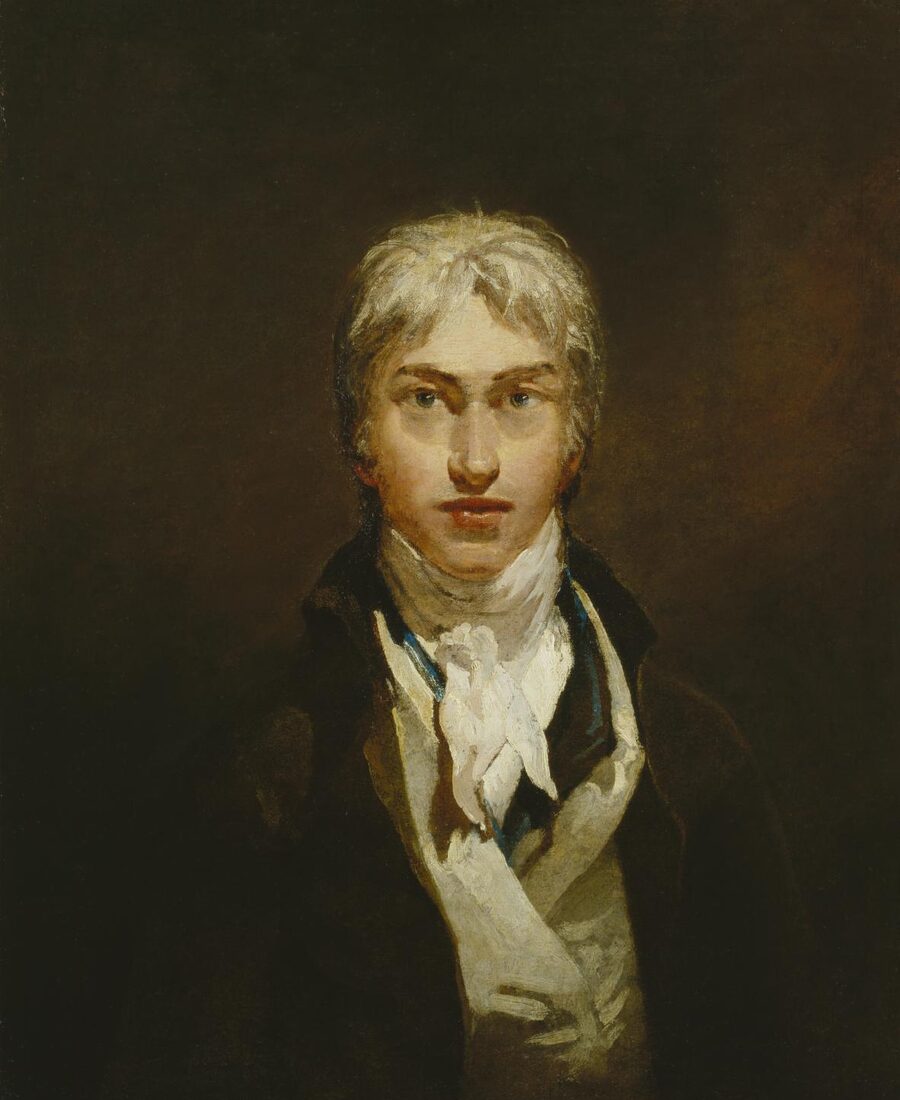

Key works
Works with a dedicated ArtAtlas page are highlighted in gold.
1843
Rain, Steam, and Speed – The Great Western Railway is an oil painting by the 19th-century British painter J. M. W. Turner.
1839
The Fighting Temeraire, tugged to her last berth to be broken up, 1838 is an oil-on-canvas painting by the English artist Joseph Mallord William Turner, painted in 1838 and exhibited at the Royal Academy in 1839.
1840
The Slave Ship, originally titled Slavers Throwing overboard the Dead and Dying—Typhon coming on, is a painting by the British artist J. M. W. Turner, first exhibited at The Royal Academy of Arts in 1840.