
Intro source: Wikipedia (EN)
Author
Caspar David Friedrich
Movement / period
Romanticism
Medium
painting
Location
Hamburger Kunsthalle, Hamburg
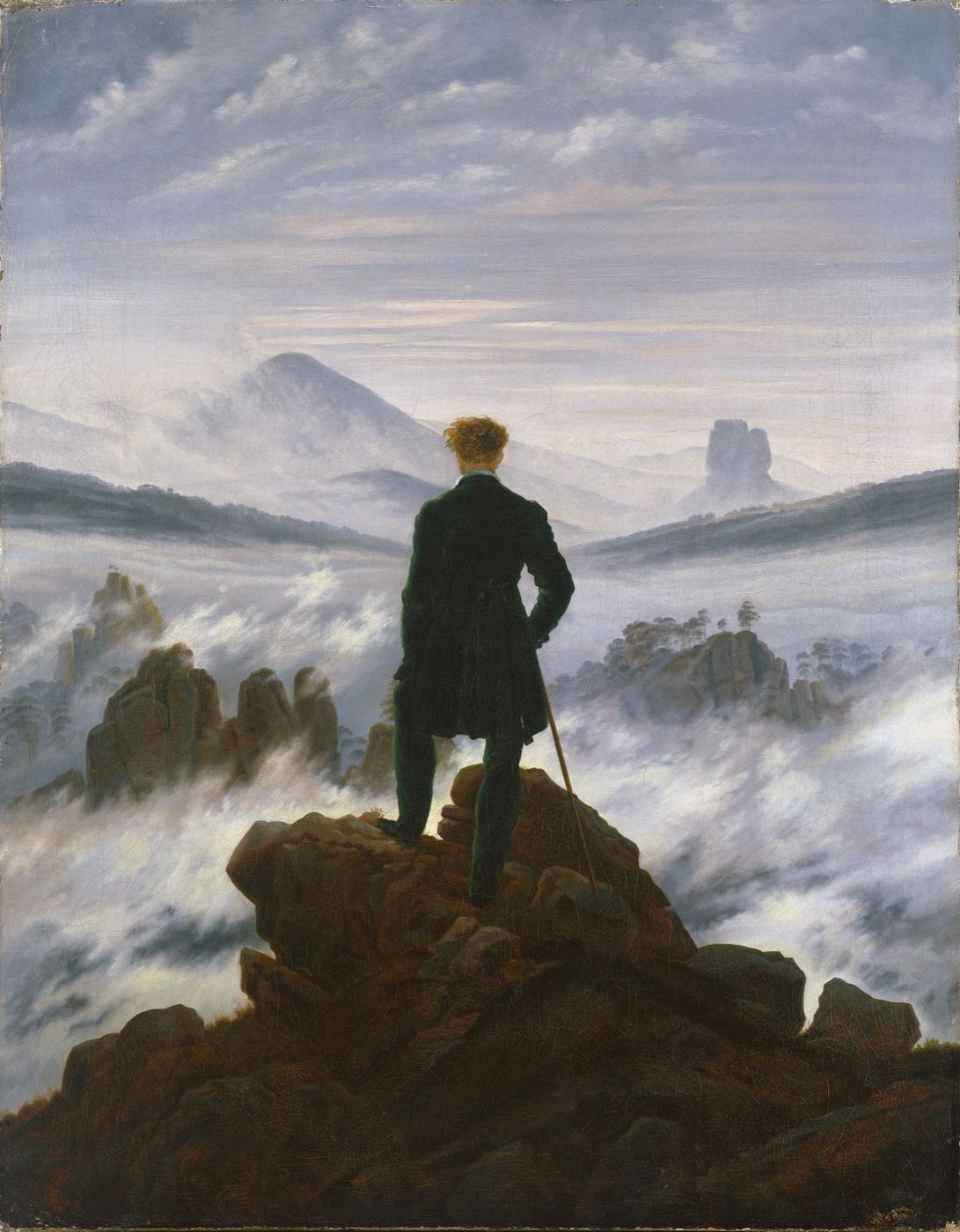
Nobody knows who the man actually is; the most persistent theory is that it's Carl Wilhelm Gotthelf von Kügelgen, a Dresden officer and friend of Friedrich who died in a highway robbery in 1820 — Friedrich painted the work around that time and may have used him as a model.
Highlights
Facts & legends
- The canvas is tiny by heroic-landscape standards — just 94.8 × 74.8 cm — which is why standing in front of the real thing in Hamburg feels so disorienting: the figure is barely larger than your hand.
- Nobody knows who the man actually is; the most persistent theory is that it's Carl Wilhelm Gotthelf von Kügelgen, a Dresden officer and friend of Friedrich who died in a highway robbery in 1820 — Friedrich painted the work around that time and may have used him as a model.
- Friedrich painted the Riesengebirge mountains in the background from sketches he made in 1810 during hiking trips, but he rearranged the peaks freely — the composition is a collage of real geology, not a view from any single spot.
- The painting sat in near-obscurity for over a century; it only entered the Hamburger Kunsthalle's permanent collection in 1970, purchased from a private Hamburg family whose ancestors had acquired it directly in Friedrich's lifetime.
- X-ray analysis of the canvas revealed that Friedrich made significant pentimenti — he shifted the figure's position and altered the horizon line at least once, suggesting the standing-at-the-edge effect was a deliberate revision, not his first instinct.
- The image became a pop-culture shorthand for existential brooding largely because it was reproduced on the cover of a 1974 West German philosophy textbook; from there it spread to album covers, film posters, and eventually every internet thread about loneliness.
More details Why the famous wanderer blocks rather than reveals the landscape—and how a reflection on the limits of sight became an icon of Romantic solitude.
A summit without proof of victory
Friedrich hides the climb and the face
A man leans on a cane above fog, yet no route, emotion or triumph is supplied. Later culture made the pose a victory emblem; the painting itself remains uncertain.
The Rückenfigur invites us into his viewpoint while his body and unreachable footing keep us out.
We watch someone watching
The landscape is deliberately interrupted
Hamburger Kunsthalle stresses that we do not receive an unobstructed panorama. Another viewer occupies the centre and covers the desired horizon.
Identification and distance occur at once: we look his way but can never see exactly what he sees.
An unknown traveller
No proposed identity is securely documented
Attempts to name the man lack reliable evidence. Hidden face, ordinary clothing and absent commission records keep him anonymous.
Specific hair, cane and unstable rock still make him bodily rather than an empty symbol.
Unusual even for Friedrich
The vertical format makes the figure unavoidable
Painted around 1817, the work is about 94.8 by 74.8 centimetres. A large central individual and portrait orientation are rare in Friedrich's landscapes.
Fog joins and erases distances, turning exact natural forms into a space that cannot be measured.
A modern icon
The museum secured the painting in 1970
Director Werner Hofmann persuaded the Hamburg collections foundation to acquire Friedrich's masterpiece for the Kunsthalle. Its ubiquity is partly a recent museum and media history.
A 200-square-metre mural marked Friedrich's anniversary, yet the original still resists the conquering-hero cliché: looking is not owning.
Official sources
Where to check
- Official institution site Hamburger Kunsthalle
- Wanderer above the Sea of Fog: catalogue essayHamburger Kunsthalle
- Nineteenth-century collectionHamburger Kunsthalle
- Contemporary mural reinterpretationHamburger Kunsthalle
Visual context


