
From the artist's life
In the Arnolfini Portrait a convex mirror reflects two figures entering the room, and above it van Eyck signed the wall in Latin: Jan van Eyck was here.
Source: Wikipedia / WikimediaNorthern Renaissance
Jan van Eyck (c. 1390–1441) was the supreme master of the Early Netherlandish school and a pioneer of oil painting. His jewel-like precision and luminous detail — above all in the Arnolfini Portrait and the Ghent Altarpiece — astonished all of Europe.
Though he did not invent oil paint, van Eyck perfected it, making possible the deep, glowing realism that defined Northern art.
In the Arnolfini Portrait a convex mirror reflects two figures entering the room, and above it van Eyck signed the wall in Latin: Jan van Eyck was here.
Source: Wikipedia / Wikimedia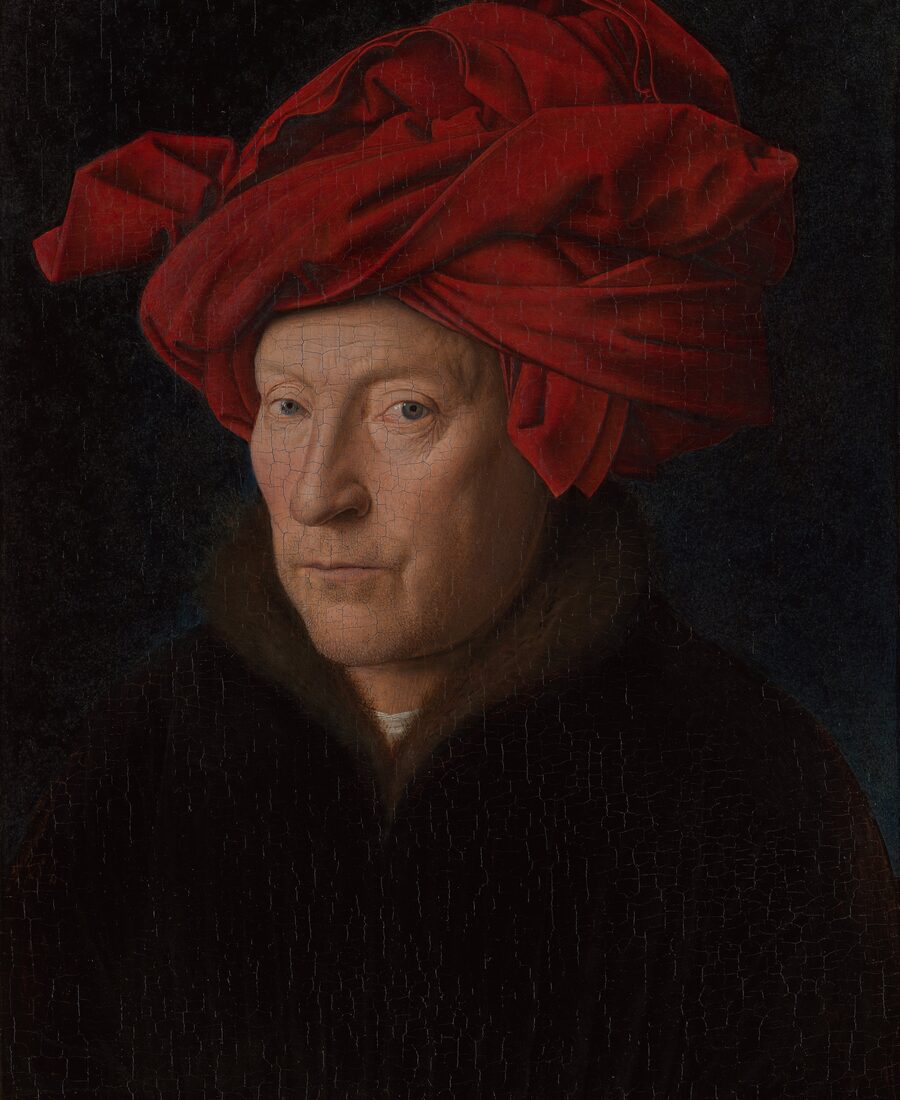

Key works
Works with a dedicated ArtAtlas page are highlighted in gold.
1434
A domestic interior becomes a dense system of signs about status, marriage, wealth, and witnessed presence.
1432
The Ghent Altarpiece, also called the Adoration of the Mystic Lamb, is a very large and complex 15th-century polyptych altarpiece in St Bavo's Cathedral, Ghent, Belgium. It was begun around the mid-1420s and completed by 1432, and it is attributed to the Early Netherlandish painters and brothers Hubert and Jan van Eyck.